
|
| China |
| On Black Soil | |
| The northeast plain is writing a new chapter for China's Granary | |
|
|
|
Black soil, known as the "giant panda of farmland," is an extremely rare fertile soil type. It forms slowly over hundreds to thousands of years or even longer, becoming rich in organic matter. Not all dark-colored soil is true black soil. Compared with ordinary soil, black soil has loose granular structure and high fertility. Globally there are only four major black-soil regions: the Mississippi River Basin in North America, the Russian-Ukrainian Plain, the Pampas of South America and the Northeast China Plain. China's Northeast Plain black-soil zone stands out for its high latitude, seasonal frozen soil and relatively short history of cultivation. Heilongjiang, China's northernmost province, lies at the heart of this black-soil belt. It contains approximately 10.4 million hectares of black-soil cropland, accounting for 56.1 percent of the total black-soil cropland in Northeast China. Heilongjiang has led all Chinese provinces in grain output for 16 consecutive years. In 2025, its grain output reached 82 million tons, accounting for 23.6 percent of the nationwide increase. The province also leads the country in marketable grain volume, interprovincial grain transfers and grain reserves. To date, Heilongjiang has developed 8.33 million hectares of high-standard farmland, ranking first in China. Agricultural science and technology account for more than 71 percent of growth in the sector, and the province's overall agricultural mechanization rate has reached 99.34 percent, the highest in the country. Across this expanse of black soil, technology, industry, seed innovation and conservation are working in concert to bring new strength to China's granary.
Smarter farming, bigger harvests At the Bei'an Geming Modern Agricultural Machinery Cooperative in Bei'an City, Heilongjiang, a land-shareholding model currently includes 32 member households and a fleet of 410 machines. Li Fuqiang, chairman of the cooperative, told Beijing Review that mechanized farming and meticulous field management are key to achieving bumper harvests. "Higher yields start with well-prepared land," Li said. In the past, with farmers relying on manual labor or low-horsepower machinery, the soil could be worked only to a limited depth. Today, a full suite of high-horsepower tracked machinery enables the cooperative to maintain a tillage depth of 32 cm during autumn land preparation, leaving the soil fine and more conducive to higher yields. 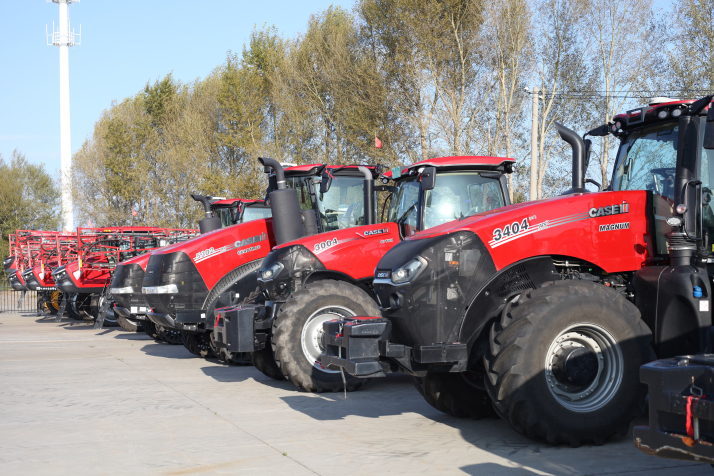 An experimental rice field of Shengchang Seed Breeding Co. Ltd. in Suihua, Heilongjiang Province, on September 1.
Sowing practices have changed as well. The cooperative has replaced the old practice of sowing seeds by weight with precision planting that meters individual seeds, achieving a target stand of 360,000 plants per hectare. Operators adjust machine settings to suit each plot and tailor fertilizer plans to soil organic-matter levels. Harvest equipment has also been upgraded. New combines that thresh soybeans with a rubbing action rather than a beating action sharply reduce bean breakage and cut losses by 52.5-60 kg per hectare. With the full equipment fleet working as an integrated system, operating efficiency is now more than 20 times what it was before mechanization became widespread. "Good machinery lays the groundwork, but in the end, farming comes down to attention to detail," Li said. Even with identical equipment, lax management makes a good harvest hard to come by. Going forward, he added, the cooperative will continue to make full use of its integrated machinery fleet, fine-tune field management, and help more farmers share in the gains of farming at scale. That same commitment to detail has become a common practice among grain producers across the black-soil region. Five years ago, Chen Yong, a professor at China Agricultural University, established an experimental station in Zhaodong City in Heilongjiang. He and a group of young students placed sensors in the soil to monitor moisture, temperature and other conditions. AI analysis of the resulting data is helping identify the optimal timing for sowing, irrigation and fertilizer application. 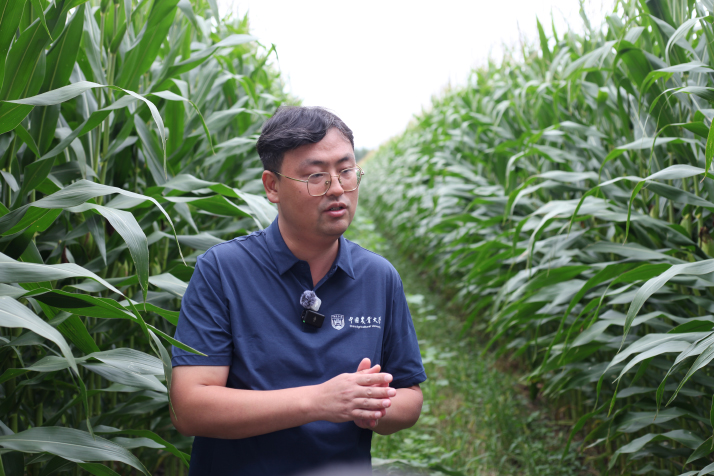 Professor Chen Yong is interviewed by Beijing Review in an experimental corn field in Zhaodong, Heilongjiang Province, on August 31.
Chen told Beijing Review that the results are already evident at his trial plots in Jucheng Village, Xiangyang Township, Zhaodong. There, wide-ridge, double-row planting and water-fertilizer integration have increased the number of established corn plants from 57,000 to 82,500 per hectare. In 2025, corn yields reached a high of 19.5 tons per hectare, an increase of 2.25 to 4.5 tons per hectare over conventional cultivation. Wide-ridge, double-row planting uses broader ridges to plant two rows of corn instead of one. The resulting layout lets in more air and sunlight while fitting more plants onto the same amount of land. Water-fertilizer integration mixes fertilizer with irrigation water in set proportions and delivers the mixture directly to crop roots through a drip-irrigation network laid across the field. The system reduces water use by more than 30 percent and fertilizer use by over 20 percent, and farmers can even control irrigation and fertilizer application remotely from home using a smartphone.
From field to factory floor A bumper harvest is only the beginning. Heilongjiang is now focused on building a fully integrated grain value chain, from field to finished product. Qinggang County in Suihua City, once a traditional farming county dominated by corn cultivation, is now drawing on its abundance of crop and livestock operations to develop a corn industrial park and attract major processors. Among them is Heilongjiang Longfeng Corn Development Co. Ltd., Asia's largest single-site corn starch processor. Kernels move through deep-processing lines and emerge as corn starch, starch-based sweeteners and L-lactic acid feedstocks, which, in turn, can be used to produce biodegradable plastics and bio-based polyester fibers. Lu Yandong, Deputy Director of the Qinggang County Bureau of Agriculture and Rural Affairs, told Beijing Review that the county produces about 1 million tons of corn a year. Yet its entire harvest is nowhere near enough to feed local processing demand: Plants across the county process 3.4 million tons annually and source corn from surrounding cities and counties within a radius of about 200 km. In 2025, Qinggang's corn-processing industry recorded an output value of 8.817 billion yuan ($1.23 billion). 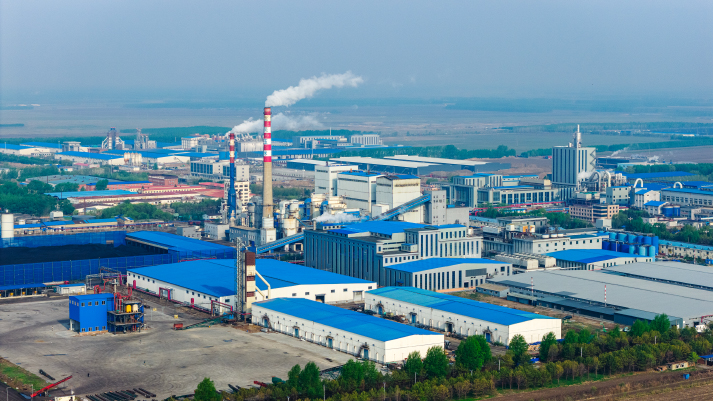 The factory premises of Heilongjiang Longfeng Corn Development Co. Ltd. in Qinggang County, Suihua.
The chain does not stop at the factory gate. After corn is steeped, crushed and separated, the process yields large quantities of corn gluten meal, corn bran, corn germ meal and other by-products alongside the primary products. Rich in protein, these materials are ideal ingredients for pig and poultry feed. Qinggang has built close local links between corn processing and livestock farming, keeping these by-products in the county for use as feed. "Feed is the main cost in livestock farming. The key to Qinggang's thriving feed industry is simple: low costs," Lu said. Using local corn-processing by-products instead of imported soybean meal avoids long-distance freight costs and sharply reduces the cost of feed. There is a quality dividend, too: Corn grown on black soil is richer in protein, which, Lu added, helps give locally raised pork a better flavor. Bei'an has achieved much the same with soybeans, maximizing the crop's value through local processing. The city maintains more than 233,000 hectares under soybean cultivation each year and produced 512,000 tons of soybeans in 2025. Mechanization across tilling, planting and harvesting has reached 99.98 percent, while improved varieties are grown on 100 percent of the land devoted to soybeans. The city has also proactively attracted and supported soybean-processing businesses. It is now home to 25 processors with a combined annual capacity of 800,000 tons, forming a specialized soybean-processing cluster. At Heilongjiang Dahang Biotechnology Co. Ltd. in Bei'an, an array of soybean products on display shows how far the value chain has evolved. According to company chairman Pan Shuwen, the value chain begins with the dehulling of raw soybeans, with the hulls sold to livestock producers as feed for ruminants. The dehulled beans are then pressed to extract soybean oil. The resulting soybean meal is further processed into soy protein isolate, textured soy protein, and fibrous soy protein. The isolate can be used to make dietary supplements, while the textured and fibrous proteins go into food products. Even the residue left after protein extraction can be processed further to extract dietary fiber. Every stage yields something of value, and every soybean moves up the value chain without ever leaving Bei'an.
Seeds for food security Seeds are often called the "chips" of agriculture, and the analogy is apt. A seed carries a crop's entire genetic blueprint, shaping its yield, quality and resilience to adverse conditions. It is both the starting point and the core of the agricultural value chain. Just as a chip determines the performance of an electronic device, while land, water and fertilizer provide the external conditions for production, it is seed that sets the ceiling for agricultural productivity. Plant breeding is technically demanding and involves long research and development cycles, making secure, independent control over seed resources a cornerstone of national food security. President Xi Jinping has repeatedly stressed that seeds are vital to China's food security. According to Xi, only by holding Chinese seeds firmly in our own hands can we hold the Chinese rice bowl steady and ensure food security. 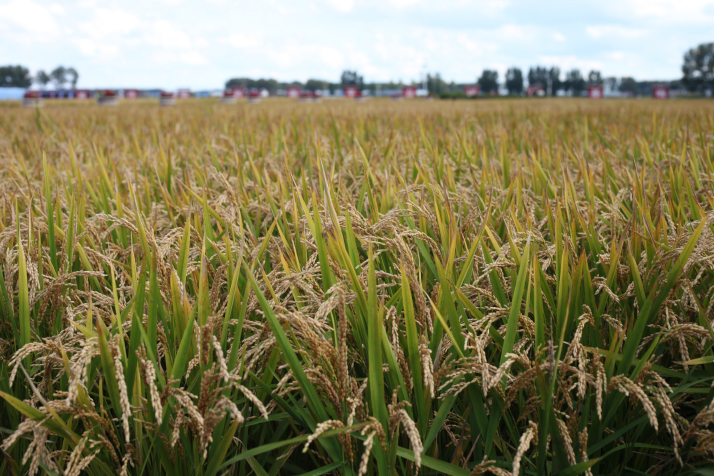 An experimental rice field of Shengchang Seed Breeding Co. Ltd. in Suihua City, Heilongjiang Province on September 1.
On the black soils of northeast China, developing a high-performing new variety has never been easy. Winters are long and bitterly cold, making breeding cycles especially lengthy. To break that bottleneck, Suihua City signed an agreement with Yazhou Bay National Laboratory in Sanya City in tropical Hainan Province this May to jointly establish the Yazhou Bay National Laboratory (Suihua) Grain and Oilseed Crop Innovation Platform. Shengchang Seed Breeding Co. Ltd. in Suihua City secured the use of 33.3 hectares of farmland in Sanya through a land-transfer arrangement, providing trial plots for the platform's seed-breeding research. "Under conventional conditions, it takes seven to eight years to develop a new rice variety in Suihua," Lu Guochen, a senior agronomist at Shengchang, told Beijing Review. "Now, with advanced breeding technologies, strong research resources and expert teams, the breeding cycle will be much shorter and new varieties will follow more quickly. We expect to develop a new variety in just three to four years." The platform is also gradually expanding its research to include corn and soybeans. Hailun City is home to a quiet powerhouse: the Hailun Agroecosystem Experimental Station of the Chinese Academy of Sciences. Established in 1978, it remains China's only national field research station dedicated to the long-term monitoring, research and demonstration of black-soil agroecosystems. The station's Dongsheng soybean varieties have been planted across a cumulative area of more than 3 million hectares, providing vital scientific support for black-soil conservation and food security across northeast China. Li Yanhua, a soybean breeding expert with the Northeast Institute of Geography and Agroecology, Chinese Academy of Sciences, has carried that mission forward since she began working at Hailun Station in 1990. She has developed 23 officially approved soybean varieties in the Dongsheng and Beisheng series, which have been planted across a cumulative area of more than 8 million hectares in northeast China. The impact ripples far beyond the laboratory: Her work has helped farmers earn more than 10 billion yuan ($1.4 billion) in additional income, while the commercialization of her research has generated more than 70 million yuan ($9.8 million). Local soybean growers have given her the title of the "Golden Soybean Queen." Li told Beijing Review that continued improvement of soybean varieties in northeast China remains essential. "China has largely achieved food security for its 1.4 billion people, but soybeans remain the one major weak spot," she said. "We import more than 100 million tons of soybeans every year, while domestic production is less than 21 million tons. With so little farmland to spare, we have to raise soybean yields per unit of land and improve quality as much as we possibly can."
Growing more without losing ground The black soil is easily degraded and exceedingly difficult to restore; once lost, it is extremely slow to regenerate. "It takes 200 to 400 years to form just 1 cm deep of black soil," Chen Yong said. "If we chase short-term yield gains with no thought for the future, we could easily undermine the very fertility that makes this land so productive." For Chen, balancing higher grain output with black-soil conservation remains a critical challenge. Researchers, he argues, must continue exploring new technologies and farming models, regularly monitor soil conditions in the field, and promptly alert farm operators to signs of degradation so they can adjust their practices. Farming, meanwhile, must work with natural processes rather than make output its only yardstick. While maintaining sufficient yields, farmers should enhance on-farm biodiversity and return organic materials, including livestock and poultry manure, to the soil to replenish its organic matter. Together, these measures can sustain the productive use of cropland over the long term. "Whether black soil can sustain its fertility comes down to one thing: Whether biomass is returned to it," said Hao Xiangxiang, deputy director of the station. In 2021, the Longjiang Model for black-soil conservation, pioneered by the station, was incorporated into China's Implementation Plan for the National Black Soil Conservation Project (2021-25). Featuring deep incorporation of shredded straw, organic fertilizer application, and corn-soybean rotation, the model offers a locally adapted system of black-soil conservation and cultivation, as well as a scientifically grounded model for wider adoption. Over the past two years, it has been applied across a cumulative area of 3.15 million hectares. Li Yanhua also mentioned that soybeans have distinctive ecological value. Like the majority of crops in the legume family, soybeans have a symbiotic relationship with soil bacteria that take nitrogen from the air and convert it into a form that can be used by plants. For this reason, soybeans require substantially less chemical fertilizer than crops such as corn. They also help loosen the soil and improve its fertility, making corn-soybean rotation an important approach to black-soil conservation. 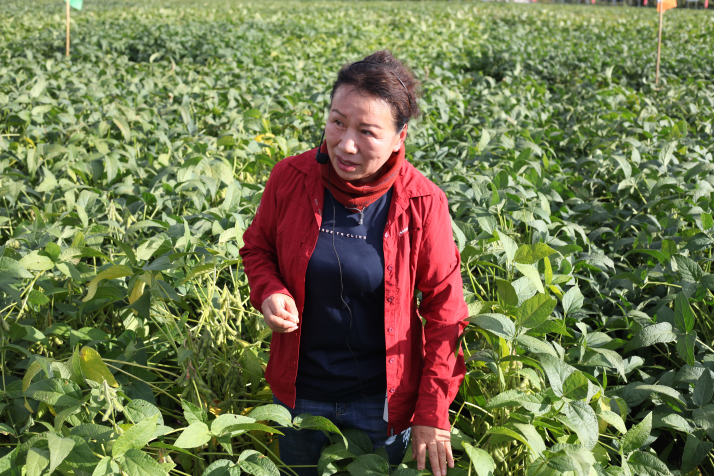 Li Yanhua, a soybean breeding expert, in a soybean field at the Hailun Agroecosystem Experimental Station of the Chinese Academy of Sciences on September 3.
More than 26.7 million hectares of land was protected during China's 14th Five-Year Plan period (2021-25), with the country enacting the Black Soil Protection Law of the People's Republic of China. Today, legal safeguards, engineering measures and scientific innovation are working in concert to sustain the fertility of this black soil and lay a lasting foundation for national food security. (Reporting from Heilongjiang Province) Copyedited by G.P. Wilson Comments to liangxiao@cicgamericas.com |
|
||
|
||||||||||||||||||||||||||||
|








