|
| China |
| Timeless poetry in the AI era | |
| Chinese Poetry Competition contestants take part in cultural exchange in Fengjie, Chongqing | |
|
|
|
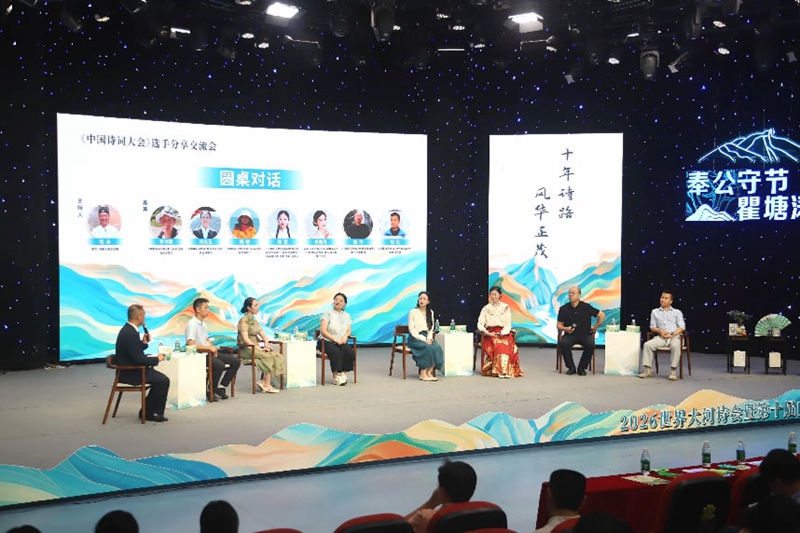
An exchange session featuring contestants from the Chinese Poetry Competition is underway in Fengjie, Chongqing Municipality, on September 15 (COURTESY PHOTO) As part of the 10th Baidicheng International Poetry Festival, an exchange session for contestants from the television program Chinese Poetry Competition was held on September 15 in Fengjie, Chongqing Municipality. Chinese Poetry Competition is a Chinese cultural program that aims to celebrate classical Chinese poetry, explore profound cultural roots, and showcase the beauty of life. Blending knowledge competitions with poetic appreciation, the program helps audiences better understand and emotionally connect with traditional literary works. Award-winning contestants, cultural and historical bloggers, and local teachers, students and poetry enthusiasts gathered at the event for face-to-face discussions on poetry and traditional culture, allowing the program to reach beyond its usual studio setting and break the limitations of the screen. During the exchange, Chen Geng, the 2019 champion of the program and a four-time participant, shared her thoughts on the irreplaceable value of poetry in the AI era. She pointed out that AI accelerates the pace of modern life, views the world through a purely rational lens, and misleads people into believing that knowledge can be effortlessly obtained at any time. “It is in such an era that poetry becomes increasingly essential. Cultural literacy and personal cultivation require long-term accumulation, and human emotion is the most precious part of life. AI may create an emotional void in modern society, and poetry perfectly fills this void,” Chen emphasized. She added that Chinese people grow up immersed in classical poetry, which teaches them to treat the world, others and themselves with sincere empathy. “Over the years, I have realized that poets perceive the world through intuitive, irrational perspectives that cannot always be explained scientifically. For instance, a famous poem by Li Qingzhao in the Song Dynasty (960-1279) contains these vivid lines: The winter ice began to melt with the warm breeze and rain, willows’ eyes opened, plum blossoms turned red again, spring’s heart already felt fast-beating.” These verses carry unique beauty and resonate deeply with readers, which can soothe modern people’s souls even amid today’s rapid scientific and technological advancement, Chen told Beijing Review. “Poetry allows us to glimpse the delicate inner world of ancient poets. Everyone struggles with unspoken hesitation, confusion and dilemmas in life. Yet the scenery, stories and emotions depicted in classic poems can bring us peace, strength and hope,” she said. In her opinion, poetry embodies tranquil moments of self-reflection, as exemplified by the timeless line from Li Shangyin’s On the Plain of Tombs, “The setting sun seems so sublime, but it is near its dying time.” Poetry calms people down to examine themselves and the world. This aligns with the philosophical metaphor of the owl: True wisdom lies not in instant responses, but in deliberate reflection. Just as an owl takes flight at dusk, poetry invites reflection on the day that has passed. The power of poetry lies not only in comforting individual souls but also in carrying forward a millennia-old cultural heritage. Chen explained that ancient China boasted a profound tradition of utilizing poetry for official selection, philosophical debate, aspiration expression and emotional communication. Countless poems once swept across the nation and were widely recited by people from all walks of life. Over thousands of years, poetry has evolved into an art deeply integrated with daily life, cherished by emperors, scholars and ordinary people alike. Encompassing nearly all dimensions of traditional Chinese culture, classical poetry represents the pinnacle of China’s traditional arts. It spreads Eastern aesthetics worldwide and inspires global artists. For example, German composer Gustav Mahler was fascinated by Chinese poetry created in the Tang Dynasty (618-907). His six-movement symphonic song cycle Das Lied von der Erde (The Song of the Earth) draws core inspiration from classic Tang poems, including Wang Wei’s At Parting. Numerous Western poets have also created works echoing the charm of Chinese classical poetry. “Alongside tea, porcelain and silk, poetry serves as another iconic cultural symbol of China on the global stage. It enables international audiences to understand the spiritual pursuit, inner affections and core values of the Chinese people,” Chen said. This cross-border poetic charm has taken root and flourished in Fengjie for thousands of years. Cultural and historical blogger Xiao Yadan said the city’s profound bond with poetry is well-documented in the book Three Hundred Tang Poems. A pivotal military stronghold in ancient times, Fengjie is endowed with the breathtaking and ethereal scenery of the Three Gorges. Literary giants including Li Bai and Du Fu composed some of their masterpieces there, enriching the treasure trove of Chinese literature. For these reasons, Fengjie deserves its renown as the City of Poetry. Copyedited by G.P. Wilson Comments to weimingxin@cicgamericas.com |
|
||||||||||||||||||||||||||||
|