
|
| China |
| A centuries-old folk craft is finding new life and livelihoods in Xunxian, Henan Province | |
| In Xunxian County, central China's Henan Province, these small clay sculptures have been made and enjoyed for generations. Today, the craft is also becoming a source of income for a village where traditional skills are being turned into a modern livelihood | |
|
|
|
The first thing you will notice about a Xunxian clay figurine is its simplicity. A bird may have an oversized head and a proudly raised tail. A tiger may look slightly exaggerated, its body compact and its expression almost playful. The lines are bold, the colors vivid and the proportions unconcerned with the pursuit of realism. Yet that is precisely where the charm lies: These are not objects trying to imitate the world; they are objects shaped by the imagination of ordinary people who have long found beauty in the familiar.
Then comes the sound. Blow gently into a small opening at the bottom, and the figurine answers with a clear, unmistakable "goo-goo." That sound gives the craft its name: Nigugu, literally "clay cuckoo." In Xunxian County, central China's Henan Province, these small clay sculptures have been made and enjoyed for generations. Today, the craft is also becoming a source of income for a village where traditional skills are being turned into a modern livelihood. Beauty in the ordinary Its raw material is humble: red clay from the old course of the Yellow River. The tools are simple too—bamboo tubes and sticks for shaping, and brushes for painting. But simplicity does not mean a lack of skill. The clay must be kneaded and beaten until it reaches the right consistency. The maker then shapes the body, adds details, makes the sound holes and leaves the piece to dry. After firing and painting, a small figurine may have passed through more than 10 stages of work. The result is a distinctive folk aesthetic. Traditional Xunxian clay figurines commonly depict birds, animals, horses, historical and opera characters, and the 12 Chinese Zodiac animals. Their forms are often compact and stylized, with strong outlines and contrasting colors to make the image immediately clear and full of life. For generations, they were sold mainly at local temple fairs, where they functioned as toys, souvenirs and objects of affection. Their value was not measured by rarity or luxury, but lay in the pleasure of making and keeping something that felt unmistakably connected to home. The shape of things to come That connection remains visible in the work of Li Weixue, a representative inheritor born in the 1990s. Li's family workshop is known for its simple, traditional character. Many of its works retain old patterns and familiar decorative motifs, preserving the visual language that has long defined Xunxian clay sculptures. At the same time, she has begun to attempt new works. A small bun-shaped Nigugu, with its rounded form, is both ordinary and instantly recognizable, but it becomes something playful and unexpected in clay. This style, rooted in everyday life while retaining a distinctly Chinese character, has proved popular overseas. "In the United States, one steamed-bun-shaped clay figurine can sell for $8. We've just shipped out an order of 2,000," Li told Beijing Review. For Li, preserving tradition does not mean refusing change. It means allowing the old forms to remain visible, while giving them room to breathe in the present. Yang Yubing, another representative inheritor, takes a more playful approach, paying close attention to what younger people find interesting. His designs often begin with familiar forms, but then take an unexpected turn. "I often ask my little boy what he likes and what the current trends are, and sometimes, I base my designs on his suggestions," he told Beijing Review. One of his creations is "Suan Niao," or "Garlic Bird," a small bird with a head of garlic perched above it. The name is a play on suan liao, a Chinese expression meaning "forget it" or "never mind." The design is amusing, but also clever. It takes a familiar folk-art form and gives it a contemporary cultural reference that younger audiences can immediately understand. The figurine is no longer just something to admire at a traditional fair; it becomes something that can participate in the language of everyday life. Soon, this small creation became extremely popular on online platforms, selling out promptly and generating demand that substantially exceeded supply. 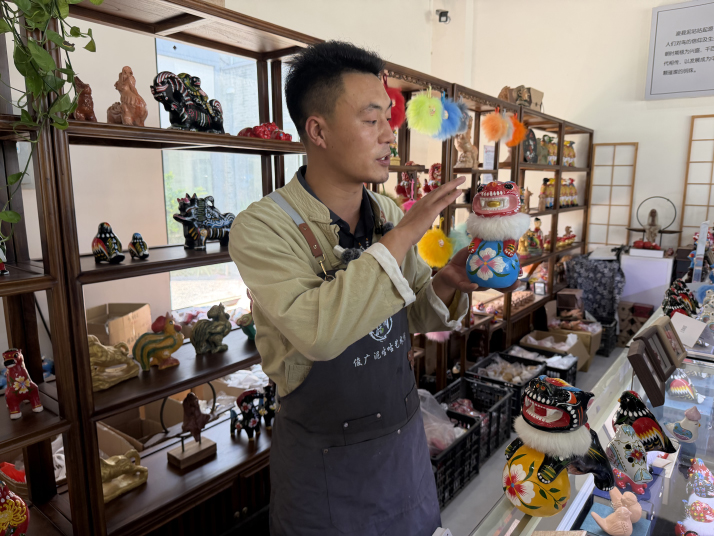 Artisan Yang Yubing introduces his Nigugu clay figurines at his studio in Xunxian County, Henan Province, on September 10 (KANGCAIQI)
In Yang's eyes, alongside new innovations, figurines must continue to be made in traditional styles to maintain the connection between past and present. "But how we can find ways to survive and develop depends on our cognitive abilities and practical skills," he said. Yang has also experimented with how the figurines are actually used. Some have become bag charms or necklaces, bringing the craft into the small, everyday spaces where young people express their personalities. He has even explored ways to expand the figurine's original sound-making function after years of experimentation. Traditional Nigugu produces a distinctive single tone. Inspired by the xun, an ancient Chinese wind instrument, Yang developed a version that could produce different musical notes and be played to perform complete pieces of music. At the other end of the spectrum is Song Kaizhan, whose work is more closely associated with contemporary art. His studio has an atmosphere distinct from the smaller, household-based workshops. The space is carefully designed, with an emphasis on visual composition and artistic presentation. Alongside the studio, he has opened a café and an experience space, creating an environment where visitors can encounter the clay sculptures not simply as folk handicrafts, but as works of art. His approach reflects a different understanding of how traditional craft can enter contemporary life, and the figurines become part of a broader aesthetic experience. Yet for Song, a provincial-level rural master craftsman in Henan, the future of Nigugu is still closely tied to the place where it began. To Song, the craft has survived largely because generations of artisans in his hometown of Xiyangqitun in Xunxian have remained committed to it. "It comes from our attachment to the land that has raised us," he said. "My confidence to carry the tradition forward is rooted in my firm belief in our hometown's culture." Looking ahead, Song believes Nigugu's development should remain rooted in its local traditions, and focus on articulating the cultural meanings behind this craft. Handwork to livelihood Inside the clay sculpture studios along the village streets, the works remain recognizably handmade: One person shapes the clay, another smooths the surface, and another adds color. Finished pieces are packed into boxes and prepared for shipment. Xiyangqitun now has more than 280 clay sculpture workshops and over 1,500 people involved in related work, according to Song Lizeng, a village official. The village sells more than 20 million clay sculptures annually. In 2025, the village's clay sculpture output value exceeded 48 million yuan ($7.2 million), significantly increasing villagers' income. 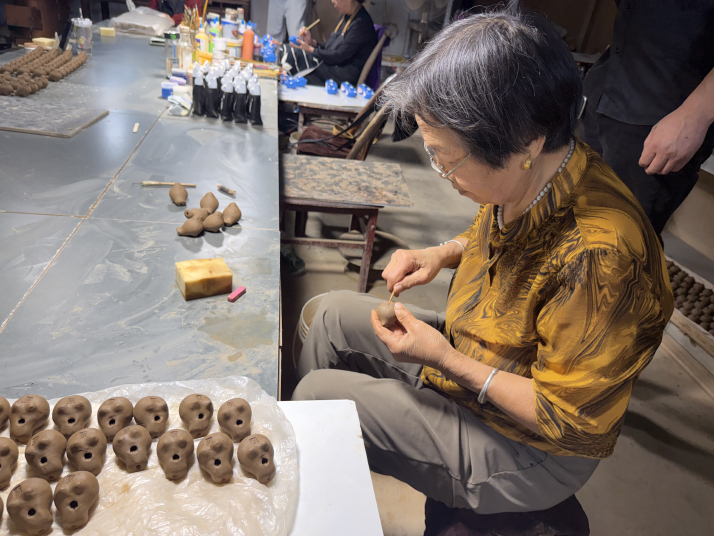 An elderly artisan shapes a Nigugu clay figurine at a workshop in Xunxian on September 10 (KANGCAIQI)
These figures tell only part of the story. The more substantial change is that the craft is no longer limited to a small number of master artisans; it has become an industry with room for different kinds of work. Some villagers specialize in shaping or painting, others handle packaging, logistics, sales or online promotion. In the workshops, even the white-haired artisans handle their part of the process with the ease from long-term practice. And for people who need to balance work with family responsibilities, employment close to home can make a meaningful difference. The clay remains humble, but it helps to sustain livelihoods. (Print Edition Title: A Song From the Soil) Copyedited by Elsbeth van Paridon Comments to kangcaiqi@cicgamericas.com |
|
||||||||||||||||||||||||||||
|