
|
| China |
| A red legacy in the Taihang Mountains | |
|
|
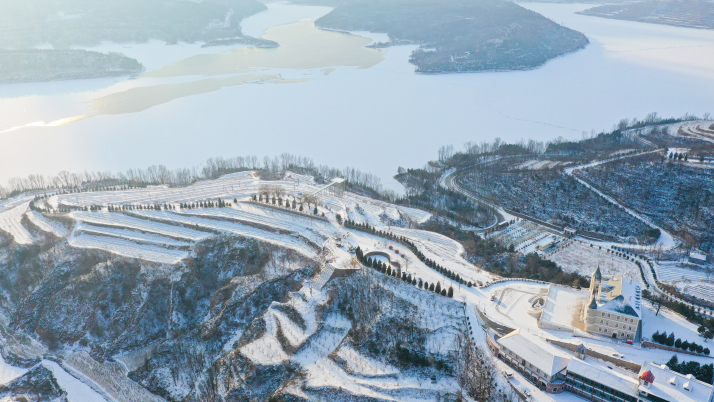 Shanxi Xianmiao Winery Co. Ltd. in Shixia Village of Zuoquan County, Shanxi Province (COURTESY PHOTO)
Nestled deep in the Taihang Mountains, where the gentle currents of the Qingzhang River carve their path, lies Matian Town. This unassuming locale in Zuoquan County, Jinzhong City, Shanxi Province, is steeped in history. It is a testament to sacrifice and an example of contemporary transformation. Zuoquan, formerly known as Liaoxian, carries a name that resonates with the courage and conviction of a pivotal figure in China's modern revolutionary history. In 1942, Zuo Quan (1905-1942), Deputy Chief-of-Staff of the Eighth Route Army—a force led by the Communist Party of China (CPC) during the Chinese People's War of Resistance Against Japanese Aggression (1931-45)—made the ultimate sacrifice. He fell at the age of 37 during Chinese efforts to resist a "mopping up" campaign, a brutal tactic employed by the Japanese against Chinese civilians and soldiers. Four months after his death, Liaoxian was renamed Zuoquan in his honor. This region, once a pivotal revolutionary base, is now channeling its historical strength into present-day development, undergoing a remarkable journey of transformation. Red tourism The echoes of the past are palpable in Matian. In November 1940, the Headquarters of the Eighth Route Army was relocated to Matian. This strategic location served as a vital hub until August 1945, when Japan announced its surrender. During the time, over 150 Party, government, and military organizations were stationed in Zuoquan. Lu Ying, a guide at the Matian Eighth Route Army Headquarters Memorial Hall, found that the former sites of the Eighth Route Army Headquarters, the humble former residence of the late Chinese leader Deng Xiaoping (1904-1997), and the former residence of Zuo Quan have been meticulously preserved. These sites have been put under national protection. Lu had previously taught broadcasting and hosting to children at a training center. Her journey to Matian began in 2020, when she participated in Shanxi's red story competition. It was during this event that she first visited Matian. She said that the transition of the county from a traditional, coal-reliant economy toward embracing cultural tourism was fraught with challenges. When the region began its transition toward cultural tourism, a sense of uncertainty permeated the minds of many villagers—with rugged mountain roads and challenging conditions, would tourists, the lifeblood of such an endeavor, be willing to venture into these remote reaches? While the map shows it's only a little more than 40 km from the county seat to the memorial hall, the journey used to be far from comparable to traveling on a plain. The road wound along the Qingzhang River in the Taihang mountain valleys, continuously turning and climbing. The view was often obscured by steep cliffs, and in rainy or foggy weather, the road surface in the past would become slippery, forcing vehicles to slow down considerably. A mere dozen km could take an hour or even longer by car. However, government initiatives to renovate the road leading to Matian marked a turning point in 2017. Subsequent efforts further enhanced accessibility. In 2022, buoyed by subsidies from the county finance department, Zuoquan launched a free county-wide public transportation service. This included a route connecting the county seat to Matian, which eased travel for both residents and the burgeoning stream of tourists. The impact was immediate. Villagers, seeing the potential, began to establish guesthouses and restaurants, while others found steady employment as cleaners and security guards at the memorial hall. Many also found profitable avenues selling their local specialties such as walnuts and Sichuan pepper. 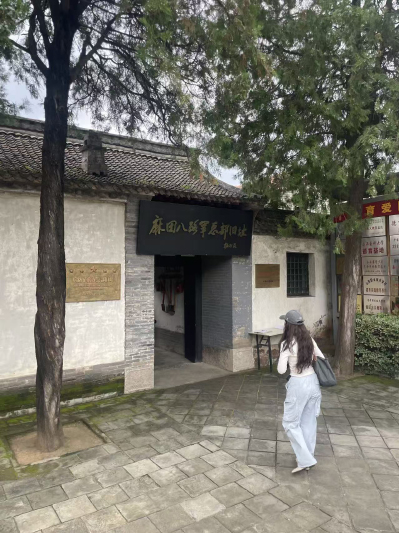 The former site of the front headquarters of the Eighth Route Army in Matian Town, Zuoquan, on August 9 (WANG YAJUAN)
Turning barren mountains into vineyards The success in tourism created a positive ripple effect, encouraging further investment and ambitious new ventures. More than a decade ago, a bold vision took root in Zuoquan: the establishment of Shanxi Xianmiao Winery Co. Ltd. This ambitious venture introduced Vidal grapes, used to make ice wine, to the region, capitalizing on the cool climate of the Taihang Mountains. Ice wine production demands exceptionally stringent environmental conditions, requiring a sufficiently long frost period for the grapes to naturally dehydrate and concentrate their sugars. Ice wine is made from frozen grapes harvested in winter, resulting in concentrated, viscous and sweet wine with high acidity. "Establishing such a large winery definitely required the understanding and support of the villagers," Hao Xinrong, the winery's general manager, told Beijing Review. During the War of Resistance Against Japanese Aggression, the Eighth Route Army relied on local people for cover and support, with the army and the people working together to defend the base area. Today, when developing industries, this logic of "mutual help and mutual trust" remains relevant, as evidenced by the winery's operational model. The winery acquires grapes grown by surrounding farmers' cooperatives on a contract basis, thereby leading and driving more villages to develop their grape industries. Local villagers are given priority for employment in weeding, pruning, and harvesting in the vineyards, allowing many residents to secure stable income close to home. The winery also leased barren hills, slopes, and wasteland in surrounding villages to develop vineyards, making use of idle land and increasing farmer income from rent. Now, Xianmiao Winery has developed into an ice wine cultural town that combines premium grape cultivation, harvesting, brewing and sightseeing. Hao remarked that without the trust and efforts of the villagers, the more than 30-hectare ice grape demonstration park could not have been formed, and the Taihang Ice Valley series of ice wines would not have been able to leave the deep mountains to reach a larger market and win numerous domestic and international awards. Ice wine is just one facet of Zuoquan's burgeoning portfolio of local specialty industries. The Taihang Mountains, with their cool embrace, abundant sunlight and significant temperature difference between day and night, have bestowed upon Zuoquan a unique agricultural endowment. Walnuts, traditional Chinese medicinal herbs and cereals including millet, were historically relegated to the status of raw materials. This resulted in low added value, with even exemplary products failing to command their true market worth. In recent years, Zuoquan has proactively elevated its agricultural offerings. This includes improving crop varieties, implementing standardized growing practices and diligently building robust brands to drive improvements in both the quality and efficiency of its specialty agricultural products. BR Copyedited by G.P. Wilson Comments to wangjinxu@cicgamericas.com |
|
||||||||||||||||||||||||||||
|