
|
| China |
| The Long March spirit resonates in a world that knows uncertainty and division all too well | |
|
|
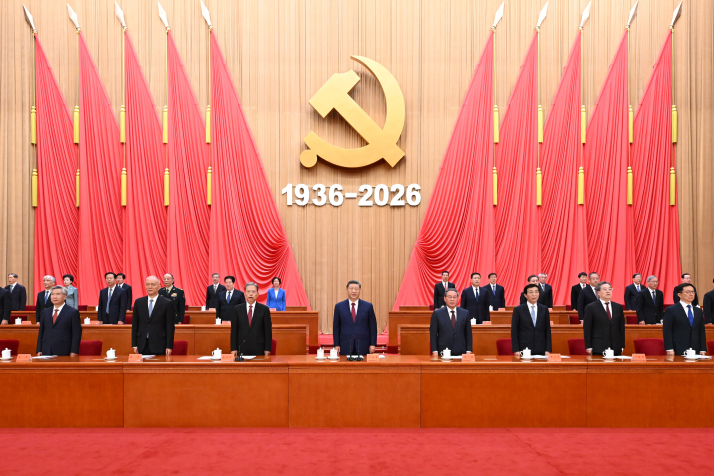 President Xi Jinping and other leaders attend a gathering commemorating the 90th anniversary of the victory of the Red Army's Long March in Beijing on October 22 (XINHUA)
In 1934, an epic journey began. Over the next two years, roughly 200,000 marchers fought over 600 battles, crossed nearly 100 rivers and climbed more than 40 rugged peaks, including over 20 snow-capped ones above 4,000 meters. These are some of the numbers behind the Long March (1934-36), the most epic military maneuver in China's modern history. The Long March was undertaken by the Chinese Workers' and Peasants' Red Army, an armed force led by the Communist Party of China (CPC). The Red Army was formed to resist the oppression inflicted on ordinary people by the repressive Kuomintang regime at the time, to defend working men and women, and to strive for national independence and the people's liberation. During the strategic retreat from east and south to northwest China, its main unit, the First Front Army or the Central Red Army, traveled roughly 12,500 km. Along that route, one soldier laid down his or her life on average every 300 meters. The Long March stands unmatched in Chinese history for its scale, distance, brutal natural environment and fierce combat. It is also extremely rare in world military history—and even in the story of human civilization at large. Today, the Long March is remembered not only as a military feat but as a defining chapter in China's modern history. Its routes have become a symbol of endurance and conviction, and the figures above are still cited in commemorations, museums and schools. For many Chinese today, the great journey represents the idea that extraordinary hardship can be met with extraordinary resolve. "This earth-shattering revolutionary feat holds great significance in the history of our Party, country and military, and has a profound impact on our path toward the rejuvenation of the Chinese nation," said Chinese President Xi Jinping, also General Secretary of the CPC Central Committee and Chairman of the Central Military Commission, when addressing a gathering held on October 22 in Beijing to commemorate the 90th anniversary of the victory of the Long March. "Only by remembering history can we create a brighter future." Endurance, sacrifice and collective action 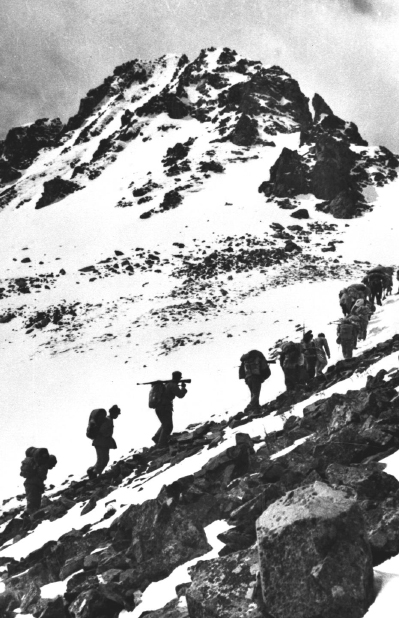 Red Army soldiers climb Jiajin Mountain, a snow-capped mountain in Sichuan, during the Long March (XINHUA)
To understand the Long March, we must return to the turbulent years leading up to October 1934. The 1911 Revolution, led by the predecessor of the Kuomintang party, brought an end to China's millennia-old absolute monarchy. However, the nation soon descended into fragmentation as warlords vied for power. After its founding in 1921, the CPC worked together with the Kuomintang to combat these warlords in a bid to reunify the country. This alliance, however, was short-lived. In 1927, the Kuomintang launched violent purges against the Communists, who responded by forming the Red Army and establishing revolutionary base areas in the countryside. Between 1930 and 1934, the Kuomintang launched five encirclement campaigns against communist base areas. The Red Army beat back the first four attacks, but the fifth was devastating. It forced the first, second and fourth front armies, along with the 25th Army, to abandon their bases and set out on the Long March. The First Front Army left from Jiangxi and Fujian provinces. The other units began their retreats from bases in Sichuan, Hunan and Henan provinces. During the Long March, the daily realities of hunger, injury and the loss of comrades were rarely recorded in memoirs or memorial collections, and even fewer of those accounts have survived. Yet the ones that do offer valuable insight into what the marchers endured. In July 1936, a regiment ran out of food when crossing the vast marshlands in Sichuan. The soldiers ate tree bark, grass roots and even resorted to boiling their rawhide belts. When only half a belt remained, 14-year-old Zhou Guangcai begged to keep it as a memento of the Long March and carried it with him to Yan'an, Shaanxi Province, where the CPC Central Committee established its headquarters in January 1937, after the Long March had concluded the previous October. Six of his comrades died on the way there; only Zhou reached Yan'an. He engraved three characters on the belt: chang zheng ji, "in memory of the Long March." In 1975, he donated it to the National Museum of China. If the half belt shows what soldiers gave up to keep going, other accounts show what they overcame physically to stay with the column. Zhong Chibing, a mid-level First Front Army commander who later rose to the senior ranks in the CPC-led armed forces, was shot in the leg in the battle to capture Loushan Pass in Guizhou Province in 1935. With no anesthesia available, surgeons used a cleaver and a saw to amputate his leg below the knee; the operation lasted over three hours. Infection set in, and he underwent two more amputations, the last one at the hip. He refused to stay behind to recover. With one leg and a pair of crutches, he completed the Long March, crossing snow-capped mountains and marshlands, falling on steep slopes and pulling himself up again. Individual endurance was matched by collective heroism under fire. In May 1935, the First Front Army's crossing of the Dadu River at Anshunchang ferry was proving too slow, so its main forces raced 120 km in a single day to seize the Kuomintang-controlled Luding Bridge. By the time they arrived, enemy troops had removed the bridge's planks, leaving only 13 iron chains. Under covering fire, 22 soldiers climbed along the chains and laid planks as they went. Some were hit and plunged into the roaring river below. The 18 survivors secured the far bank. This takeover opened a vital route for the First Front Army to cross the river and continue northward. "The crossing of the Dadu River was the most critical single incident of the Long March. Had the Red Army failed here, quite possibly it would have been exterminated," American journalist Edgar Snow wrote in his 1937 book Red Star Over China, which documents the Chinese communist revolution and contains the first Western account of the Long March. The Luding Bridge memorial has 22 pillars commemorating these men, but only four bear names; the other 18 remain blank—their identities still, and probably forever, unknown. In October 1936, the first, second and fourth front armies joined forces in northwest China, successfully completing this grueling strategic maneuver. The victory of the Long March dealt a decisive blow to the Kuomintang regime's efforts to eliminate the CPC and the Red Army. Wang Chaoguang, former Director of the Institute of World History, Chinese Academy of Social Sciences, said the Red Army faced not only the enemy's layered fortifications, heavy defenses and relentless pursuit, but also a harsh and unforgiving natural environment. "Towering snow-capped mountains rose to heights where even birds could barely fly and where breathing itself became a struggle for humans," he told Beijing Review. "Even today, with modern technology and advanced equipment, getting across those ranges would be no easy feat." Of the roughly 200,000 officers and soldiers who took part in the Long March—more than 180,000 at the outset—only about 57,000 survived. Wang added that the ultimate goal of Red Army, saving China and its people from threats to their very survival, was forged into a rock-solid faith that has endured through successive generations. The unwavering ideals and convictions, the heroic courage and sacrifice in the face of countless setbacks, and the commitment to rely on people and unite all in common purpose were not just the sources of strength that enabled the Red Army to overcome every hardship and obstacle during the Long March. They also became the wellspring of strength that later enabled the Chinese people to achieve victory in the War of Resistance Against Japanese Aggression (from 1931 to 1945), as well as in the War of Liberation against the Kuomintang regime, and establish the People's Republic of China in 1949. Xi further said that the road of the Long March continues to extend. "On our new journey, we are now committed to realizing the Second Centenary Goal of building China into a great modern socialist country in all respects and advancing the rejuvenation of the Chinese nation on all fronts through a Chinese path to modernization," he noted. 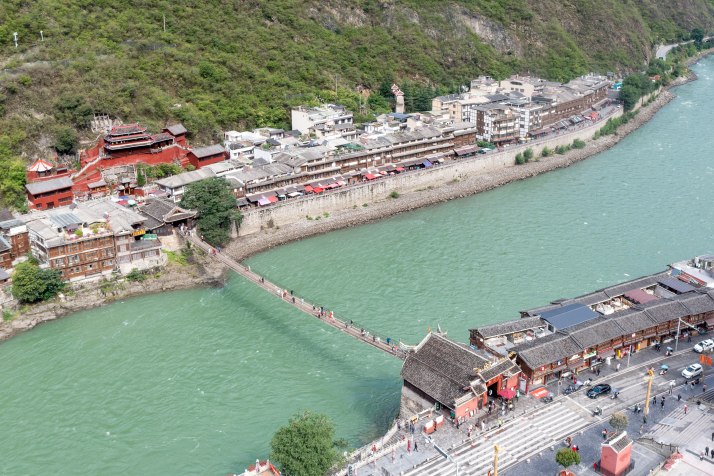 Luding Bridge in Luding, Sichuan Province, where a battle for the survival of the Red Army took place in May 1935 during the Long March, on May 19 (WEI YAO)
Living on Xi said the great spirit of the Long March demonstrates the power of loyalty, truth, justice and unity. "It will always be a precious treasure and a powerful driving force inspiring us to overcome difficulties and forge ahead courageously." Today, Chinese people learn about the Long March through textbooks, museums, memorial sites and other channels, and keep its spirit alive. In January 2017, China put forward a proposal to create a Long March National Cultural Park which would stretch across 15 provincial-level regions, including Jiangxi, Guizhou and Gansu provinces, in order to promote the spirit of those who marched and protect the relics and cultural resources associated with this historic event. Construction of the park linked up relic sites and created classic red tourism scenic spots and routes along the path of the Long March. Red tourism refers to tours of destinations associated with the revolutionary history of the nation. "The Long March is not a sealed relic of the past; it continues to shape the way Chinese people today confront and overcome difficulties," Ma Weifang, a researcher at the Academy of Military Sciences and head of the expert team of the construction of the Long March National Cultural Park, told Beijing Review. Xi said every generation has its own Long March, and every generation must see that march through. "It is a relay of spirit across generations," Ma said. "The Red Army's Long March back then was a bloody struggle for survival—a fight to open a path to national salvation. The Long March of the new era has national rejuvenation as its goal, and the 'steep passes' and 'perilous gorges' we must cross now are the new challenges such as achieving high-quality development and technological breakthroughs." "Today's young people face many crossroads—moral, professional and personal. Amid fierce competition and uncertainty, should they hold fast to their ideals? Should they settle down and endure hardship for long-term goals?" Ma said, adding that the Long March spirit and the logic of faith behind it still offer inspiration to young people today. "The Long March spirit is rooted in China, yet it speaks to a question every society must face: When people find themselves in hardship and the road ahead is shrouded in uncertainty, how can they keep moving forward?" Ma said. Today, as countries and regions around the world run up against development bottlenecks and face one crisis after another, that spirit offers lessons that reach well beyond any single nation's borders. Ma explained that for one thing, it shows the courage to meet crisis head-on and fight a way out, a refusal to look away from hardship. For another, it embodies a pragmatic habit of mind: seeking truth from facts, adapting as circumstances change and finding one's own path instead of clinging to dogma. It also carries a deep sense of community, of standing together when times are hardest, which speaks to a world so often divided. And it holds out the power of hope: the resolve to keep sight of long-term goals through repeated trials. "The specific history of the Long March cannot be repeated. But its hard-won experience of overcoming crisis can offer an uncertain world a source of inspiration from the East," Ma concluded. Copyedited by Elsbeth van Paridon Comments to luyan@cicgamericas.com |
|
||||||||||||||||||||||||||||||
|