|
| China |
| From the Peace Hotel to Tianjin 117: Otis grows with China’s changing cities | |
|
|
|
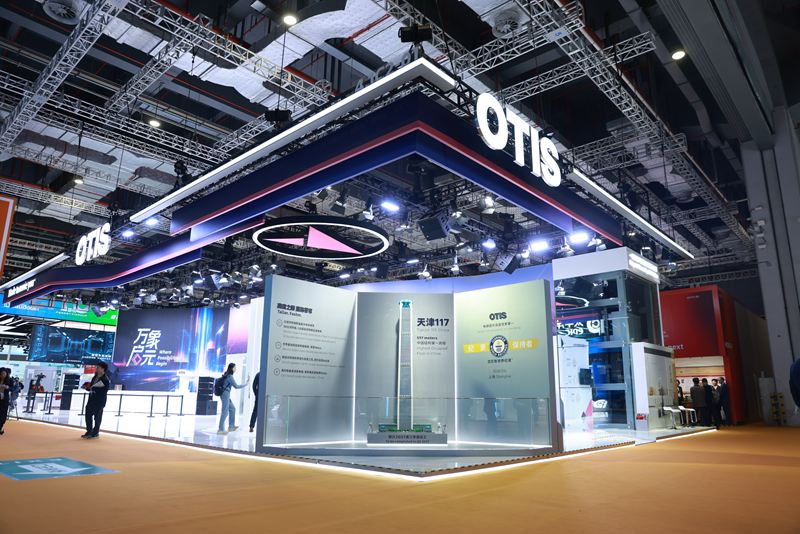
Otis, an American elevator company, showcases its products at the 9th China International Import Expo in Shanghai on November 6 (YIN KANG) In 1900, Otis installed what it identifies as its first elevator in Chinese mainland at Shanghai’s Peace Hotel. More than a century later, the American elevator manufacturer is involved in another landmark project: Tianjin 117 Tower, which is designed to feature the world’s longest elevator hoistway, extending more than 597 meters. The two projects offer a glimpse into the transformation of China’s cities and the country’s elevator industry. From early modern urban construction to the rise of skyscrapers, and now to the renewal of aging residential buildings, Otis has been part of China’s changing urban landscape. Its own development in the country has also been shaped by that transformation. “We have such a rich history in China,” Judy Marks, Chair and CEO of Otis Worldwide Corporation, told Beijing Review during the ninth China International Import Expo (CIIE) in Shanghai on November 6. “We installed the first elevator in China at the Peace Hotel, and we’ve been here over 40 years as an operating company.” In 1984, Otis established its first joint venture in China with the Tianjin Elevator Factory, marking the beginning of its sustained local operations. Over the following four decades, the company expanded its manufacturing, research and development, installation and maintenance networks across the country. Its development in China has accompanied the country’s economic growth and urbanization. For Marks, one of the most significant changes in recent years has been the evolution of the market itself. “The China we started with was a developing China. Now, for elevators, it’s more of a mature economy, which is more service-driven,” she said. China’s rapid urbanization and construction boom created enormous demand for new elevators over the past decades. But as construction patterns have changed, the industry has entered a new phase in which maintaining existing equipment, modernizing older elevators and installing lifts in buildings that previously had none are becoming increasingly important. Otis anticipated this transition and adjusted its business accordingly. “We pivoted to become more of a service business here in China,” Marks said. While manufacturing and research and development remain important, the company has expanded its maintenance, repair and modernization capabilities. Its service business accounted for more than half of its revenue in China as of the previous quarter, compared with around 20 percent six or seven years ago. The shift is closely connected to China’s broader urban renewal agenda. National policies supporting large-scale equipment upgrades have included the renewal of aging residential elevators, while measures have also been introduced to support elevator installation in older residential communities. For companies such as Otis, opportunities increasingly lie not only in building new infrastructure, but also in improving the safety, accessibility and performance of existing buildings. At this year’s CIIE, Otis presented its Gen3 Comfort 2.0TM elevator, designed with residential users including older passengers in mind. Features include improved lighting and air quality, larger buttons, handrails and longer door-opening times. “We put features in there for residential and for aging customers,” Marks said. “They need that mobility. They need that dependable elevator.” The company’s approach to the Chinese market also involves working more closely with local partners. At Tianjin 117 Tower, Otis has collaborated with Chinese technology company Lenovo to use commercially available robots to install elevator guide-rail brackets, a task traditionally performed by workers. “We’re always concerned about safety. It’s one of our absolute priorities. We’re concerned about quality and repeatability,” Marks said. The partnership, she added, helps reduce labor time while making the installation process safer, more consistent and more efficient. For Otis, local partnerships are part of a broader business philosophy. “We believe that when you’re doing business in a country, you do business with your partners in that country,” Marks said. Working with local suppliers and technology companies provides access to expertise and scale while helping the company respond to market needs. Welcoming competition The relationship with local companies also extends to competition. China’s elevator industry has developed a strong domestic manufacturing base, creating an increasingly competitive market for international brands. Marks said Otis welcomes competition from Chinese companies. “There’s room for everyone to be able to serve this market,” she said. “We believe we can differentiate ourselves with our innovation, with our technology and with our colleagues.” That competition, she suggested, is also a reason to keep improving. Chinese customers have high expectations and want the latest products, while the pace of market development leaves little room for lengthy product-development cycles. Marks sees this as an advantage that extends beyond China. The company’s Shanghai-based development center contributes to digital projects for its global operations, and products and technologies developed in China can be applied in other markets. “We become better by being able to respond in China,” she said. “We can use those features. We can use that functionality. We can export the product. We can use the talent to share to make us better globally.” The Tianjin 117 project brings this two-way relationship into focus. Otis will provide 251 elevators and escalators for the tower, including two elevators with hoistways measuring 597.2 meters. Some double-deck elevators will travel at speeds of up to 12 meters per second. The project combines the company’s high-rise technology with manufacturing and innovation capabilities in China. Changes in the environment Despite changes in the global business environment, Marks said Otis continues to see significant opportunities in China. “We have incredible opportunity here in China. We’re treated equally, and as long as we can compete fairly and innovate and allow ourselves to grow, we’re going to continue to invest here,” she said. She also expressed confidence in the relationship between the two countries, particularly following the multiple meetings between the two countries’ leaders. For Marks, the appeal of China goes beyond the size of its market. The country’s demanding customers and fast pace of development have pushed Otis to improve its products, productivity and responsiveness. These capabilities, in turn, strengthen its competitiveness globally. “China is a great place to invest. It’s one of the largest markets you want to have access to in the world,” she said. Her message to foreign companies considering the Chinese market was straightforward: “The Chinese market is demanding, but demanding is a positive to me... If you come, you need to come and come all in.” From the Peace Hotel to Tianjin 117 Tower, Otis’ journey reflects how far China’s cities and the elevator industry have come. And as the country moves from building new skylines to renewing existing ones, the company is looking to grow alongside China’s next stage of development. Copyedited by Elsbeth van Paridon Comments to zhangshsh@cicgamericas.com |
|
||
|
||||||||||||||||||||||||||||
|