
|
| Voice |
| Why the Long March still resonates in today's China | |
|
|
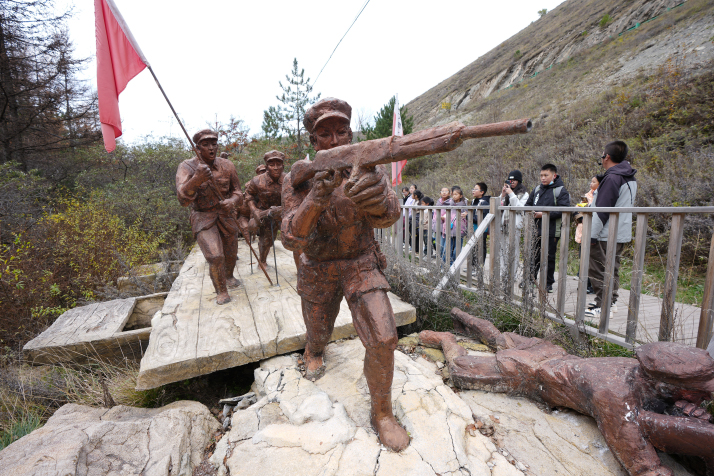 A Long March-themed tourist site in Guyuan County, Ningxia Hui Autonomous Region, on October 30, 2025 (XINHUA)
In 1936, the Red Army led by the Communist Party of China (CPC) completed an epic two-year trek that has come to be known as a triumph of tenacity, human endurance and military strategy. Confronted with the threat of annihilation by a repressive regime, the Red Army carried out the Long March, which is widely known to have covered roughly 12,500 km, emerging as a more battle-hardened, resilient force and leaving behind an enduring legacy. This year is the 90th anniversary of the completion of the Long March. To reflect on its historical importance and lasting impact, Beijing Review talked with Wang Chaoguang, former Director of the Institute of World History, Chinese Academy of Social Sciences. Edited excerpts of the conversation follow: Beijing Review: What are some key elements people today should know and understand about the Long March? Wang Chaoguang: Starting in October 1934, the Red Army implemented a series of strategic relocations from its bases in order to break through the encirclement by the repressive Kuomintang regime. In October 1936, the multiple units of the Red Army joined forces in the Shaanxi-Gansu-Ningxia border region in northwest China, successfully completing this grueling trek. Over the course of this great journey, the Red Army crossed more than 10 provinces, covering a distance of about 12,500 km. The length of time, the vast distance, the extreme hardships and the treacherous terrain they faced were almost unprecedented in the history of human warfare. For this reason, the process of this strategic relocation came to be known as the Long March. The Long March embodies many profound ideas that are important to understand today. One of these is maintaining firm ideals and beliefs. During the Long March, the Red Army not only had to confront relentless pursuit and encirclement by the Kuomintang troops, which far outnumbered and outgunned them, but also had to endure the harsh and treacherous natural conditions along the way such as marshy grasslands that seemed benign but concealed deadly dangers. The unwavering ideals and beliefs of Red Army soldiers were what carried them through the continuous battles and extreme physical exhaustion, and were further reinforced by the hardships they endured. Their ultimate goal, saving China and its people from threats to their very survival, was forged into a rock-solid faith that has endured through successive generations of the Chinese people. Two other ideas from the Long March that maintain relevance today are the spirit of fearlessness in the face of hardship and the willingness to sacrifice. Due to severe difficulties in logistics, getting enough food to eat was a pressing problem for the army. Many of its soldiers did not fall in battle, but perished amid the brutal natural conditions. From the 206,000 people who set out at the beginning of the Long March to the 57,000 who survived at its end, countless comrades gave their lives along the way. It was this willingness to face hardship and make sacrifices that led to the regrouping of the Red Army in Shaanxi and ultimately changed the course of China's development. Other concepts from the Long March that carry through to today are the equality that was fostered between the officers and the soldiers. From the very moment of its founding, the Red Army emphasized equality between officers and soldiers, forming a unified whole. Commanders had no special privileges, standing shoulder to shoulder with the ranks, a striking contrast to the old armies of China, where officers sat high and mighty. The Red Army also firmly upheld its identity as an army of the people, devoted to serving them and fighting for the liberation of the toiling masses. Wherever the Long March passed, often through remote regions, the local population, including ethnic minorities, initially knew little about the CPC or the Red Army. However, every time the Red Army arrived somewhere, soldiers would explain the Party's and the army's goals: the liberation of the people and the pursuit of their happiness. They inspired millions of workers and peasants to join the common cause. As a result, people who had once been unfamiliar with the Red Army eagerly lent their support, enlisting, fighting and contributing their strength to the ultimate victory of the Long March. Finally, two additional ideas embodied by the Long March that are important to understand today are strict discipline and close unity. The CPC has always placed great emphasis on strong organization and strict discipline, underscoring unity within the Party. It resolutely opposes factionalism and the formation of small cliques or personal networks. Under the extremely difficult conditions of the Long March, lacking discipline and unity would inevitably have led to disarray and fragmentation. It was precisely through upholding strict discipline and maintaining close unity that the Long March achieved victory. The unity of the Party and the unity of the Red Army have always been among the most distinctive features that set them apart from the Kuomintang and its military forces and from all old-style political parties and armies in China's past. 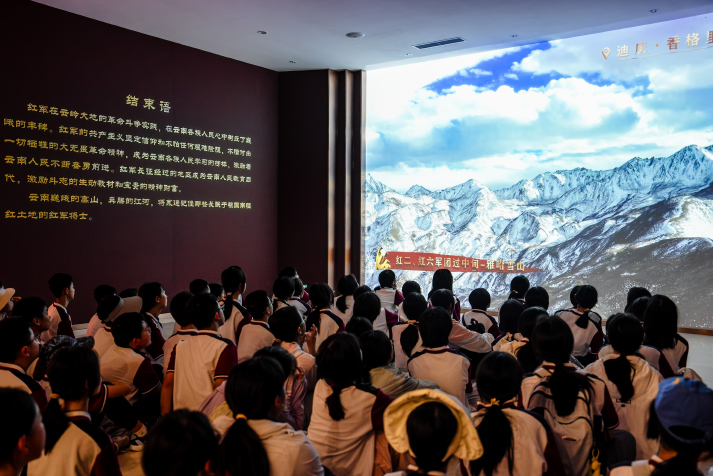 Middle school students learn about the Long March at a dedicated immersive experience center in Zhaotong, Yunnan Province, on May 12, 2025 (XINHUA)
The same strength and resilience of the Long March have been carried forward in China's recent history. The country has become a global economic, social and sustainable development leader despite the efforts of some in the West to try to constrain its modernization. What are your thoughts on this? An old Chinese saying goes, "Adversity tempers a person as jade is polished." The spirit of the Long March was forged through the heroic struggle of the Red Army. Today, this spirit is the continuation, development and renewal in revolutionary practice of these Long March traditions. The unwavering ideals and convictions, the heroic courage and sacrifice in the face of countless setbacks, action that relies on the people and unites all in common purpose, and the supreme emphasis on close unity and strict discipline were not only the sources of strength that enabled the Red Army to overcome every hardship and obstacle during the Long March. They also became the wellspring of strength that later enabled the Chinese people to achieve victory in the national war of resistance against Japanese aggression from 1931 to 1945, as well as achieve victory in the War of Liberation against the Kuomintang regime and establish the People's Republic of China in 1949. In the subsequent socialist revolution and construction, in the practice of reform and opening up that began in 1978, and in the development of China in the new era since Xi Jinping became the Party's top leader in 2012, this spirit has continuously demonstrated its enduring power in driving the country's progress. In the first three decades after the founding of the People's Republic of China, the Chinese people, through hard work and perseverance, laid the foundations of modern industrialization. Thirty-two years after reform and opening up began, China became the world's second largest economy with the world's largest and most comprehensive modern industrial system. In the new era, China has achieved the eradication of extreme poverty for its population of 1.4 billion, an accomplishment unseen in human history, while steadily raising living standards, advancing across all industrial sectors to the forefront globally and earning broad recognition as a major country. All these achievements are inseparable from inheriting and carrying on the spirit of the Long March, which will continue to provide an enduring source of inspiration and momentum for achieving Chinese modernization and realizing the Chinese dream of national rejuvenation, the goals the Party has vowed to accomplish by the mid-21st century. What can we learn from the Long March in order to successfully overcome current challenges, from a volatile global landscape to the rise of AI, and to thrive in the future? This history and spirit of the Long March reflect humanity's pursuit of universal ideals. Through the accounts of international journalists and media coverage at the time, the historic feat once attracted considerable attention around the world. In today's interconnected global era, viewed through the lens of President Xi Jinping's vision of a community with a shared future for humanity, people of all nations can still draw wisdom and inspiration from the Long March legacy. It embodies timeless values: the lofty aspiration for progress and equality, the tenacity to advance civilization, the resolve to fight for social justice, the courage to sacrifice in critical moments, and the steadfastness to endure uncertainty and upheaval. These are ideals that transcend borders, lessons the world can still learn from the Long March and its enduring spirit. BR __________ The Long March The 1911 Revolution, led by the predecessor of the Kuomintang party, brought an end to China's millennia-old absolute monarchy. However, the nation soon descended into fragmentation as warlords vied for power. After its founding in 1921, the Communist Party of China (CPC) worked together with the Kuomintang to combat these warlords in a bid to reunify the country. This alliance, however, was short-lived. In 1927, the Kuomintang launched violent purges against the communists, who responded by forming the Red Army and establishing revolutionary base areas in the countryside. Between 1930 and 1934, the Kuomintang launched five encirclement campaigns against communist bases. While the first four were repelled, the fifth proved devastating, compelling the Red Army to relinquish its bases and embark on what would come to be known as the Long March. The Central Red Army, or the First Front Army, began its march from Jiangxi and Fujian provinces. Other Red Army units started their relocations from their own bases in Sichuan, Hunan and Henan provinces. The Long March is more than just a pivotal event in China's early revolutionary history. It has become a cornerstone of China's national identity and philosophy of governance. The grueling trek forged core values that are deeply embedded in the culture of the CPC and in the national consciousness to this day, providing guidance and inspiration from primary schools to the Great Hall of the People in Beijing. Just as they guided the Red Army nine decades ago, the attributes of steadfastness in belief, willingness to face hardship and make sacrifices, unity, equality and discipline guide China through modern challenges, toward its modernization goals. Copyedited by Elsbeth van Paridon Comments to yanwei@cicgamericas.com |
|
||||||||||||||||||||||||||||
|