
|
| Voice |
| Signals from the Shangri-La Dialogue | |
|
|
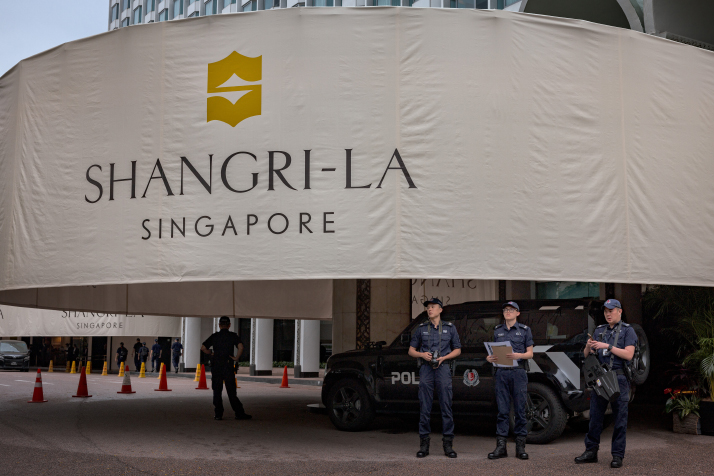 Security guards at the Shangri-La Hotel in Singapore on May 29. The Shangri-La Dialogue was held in the hotel on May 29-31 (CFP)
Every year, the Shangri-La Dialogue in Singapore serves as a stage where China-U.S. dynamics attract outsized attention. This year, however, the atmosphere was different. U.S. Defense Secretary Pete Hegseth adopted a far more restrained tone, describing bilateral ties as "better than they have been in many years" and avoiding any mention of Taiwan. At the same time, China sent its lowest-level delegation in years, and the traditional China special session was canceled. What do these shifts reveal about evolving China-U.S. relations and the regional security landscape? Zhou Bo, a senior fellow at the Center for International Security and Strategy, Tsinghua University, shared with news portal Guancha.cn his assessment of the signals emerging from this year's gathering on May 29-31, hosted by the International Institute for Strategic Studies, a British think tank. Edited excerpts from the interview follow: A low-key tone U.S. Defense Secretary Pete Hegseth's speech was, in my view, the lowest-key address delivered by a U.S. defense chief at the forum in many years. I have attended the Shangri-La Dialogue 13 times, and this change in tone was obvious. This was not accidental. It came shortly after President Donald Trump's visit to China (on May 13-15), against the background of America's declining global influence and an ongoing war in the Middle East. These factors inevitably shaped Hegseth's remarks. Throughout his speech, he repeatedly emphasized three key words: strong, quiet and clear. But what do they really mean? "Clear" is the most questionable. Clear about what? Clear about the global situation? Clear about the reason for using force against Iran? To this day, very few people can explain convincingly why Trump chose military action against Iran. If nobody can clearly explain the purpose of a war, then clarity is hardly the right word. "Strong" is easier to understand. The United States is still the world's leading military power. But American power is no longer what it was. Its own strategic documents now talk about shifting U.S. military focus to the Western Hemisphere. It is a sign that Washington can no longer afford to police the whole world. Yet the U.S. cannot simply withdraw to its own doorstep. The Indo-Pacific remains the world's most economically dynamic region. Every major power wants a share of its prosperity. This is why the U.S. still wants to remain deeply involved here, even as its resources are stretched elsewhere. The word "quiet" is the hardest to interpret. How can the world's only superpower describe itself as "quiet?" Perhaps what Hegseth meant was a kind of restrained posture, speaking softly while still holding a big stick. If we look at U.S. behavior, its restraint is primarily rhetorical. Washington talks about strategic contraction, yet it continues to act aggressively in different parts of the world. China-U.S. relations Some Western observers have dismissed Trump's visit to China as limited in outcome because there was no joint statement. I think this view is wrong. The visit was historically significant. The most important result was not beef, Boeing aircraft or any single trade item. The real achievement was that the two presidents agreed on a new understanding: "building a constructive China-U.S. relationship of strategic stability." This phrase deserves careful attention. "Constructive" refers to how the two sides should approach the future. Whether that vision can be translated into concrete actions, however, remains to be seen. This is precisely why China has stressed that "constructive" must not be allowed to become an empty slogan. The message is clear: Without genuine commitment and serious follow-through, the concept risks remaining little more than rhetoric. "Strategic stability" is even more significant. For the first time, the U.S. has accepted language that implies China and the United States are two major countries whose relationship must be managed on the basis of equality. Strategic stability does not exist between two actors of vastly unequal power. For years, Washington's description of China has ranged from "strategic competitor" to "pacing threat," with little positive content attached to the relationship. The concept of strategic stability is therefore noteworthy. As a shared objective, it offers a firmer foundation for future engagement between the two countries. In military terms alone, China has no intention of seeking numerical parity with the U.S. in nuclear weapons. However, in areas such as outer space, AI and cyberspace, the gap between the two sides is not large, and these are precisely the fields in which greater communication and cooperation are needed. Taiwan, South China Sea and guardrails This year, Hegseth did not mention the Taiwan question even once in his formal speech. This is consistent with Trump's own approach after his China visit. On his return flight from China, Trump made a very important point when asked about Taiwan: "We're not looking to have somebody say, 'Let's go independent because the United States is backing us.'" Trump is unpredictable, but he is not usually a hypocrite. He often says what he really thinks. From now on, the U.S. will face mounting pressure in advancing its arms sales to China's Taiwan region. The reason is simple: The balance of power has changed. China has more tools to respond. At the end of the day, U.S. arms sales are also about making money. But if the money comes with rising risks, possible Chinese sanctions on U.S. businesses involved in the sales and the danger of being dragged into an unwinnable conflict, Washington will have to recalculate. In the South China Sea, the risk is different. I do not believe direct military conflict between China and the U.S. is likely in either the South China Sea or the Taiwan Straits in the near term. In the South China Sea, the core issue is not really between China and ASEAN claimant countries. It is between China and the U.S. The immediate operational risk is whether ships or aircraft collide. China has consistently viewed the issue as one involving its sovereignty and territorial rights, and remains firmly committed to safeguarding its legitimate interests. The United States, however, does not share this position. Instead, it treats the waters in question as international waters and frequently conducts operations that test China's bottom lines. As a result, Chinese and U.S. ships and aircraft are often operating in close proximity, creating tangible risks of incidents and miscalculation. Technically, the two countries have mechanisms and rules for encounters at sea and in the air. But the problem is not merely technical. It is political. If U.S. military aircraft and warships come close to China's doorstep, and then ask China to keep a safe distance, that logic is difficult for us to accept. From China's point of view, the provocation comes first. For a long time, the two sides have been talking past each other on the question of "safety" versus "security." The United States focuses on safety in the physical sense—the safety of personnel, ships and aircraft—while China is concerned with security in the broader sense of sovereignty and national interests. This is not a disagreement that can be easily resolved, either in the short term or the foreseeable future. That said, we may be seeing some changes on the U.S. side. By Washington's own account, the frequency of U.S. operations in the South China Sea has declined, something American officials themselves have acknowledged. Part of the reason is the shortage of available naval assets, while ongoing tensions in the Middle East have also diverted U.S. attention and resources. In the end, however, the most effective way to reduce such risks is for China to continue strengthening its own military capabilities. When the U.S. concludes that these operations bring more costs than benefits, it will naturally think twice before conducting them. Dialogue matters more than rank The Shangri-La Dialogue is an important platform for international security exchange, second only to the Munich Security Conference (in Munich, Germany) in terms of global influence, and China has never ignored its importance. What matters to China is continued engagement and maintaining communication and dialogue. Participation should not be measured solely by whether its defense chief is present. Notably, the same standard is rarely applied in reverse. At the annual Beijing Xiangshan Forum, China's premier platform for international security and defense dialogue, Western countries typically send relatively low-level delegations, sometimes represented mainly by embassy personnel. I often joke that if Western countries truly want to meet China's defense minister, they only need to attend the Beijing Xiangshan Forum, where he is certain to appear. The Shangri-La Dialogue itself also faces limitations. Over the years, its agenda has remained largely centered on speeches by Chinese and American representatives, reflecting an enduring fascination with China-U.S. competition. Many discussions also revolve around familiar regional flashpoints. Maritime security, for example, returns to the agenda every year under slightly different titles. Compared with the Munich Security Conference, the range of topics is relatively narrow. BR Copyedited by Elsbeth van Paridon Comments to dingying@cicgamericas.com |
|
||||||||||||||||||||||||||||
|








