
|
| Voice |
| A living moral compass | |
|
|
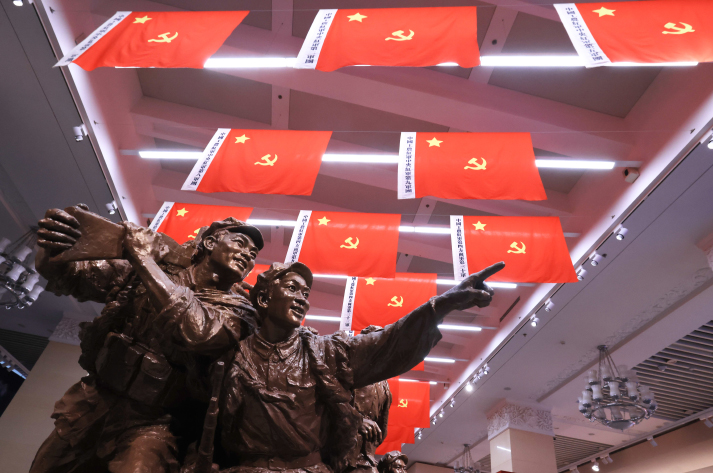 On September 22, the thematic exhibition commemorating the 90th anniversary of the victory of the Long March of the Chinese Workers' and Peasants' Red Army opened in Beijing.(XINHUA)
When I was writing my candidate's dissertation, I chanced upon Agnes Smedley's The Great Road in an archive in Irkutsk, a principal city in East Siberia, Russia. This American journalist and activist lived among Red Army veterans under Mao Zedong in Yan'an, Shaanxi Province. This was where the Long March undertaken by the Chinese Workers' and Peasants' Red Army, led by the Communist Party of China (CPC), concluded in 1936, following two years of traversing some of China's harshest terrain. The book recorded her firsthand recollections of the Long March campaign. In the book, Smedley placed little emphasis on military combat. Instead, she dwelt on the social life of the Red Army. She offered vivid accounts of rank-and-file soldiers' daily lives, the logistics and supply systems, and peasant outreach efforts. She told how paupers of yesterday grew into commanders, how ordinary peasants evolved into politically conscious fighters, how age-old feudal conventions crumbled within the army's ranks, and how a brand-new code of discipline took shape. It was then that I developed a deep-seated interest in the Long March.
Stories to keep telling In 2009, Chen Haosu, the eldest son of Marshal Chen Yi and then President of the Chinese People's Association for Friendship with Foreign Countries, visited Irkutsk. I was fortunate to interview this well-known public figure. Chen recounted stories of the Long March he had heard from his father. During the Long March, Marshal Chen remained in the southern base areas to cover the main Red Army force's breakout. Afterward, he led the remnants of his troops through grueling maneuvers in southern mountain forests and waged arduous guerrilla warfare. Against overwhelming odds, he fulfilled the mission personally entrusted to him by Mao Zedong, one of the CPC's key figures at the time. Tears glistened in Chen Haosu's eyes as he spoke of the agonies his father endured from a thigh wound sustained while carrying out combat duties to support the Long March. Chen Haosu himself never took part in the Long March, given he wasn't even born at the time. Nor did his father reach Yan'an until well after the Long March had concluded there. Yet old comrades-in-arms would often call on Marshal Chen. They told of the immense hardships of this unprecedented military trek in human history. They spoke of how leader of the Kuomintang Chiang Kai-shek's clique looted, burned and slaughtered urban and rural populations in regions liberated from Kuomintang rule. Survivors saw the Red Army as their last ray of hope and flocked to join its ranks. In reply to one interview question, Chen Haosu observed, "Without the Long March, there would be no New China."
A great leap In less than 100 years, China has made a truly miraculous leap forward. It has transformed from a backward feudal country bound by age-old traditions into one of the world's most powerful and economically advanced nations. China's journey is marked by dramatic upheavals, bloody wars and revolutions. Generals and revolutionaries, wholeheartedly devoted to their people and motherland, secured the nation's rebirth and enduring prosperity at the cost of their own lives. New China rose from the raging flames of that turbulent, frenzied era. One might say that it was not only those forebears who embraced the communist ideals of socialism, equality and freedom who embarked on the Long March—the whole of China itself completed a 90-year-long march. Each successive generation of Chinese citizens has had its own Long March. For today's Chinese people, this "march" means realizing the Chinese Dream: national rejuvenation, pursued through the comprehensive modernization of the country.
Why the march matters Russian Academician Mikhail Leontyevich Titarenko, then Director of the Institute of Far Eastern Studies of the Russian Academy of Sciences, shared his assessment of the Long March's importance for China when I put the question to him: "The Long March is more than just a page from the past; it is a living moral compass for contemporary China. It stands as a turning point: Having weathered the severest ordeals, the CPC turned defeats into victories and attained its 'second birth.' For modern China, the spirit of the Long March means above all unyielding faith in ideals and readiness for self-sacrifice. This historical legacy serves as a source of inspiration for overcoming all manner of adversities, be they economic challenges or hurdles in technological development. Thus, collective memory of the Long March constitutes a vital instrument for forging national identity and unity. The route is designated a historical heritage site of the People's Republic of China. Its heroic narrative features prominently in education and state media, embodying the fortitude, courage and resolve of the Chinese people to endure the harshest trials for the sake of a grand noble cause." Last year, I picked up the two-volume work The Agony and the Glory by renowned Chinese author Jin Yinan at a bookstore in the Russian capital of Moscow. To be frank, I have not yet finished reading this massive 1,000-page tome. Still, as I make my way through its pages, sweeping panoramas of historical figures and events unfold before my eyes. The book stirs the soul and tugs at the heartstrings. Far from being a dry compilation of historical facts, it gives voice to a nation's innermost cry: Once referred to as the feeble "Sick Man of East Asia" by some, China has emerged as an invincible Oriental dragon. Cast your mind back to the 1920s and 30s. China burned in the fires of war. Japanese militarists seized vast swathes of territory, while warlord cliques tore the country apart. Two forces proclaimed their goal of national unification and the total expulsion of invaders: the Kuomintang and the CPC. Who held the truth? Whom should the people trust? Rumors traveled ahead of the Red Army. Ordinary folk spoke of them: "They would not take so much as a thread or a grain of millet from the population. They buy provisions at fair prices and pay in full for everything they acquire." The Kuomintang troops, by contrast, acted as oppressors. They plundered the populace, justifying their misdeeds as "wartime necessity" in the fight against Japanese aggressors and Comintern-subservient communists."
The deeper one digs... The deeper I delve into this subject, the more I realize: The Red Army's Long March 90 years ago was a purgatory for communists. Outside lay millions of Kuomintang bayonets bearing down upon them; within their ranks lurked betrayal and doubt. The Long March meant endless marches, hunger and death, yet not one step backward. To study it is to grasp a timeless truth: True greatness is forged in the depths of profound suffering. The Long March is a concentrated microcosm of China's entire modern history. I often ponder: What would have become of the Chinese people, and of Russia too, had the Long March failed and the Kuomintang seized full control over China? For all the American and Soviet aid it once received, that party never addressed the peasants' most urgent existential needs and turned a blind eye to popular material hardship. That corrupt regime would in all likelihood have leaned fully toward the United States for the self-serving interests of its politicians, disregarding public wellbeing. It would have become an American proxy against the Soviet Union and plunged the whole region into the shadow of war. As official commentary notes, Russia-China relations are today at their best point in the shared history of the two nations. That is undeniably true. Our ties are nonetheless pragmatic; both sides retain room for strategic maneuver, and there remains ample scope for further deepening cooperation. Most crucially of all: Having weathered ordeals and ideological disagreements, we harbor no mutual suspicions today. To some extent, the origins of this mutual trust stretch back to that great Long March of China's Red Army 90 years ago. The author is editor in chief of Russia and China magazine
Copyedited by Elsbeth van Paridon Comments to dingying@cicgamericas.com |
|
||
|
||||||||||||||||||||||||||||
|