
|
| Voice |
| The Long March at 90 | |
|
|
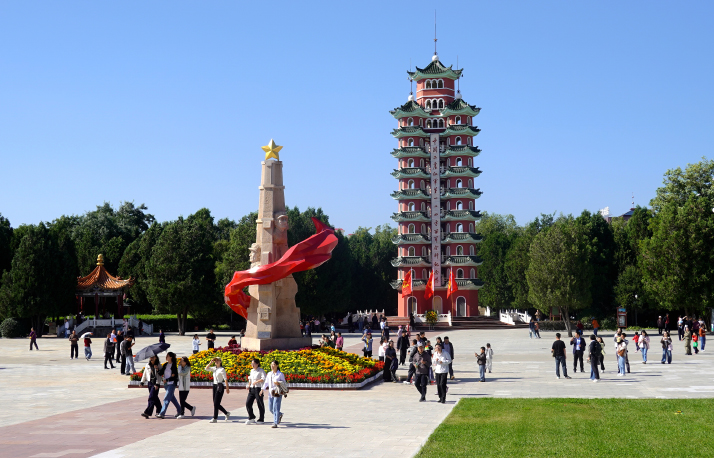 The historic site of the Red Army's reunion in Huining County, Gansu Province, on October 1 (XINHUA)
This October, it is 90 years since the three main forces of the Chinese Workers' and Peasants' Red Army—the first, second and fourth front armies—joined hands at Huining, in Gansu Province, and at Jiangtaipu, in what is now Ningxia Hui Autonomous Region, bringing the Long March (1934-36) to a close, what American journalist Edgar Snow called "an odyssey unequaled in modern times." To understand contemporary China—its achievements, its vision, its socialist orientation—one must understand the Long March. The road to Jiangxi The Communist Party of China (CPC) was formed in 1921, in the wake of the May Fourth Movement in 1919, a great patriotic and revolutionary campaign pioneered by advanced young intellectuals and joined by people from all segments of society to fight imperialism and feudalism. At that time, the 1911 Revolution that overthrew the Qing Dynasty (1644-1911) had come to a dead end; most of the country was run by warlords; the feudal economy remained in place; and the imperialist powers maintained their footholds. The CPC was the first organization to put forward the slogan "Down With Imperialism," recognizing that China's weakness was inherently bound up with foreign domination. From 1923, the young Party built a united front with the Kuomintang party to end feudalism, unite the country and drive out the imperialist powers. That alliance was drowned in blood after Kuomintang leader Sun Yat-sen's death. In March 1927, Shanghai was liberated from warlord control by an insurrection of the local working class; three weeks later, Chiang Kai-shek's Kuomintang forces took the city by massacring its liberators. Under Chiang's new regime, communism became a crime punishable by death; CPC membership fell from 58,000 to 10,000 in a single year. Disaster forced a strategic reorientation of world-historic significance. A revolution modeled on the European template—built on the industrial proletariat of the major cities—was no longer viable in a country where the working class constituted less than 1 percent of the population. Mao Zedong was, in the words of Chinese-born British writer Elisabeth Comber, "the first in the Party (CPC) who abandoned the city orientation and devised a major strategy born from China's reality." The Jiangxi Soviet Area—the first substantial liberated territory—grew to encompass millions of people. Land was redistributed, taxes lightened and mass literacy campaigns launched. Between 1930 and 1934, Chiang's forces waged five successive encirclement campaigns against the base areas of the CPC, the last mobilizing nearly a million troops and some 400 aircraft under German advisers headed by German General Hans von Seeckt. As American journalist Agnes Smedley recorded, the Kuomintang itself admitted that about 1 million people (almost entirely peasants) were killed or starved to death in the process of its reoccupation of Soviet Jiangxi. There was, she concluded, "no alternative but to abandon Jiangxi in order to save the Red Army. The sequel was the famous Long March." The march The Long March featured several extraordinary feats. The crossing of the Jinsha River, secured by a feint and a 90-km march in a night and a day, without the loss of a single life. The crossing of the Dadu River was judged by Snow to be "the most critical single incident of the Long March," because "had the Red Army failed there, quite possibly it would have been exterminated." The crossing culminated in the seizure of the Luding Bridge, where assault troops crawled hand over hand along bare iron chains into machine-gun fire. The snowy mountains, and then the grasslands, a vast trackless swamp where, Smedley wrote, "no tree or shrub grew, no bird ventured near, no insect sounded." Peng Dehuai, a Red Army general who walked most of the Long March, having given his horse to wounded comrades, once put it bluntly: "Victory was life; defeat was certain death." The Long March was equally a triumph of political strategy and a landmark in the development of Chinese Marxism. At the Zunyi Meeting in Guizhou Province in January 1935, the Party leadership confronted the failed military line associated with its Comintern advisers and elevated Mao Zedong to the core of decision-making—the beginning of a process through which the Chinese revolution came under the leadership of those who best understood China. As Danish writer Torkil Lauesen observed, the Long March "not only created a physical distance between the Communists and the Kuomintang, but also a political distance between the Comintern's Eurocentric interpretation of Marxism and the Chinese interpretation of Marxism." Here are the roots of the "Sinification of Marxism"—the insistence, in Mao's formulation, that Marxism apart from Chinese peculiarities is "merely an empty abstraction"—and thus the deepest roots of what we now call socialism with Chinese characteristics. And the march had a destination that was also a purpose: north, to resist Japanese aggression—converting a desperate retreat into a strategic advance and positioning the CPC as the standard-bearer of national resistance against foreign occupation. The new Long March Marking the CPC's 105th anniversary in July, Chinese President Xi Jinping described the Party's century as the most magnificent chapter in the millennia-long history of the Chinese nation, and identified among the qualities that explain its success: The Party remains steadfast in pursuing truth and always steers the right course; it is deeply rooted in the people and always rests on a solid foundation; it bravely shoulders its historic mission and always holds the strategic initiative; it keeps pace with the trend of development and always stands at the forefront of the times; it dares to struggle and excels in it, and always maintains full confidence in victory; and it focuses on self-strengthening and always brims with vigor and vitality. Every one of these was forged on the Long March. And for China, as Xi said in 2016 at a Beijing gathering marking the 80th anniversary of the Long March's victorious conclusion, "Every generation has its own long march, and every generation must see that march through." Today's is walked in the victory over extreme poverty and the campaign of rural revitalization (which aims to consolidate the gains made in poverty alleviation through rural development and to narrow the existing urban-rural gap—Ed.); in the drive for scientific and technological self-reliance in the face of a U.S.-led technology war; in the building of an ecological civilization. Each of these long-term undertakings demands the perseverance, strategic resolve and reliance on the people that carried the Red Army to Shaanxi. The march speaks to the world, too. For the Global South, it remains the great demonstration that a people organized around a clear political project can defeat apparently overwhelming force, and that Marxism lives by adaptation to national conditions. Its spirit finds contemporary international expression in cooperation under the Belt and Road Initiative (which aims to boost connectivity along and beyond the ancient Silk Road routes—Ed.) and the global initiatives on development, security, civilizations and governance—China working with other countries, above all in the Global South, toward a community with a shared future for humanity. The road is long; the foundations were laid by those youths of whom Snow wrote that they "would not admit defeat either by man or nature or God or death." The author is an activist, writer and independent political commentator based in London. He is the author of The End of the Beginning: Lessons of the Soviet Collapse (2019) and The East Is Still Red: Chinese Socialism in the 21st Century (2023) Copyedited by G.P. Wilson Comments to dingying@cicgamericas.com |
|
||
|
||||||||||||||||||||||||||||
|