
|
| Voice |
| The Race to Power AI | |
| China or the U.S., whose energy strategy will prove more effective? | |
|
|
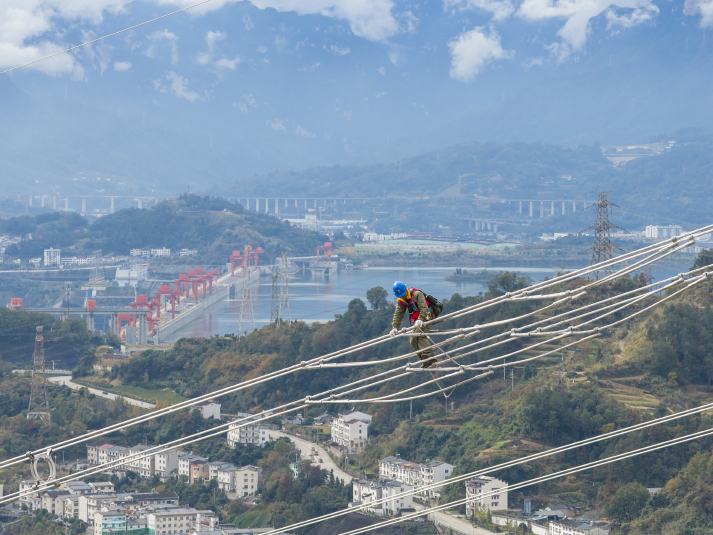 A worker inspects power transmission lines in Yichang, Hubei Province, on November 17.(Xinhua)
In the recently concluded U.S. midterm elections, AI data centers unexpectedly became a hot-button campaign issue. Massive power consumption by data centers, growing strain on local power grids and household electricity prices, alongside practical concerns over the environment and water resources, have aroused widespread worries among voters. The AI race between China and the U.S. is usually described in terms of chips, models and capital. But another resource is becoming increasingly important: electricity. Even the most advanced chips are useless without a reliable power supply, and a new data center must not only be built but also connected to the grid on time. Therefore, the ability to integrate computing capacity, power generation and electricity grids into a single infrastructure system is becoming increasingly important.
No power, no AI The relationship between energy and AI has long been a subject of discussion among experts around the world. The development of AI requires us to consider whether the construction of power grids and generating facilities can keep pace with demand for computing power, and whether data center planning and energy infrastructure planning can be advanced in step with each other. In 2025 alone, data centers consumed approximately 485 terawatt-hours (twh) of electricity. For comparison, this figure exceeds France's total annual electricity consumption. The International Energy Agency (IEA) projects that by 2030 this consumption will climb to around 950 twh. A substantial part of this growth will be contributed by data centers serving AI operations. The power consumed by these data centers rose by 50 percent in 2025 alone. Yet the core difficulty facing AI data centers lies not solely in the total volume of power generation, but in the ability to guarantee power supply during peak load periods. According to the same IEA estimates, by 2027 the peak load electricity demand of a single AI server rack will equal the combined consumption of 65 households, while a full AI data center will consume as much power as a large industrial facility. Faced with such loads, the reliability of power supply takes on special significance: Even a brief interruption is enough to destroy expensive equipment. Industry estimates indicate that 57 percent of major incidents in data centers cause losses exceeding $100,000, and one fifth of these exceed $1 million. The leading cause of the most serious failures is the power supply. Consequently, the energy problems constraining AI development ultimately boil down to one core task: guaranteeing a timely, sufficient and uninterrupted electricity supply. The IEA assesses that by 2030 China and the U.S. will account for nearly 80 percent of the global increase in data center electricity consumption. These two main participants in the global AI race approach this challenge in markedly different ways.
China: data in the east, computing in the west China is focusing primarily on the centralized coordination of computing and energy infrastructure. Beijing's approach is based on the Eastern Data, Western Computing project, which was outlined in May 2021 in a plan to establish a national system of computing hubs. The logic behind the project is dictated by China's geography. Most digital service consumers are concentrated in the eastern regions. The western regions, by contrast, have more available land and access to cheaper energy. As a result, the combined costs of building and operating data centers there are only 50-70 percent of those in east China. Consequently, model training, data storage and other tasks that do not require an immediate response are planned to be relocated closer to cheaper power generation—that is, to the country's western regions. Services for which minimal latency is critical remain closer to users in the east. This system is already operating in practice. During the 14th Five-Year Plan period (2021-25), a large proportion of China's newly added computing capacity was located in the western regions, which are increasingly taking on large model training, rendering and other resource-intensive tasks originating in the eastern regions. However, relocating computing capacity to the west raises questions about the environmental sustainability of its energy supply. China is the world leader in the expansion of renewable energy, accounting for more than half of the planet's newly installed solar and wind power capacity. Nevertheless, the pace of data center construction makes it difficult to power them entirely with clean energy. According to the IEA, approximately 70 percent of the electricity consumed by China's data centers still comes from coal-fired generation. The government recognizes this problem and sees its task as not only moving computing workloads westward but also gradually changing the composition of their energy supply. China continues to face the challenge of synchronizing the construction of computing and energy infrastructure. Chinese experts and government agencies estimate that building a data center takes approximately 0.5-1.5 years, while constructing transmission lines and substations can take two to five years. However, in April, China adopted a plan for the coordinated development of AI and energy, bringing computing clusters, renewable energy facilities, dedicated power supply lines, energy storage systems and demand management mechanisms into a unified framework. This approach certainly will not eliminate the problem immediately, but it represents an important step toward synchronizing their development. Ultimately, the Chinese model has not yet eliminated all the energy constraints on AI development, but it is addressing them effectively. Solutions begin at the government level, making it possible to think and act on a nationwide scale to adjust the geography of computing, the structure of power generation and approaches to developing electricity grid infrastructure.
The U.S.: decentralization and private capital The U.S. approach to AI development has its strengths and weaknesses. The American ecosystem is largely based on market mechanisms, private investment and decisions made by individual companies. The rapid growth of investment in AI infrastructure, however, does not guarantee a solution to the problem of energy supply and, in some respects, even complicates it. In the U.S., more than 90 percent of data center operators already identify power availability as their biggest challenge, and in 2024, the waiting time for connecting a new facility to the grid ranged from one to three years. In the largest clusters, it could reach seven years. The problem lies not only in the number of new data centers but also in the fact that each successive generation requires increasingly greater power capacity. Between 2020 and 2025, the average power demand of a new data center increased from 25 megawatts (mw) to 80 mw, while projects scheduled to become operational in 2030 are already being designed for an average of 400 mw. The American system responds to these challenges largely through a range of fragmented and local solutions: accelerated approval procedures, and the co-location of power generation facilities and data centers, some of which are adopted and implemented by the technology corporations themselves. For example, Microsoft signed a 20-year power purchase agreement with energy provider Constellation, enabling the restart of an 835-mw nuclear reactor that had been shut down since 2019. For its computing complex in Memphis, Tennessee, the Elon Musk-owned AI company SpaceXSI uses 69 temporary mobile gas turbines, which will be dismantled as its own 1.2-gigawatt power plant is developed. However, these accelerated and fragmented solutions create additional risk. Time constraints and long grid connection delays are pushing American companies to increasingly rely on their own gas-fired power generation. Natural gas already supplies more than 40 percent of the electricity consumed by U.S. data centers, and according to IEA forecasts, gas will account for the largest increase in electricity supply to AI infrastructure by 2030. On the one hand, this allows new computing capacity to be brought online more quickly, but on the other, it increases environmental risk. The previously mentioned SpaceXSI project in Memphis is a case in point. According to a lawsuit filed by the civil rights organization NAACP, the company began operating 27 gas turbines to power its Colossus-2 computing cluster before obtaining the necessary emissions permits. The plaintiffs estimate that these installations could emit more than 1,700 tons of nitrogen oxides annually, potentially making them the largest industrial source of such emissions in the Memphis metropolitan area. Another risk concerns the strain on the power grid and rising electricity costs for other consumers. Energy supplier Dominion Energy estimated that in Virginia, the largest data center market in the U.S., growing demand from data centers could lead to an increase of approximately 13 percent in consumers' electricity bills. Against this backdrop, the energy and infrastructure consequences of the data center boom are increasingly provoking opposition from local communities. According to the IEA, since the beginning of 2024, 46 AI data center projects in the U.S., with announced investments totaling more than $170 billion, have been blocked, withdrawn or delayed. The main reasons cited include concerns about electricity costs, pressure on power grids, water consumption and the impact of large facilities on surrounding areas. The scale of the problem has become so significant that tensions surrounding data center development are beginning to emerge at the regulatory level as well. In August, the White House removed data centers and advanced cloud services from its updated list of critical and emerging technologies. This decision does not in itself mean that the government is withdrawing support for the industry. However, it shows that the development of AI infrastructure has moved beyond simply expanding capacity and is forcing authorities to consider the energy, economic and social consequences of this process. The U.S. model is capable of rapidly mobilizing private capital and finding new market-based and technological solutions. However, the decentralized nature of these solutions and the growing scale of their consequences make it more difficult to reconcile the interests of businesses, energy companies, consumers and local communities. Ultimately, the AI race will not be won by chips or power plants alone, but by the ability to integrate computing capacity, power generation and electricity grids into a single functioning system.
The author is chair of the Association for the Development of the Fuel and Energy Complex, a Russia-based industry association, and an expert to the State Duma Committee on Energy of the Russian Federation Copyedited by G.P. Wilson Comments to dingying@cicgamericas.com |
|
||
|
||||||||||||||||||||||||||||
|