
|
| World |
| Carney's China card | |
|
|
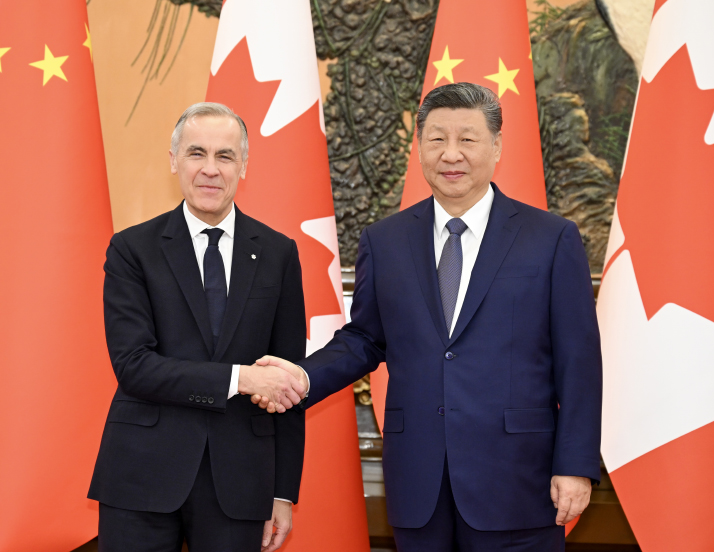 Chinese President Xi Jinping meets with visiting Canadian Prime Minister Mark Carney at the Great Hall of the People in Beijing on January 16 (XINHUA)
On January 16, Chinese President Xi Jinping met with Canadian Prime Minister and Liberal Party leader Mark Carney in Beijing. Carney is the first Canadian head of government to visit China since 2017. His China trip resulted in a joint statement outlining a shared commitment to strengthening bilateral relations, deepening practical cooperation and upholding multilateralism. In recent years, China-Canada relations have been turbulent, with repeated disruptions in diplomatic exchange and economic cooperation. At the same time, the global balance of power is undergoing profound shifts: U.S. foreign policy has become increasingly unpredictable; Europe faces security and economic pressures; and unilateralism continues to erode regional and global stability. Against this backdrop, what Carney perhaps seeks to "recalibrate," starting with this recent visit, is not merely the relationship between China and Canada, but Canada's broader international posture and its survival strategy amid mounting U.S. pressures and a volatile geopolitical landscape. Pressure from Washington To understand why Canada feels the need to "recalibrate," we must examine its most consequential external variable—the U.S. For decades, Canada and the U.S. have been deeply integrated in both trade and defense. The U.S. is Canada's largest trading partner and the cornerstone of its national security architecture. Yet this long-standing arrangement is showing unprecedented signs of strain. In recent years, U.S. foreign and economic policies have taken on increasingly unilateral and transactional characters. Since Donald Trump's return to the White House early last year, Washington has relied more frequently on tariffs and other coercive measures, even against its closest allies. Trump's repeated remarks about turning Canada into the "51st state" have further shaken the foundation of mutual respect between the two countries at both the diplomatic and public-opinion levels. Meanwhile, U.S. kidnapping of Venezuelan President Nicolás Maduro in early January and Trump's unhinged appetite for the acquisition of Greenland have exposed the American ambition to reforge its unquestionable hemispheric dominance. For Canada, which shares the longest land border with the U.S., these dynamics are impossible to ignore. Raymond Blake, a historian at Canada's University of Regina and a fellow of the Royal Society of Canada, told Beijing Review that Canada's resolve to defend sovereignty and independence is not a product of short-term political rallying, but rather the result of long-standing historical experience and nation-building. In Blake's words, "any notion of becoming an American state is unfathomable to them." Ottawa is coming to realize that Washington is no longer a consistently predictable ally, and uncertainty itself has become a major strategic liability. Hedging against uncertainty Canada's "recalibration" does not imply a complete rupture with the U.S. Instead, it reflects an effort to build greater strategic resilience in a world where an American "safety net" can no longer be taken for granted. Economic diversification lies at the heart of this adjustment. Though the U.S. will remain Canada's top trading partner for the foreseeable future, over-reliance on any single market poses a systemic risk. According to data released by Statistics Canada on January 8, exports to the U.S. accounted for 67.3 percent of Canada's total exports last October. Although this share has declined gradually, Canada's continued reliance on the American market still gives Washington considerable leverage. Against this backdrop, the liberal government's proposal to increase exports to non-U.S. markets by 50 percent over the next decade reflects Carney's commitment to trade diversification. Diplomatically, Canada also seeks to strengthen dialogue and cooperation with other major countries to amplify its voice in global affairs. Ottawa increasingly sees that uncritical alignment with U.S. strategy yields diminishing returns and exposes Canada to risks against its national interests and public welfare. However, diversification does present its own dilemma: How to reduce reliance on the U.S., without provoking its increasingly sensitive neighbor, remains a formidable challenge for Canadian policymakers. Why China matters As Canada recalibrates, China's growing importance becomes clear. China is the second largest economy in the world and Canada's second biggest trading partner. The Chinese market is particularly important for Canadian agricultural products, meat and energy exports. However, in late 2024, Canada followed the U.S. in imposing tariffs of up to 100 percent on Chinese electric vehicles, along with 25-percent duties on steel and aluminum. China responded by imposing retaliatory measures beginning from March 2025, including a 100-percent tariff on Canadian canola oil, canola meal and peas, followed by a 75.8-percent provisional anti-dumping tariff on Canadian canola seeds last August. These measures dealt a severe blow to Canada's western agricultural provinces. Saskatchewan, in particular, has emerged as a real-life casualty of Canada's blind alignment with U.S. policy toward China. The latter is the province's second largest trading partner, with 4 billion Canadian dollars ($2.9 billion) in exports in 2024, dominated by agricultural products. Saskatchewan is the world's largest canola producer and accounts for 27 percent of global dry pea production. China's retaliatory tariffs on related commodities devastated Saskatchewan's exports, imposing calamitous economic pressures on farmers and related industries. By August 2025, Saskatchewan's exports to China had plunged to 960 million Canadian dollars ($693 million), a 76-percent year-on-year decline. Carin Holroyd, a professor of political studies at the University of Saskatchewan and an expert in international trade policy, told Beijing Review that the trade disputes between China and Canada had immediate consequences for the province's economy and community. China's sheer scale in the global economy, she noted, gives it decisive influence over resource- and agricultural-dependent regions. "China is a major player in the global economy. It has the potential to enrich desperate regions and to cause economic dislocations if it takes its purchases elsewhere," she added. Holroyd emphasized that prolonged trade tensions have deeply damaged Saskatchewan's farmers and local economy, while a stable and long-term China-Canada economic partnership would support the province's rural communities and industrial sectors, providing China with a secure and reliable source of supply. She also pointed out that Saskatchewan Premier Scott Moe's participation in the recent national trade delegation to China underscored the high priority the provincial government places on this relationship. "With the support of the federal government, Saskatchewan's trade relationship with China has been largely restored," Moe told a press conference hours after returning home on January 20. Post-U.S. prospects Carney's China visit signals more than a short-term diplomatic turnaround. It reflects a growing recognition within Ottawa that Canada's long-standing assumptions about its strategic environment no longer hold. In a world where American guarantees are increasingly conditional and transactional, Canada can no longer afford to anchor its economic security and foreign policy to a single partner. China's role in this recalibration is not ideological, but structural. Its market size, demand profile and position within global supply chains make it indispensable to any serious attempt at Canadian trade diversification. The experience of Saskatchewan underscores this reality with particular clarity: When Chinese market access is constrained, the costs are immediate, localized and politically consequential. When engagement is restored, the benefits extend far beyond trade statistics, stabilizing communities, industries and provincial economies. None of this suggests that Canada is "choosing sides" or abandoning its relationship with the U.S. Rather, it points to a more sober and autonomous strategic posture—one that seeks balance instead of dependence, resilience instead of comfort. In this sense, China is not a substitute for the U.S., but an essential component of a more diversified and sustainable Canadian foreign policy. BR Copyedited by Elsbeth van Paridon Comments to dingying@cicgamericas.com |
|
||||||||||||||||||||||||||||||
|