
|
| World |
| Solidarity for security | |
|
|
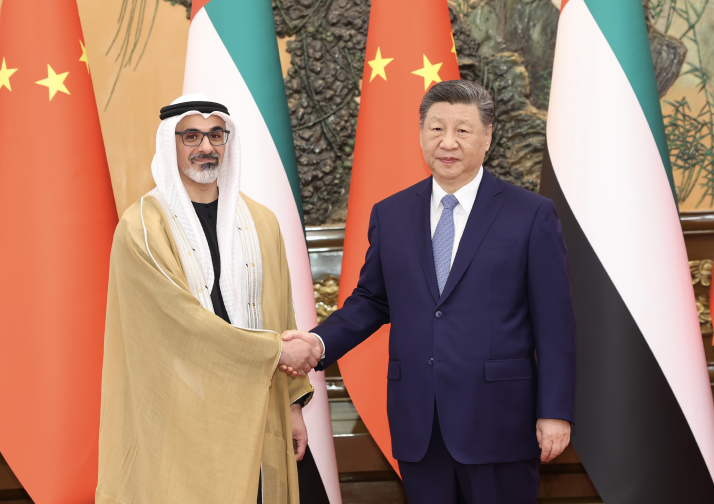 Chinese President Xi Jinping meets with Sheikh Khaled bin Mohamed bin Zayed Al Nahyan, Crown Prince of Abu Dhabi, United Arab Emirates, at the Great Hall of the People in Beijing on April 14 (XINHUA)
Since the outbreak of the U.S.-Iran conflict, China has maintained a steady and coordinated position across different levels of government and diplomacy. The core message has remained steady: reject unilateral military escalation, uphold sovereignty and international law, seek an immediate ceasefire and return to diplomacy. Over time, that position has become more layered, combining principle and crisis management. A four-point proposal for regional stability China's position is anchored in a four-point proposal put forward by Chinese President Xi Jinping during his meeting with Sheikh Khaled bin Mohamed bin Zayed Al Nahyan, Crown Prince of Abu Dhabi, United Arab Emirates (UAE), in Beijing on April 14. As the two leaders exchanged views on the current situation in the Middle East and the Gulf region, Xi emphasized China's position on promoting peace and talks, and reaffirmed that China will continue to play a constructive role in this regard. Xi called for adherence to the principle of peaceful coexistence. Countries in the Middle East and Gulf region are interdependent and inseparable neighbors. Efforts should be made to support these countries to improve their relations, and it is imperative to promote the building of a common, comprehensive, cooperative and sustainable security architecture for the Middle East and the Gulf region. He urged adherence to the principle of national sovereignty. Sovereignty serves as a foundation for all countries, especially developing countries, to survive and thrive, and it must not be violated. The sovereignty, security and territorial integrity of countries in the Middle East and the Gulf region should be fully respected, and the safety of personnel, facilities and institutions of all countries should be effectively safeguarded. On adherence to the principle of international rule of law, Xi said the authority of international rule of law should be upheld, rejecting selective application to prevent the world from falling back into the law of the jungle. He called for firmly upholding the international system with the UN at its core, the international order based on international law, and the basic norms of international relations underpinned by the purposes and principles of the UN Charter. He said development and security should be coordinated. Security makes development possible, and development helps maintain security. All parties should work together to create a favorable environment for the development of countries in the Middle East and the Gulf region. China is ready to share with these countries the opportunities brought about by Chinese modernization to strengthen the foundation for regional development and security. This proposal has since been cited in multiple official statements. On April 20 and 21, Chinese Foreign Ministry spokesperson Guo Jiakun said China supports all relevant parties in maintaining the momentum of a ceasefire and negotiations and in acting on the basis of Xi's four-point proposal. "The four-point proposal reflects China's consistent position and active efforts in promoting peace, preventing escalation and encouraging dialogue to resolve differences. It also offers a practical pathway toward a political settlement of the ongoing Middle East crisis," Chinese Ambassador to Egypt Liao Liqiang wrote in an article published in Egyptian newspaper Al Gomhuria on April 16. Diplomatic engagement While the four-point proposal provides the overall direction, China's diplomatic efforts have focused on communication and coordination with relevant parties. During the conflict, Chinese Foreign Minister Wang Yi maintained contact with foreign ministers from countries involved. According to the Chinese Foreign Ministry spokesperson Mao Ning on April 8, Wang had held 26 phone calls with counterparts. These contacts covered key parties directly involved in the conflict, including Iran and Israel, as well as major stakeholders such as Russia and multiple Gulf states. They also extended to countries with roles in mediation efforts and broader regional stability. On April 15, in a phone conversation with Iranian Foreign Minister Abbas Araghchi, Wang said the situation stood at a "critical juncture between war and peace" and called for efforts to maintain a ceasefire and advance negotiations. In the same conversation, Wang addressed the situation in the Strait of Hormuz. He said that the sovereignty, security and legitimate rights and interests of Iran as a country bordering the Strait of Hormuz should be respected and upheld. Meanwhile, the freedom and security of navigation in the internationally accessible strait should also be guaranteed, and restoring normal navigation in the strait is a goal shared by the entire international community. China has also taken part in joint diplomatic initiatives. On March 31, China and Pakistan issued a five-point initiative on restoring peace and stability in the Gulf and Middle East. According to the statements, the initiative calls for the immediate cessation of hostilities, start of peace talks as soon as possible, security of nonmilitary targets, security of shipping lanes and primacy of the United Nations Charter. At the United Nations, China has presented its position in legal and institutional terms. Chinese representatives have stated that the use of force should comply with the purposes and principles of the UN Charter and that disputes should be resolved through peaceful means. They have also said that actions which bypass or undermine international law could affect the authority of the international system. In discussions on the situation, Chinese diplomats have called for restraint and for all parties to return to dialogue. In addition to bilateral and multilateral efforts, China has sent its Special Envoy on the Middle East Zhai Jun to the region to engage with relevant parties. Chinese Foreign Ministry has stated that these efforts are part of China's role as a major country working for peace. Chinese diplomatic missions abroad have also conveyed the same message. In a signed article published in Canada's The Hill Times on April 13, Ambassador Wang Di said that restoring peace requires an immediate ceasefire and a return to negotiations. He noted that the conflict has caused casualties and disruptions and called for a political solution. Across official channels, China has outlined a consistent set of positions. It calls for an immediate ceasefire and opposes further escalation. It maintains that sovereignty and territorial integrity should be respected. It supports the role of international law in addressing disputes. It calls for the protection of international shipping routes. It encourages regional countries to play a greater role in their own security affairs. And it promotes political dialogue as the way forward. These positions have been repeated in statements by Chinese leaders, diplomats and official media since the outbreak of the conflict. "We don't have ready-made solutions to these challenges, and it is hard to predict where international politics will be in the next 20 years," Wang Zhen, research professor and Deputy Director of Institute of International Studies under Shanghai Academy of Social Sciences, told Beijing Review. "But one thing is clear: We are all in the same boat, and we cannot let the ship of human destiny drift in turbulent waters." He said countries should take action to defend the post-World War II international system, including institutions, norms and rules represented by the United Nations and its Charter. Wang also called for opposing "irrational political forces" that incite racial hatred, violence and conflict, and stressed the need to strengthen communication and mutual trust among nations. Building a community with a shared future for humanity, he added, is not only about the present, but also about responsibility to future generations. Copyedited by G.P. Wilson Comments to liwenhan@cicgamericas.com |
|
||
|
||||||||||||||||||||||||||||
|








