|
| World |
| How the formation of Brazil resonates in China | |
|
|
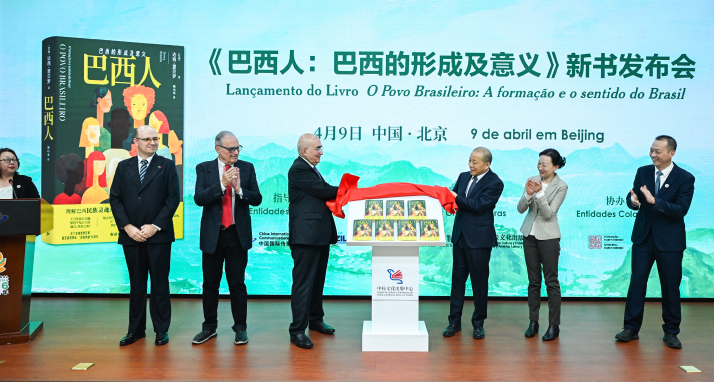 The launch ceremony of the Chinese-language edition of O Povo Brasileiro: A formação e o sentido do Brasil (The Brazilian People: The Formation and Meaning of Brazil) in Beijing on April 9 (WEI YAO)
As China and Brazil jointly celebrate 2026 as their Year of Culture, a profound literary bridge is being built across hemispheres. The Chinese-language edition of O Povo Brasileiro: A formação e o sentido do Brasil (The Brazilian People: The Formation and Meaning of Brazil), a monumental work by the late Darcy Ribeiro, has officially arrived in China, offering a deep dive into the soul of a nation as it grappled with its identity. Ribeiro, a legendary figure in 20th-century Brazil, is celebrated as one of the country's most influential thinkers, educators, writers and politicians. He dedicated three decades to writing this seminal book.
Attending the release of the Chinese edition on April 9 was part of the first China visit by José Ronaldo Alves da Cunha, President of the Darcy Ribeiro Foundation, and Gisele Jacon de Araújo Moreira, the foundation's Vice President and a respected anthropologist, beginning in Beijing. In an interview with China Hoje, a Portuguese-language journal published by China International Communications Group Center for the Americas, they discussed not only the book's critical importance in defining Brazil's national character but also their anticipation for their journey through the country. "This visit is the realization of a dream," Alves da Cunha said. "Walking in a park, observing the culture, feeling the atmosphere of this land; everything touched me deeply." Their three-week journey also took them to Shanghai, Suzhou in Jiangsu Province, Xi'an in Shaanxi Province and Macao Special Administrative Region. Adding a layer of local insight is Rafael Zerbetto, a Brazilian scholar who has long been a fixture in China and is a recipient of the Chinese Government Friendship Award, the highest honor for international experts who have contributed to China's development. At the book launch, Zerbetto explained Ribeiro's driving force behind O Povo Brasileiro: a determined effort to articulate Brazil's narrative on its own terms, free from the impositions of foreign theories, and to resurrect the silenced voices within its history, particularly those of Indigenous peoples and enslaved Africans. "Darcy Ribeiro dedicated his entire life to this book, a profound testament to his love for Brazil," Zerbetto said.
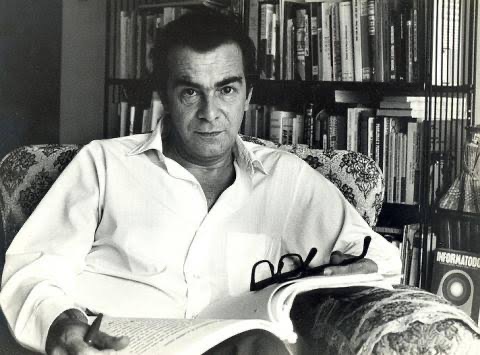
Darcy Ribeiro (1922-97), author of O Povo Brasileiro: A formação e o sentido do Brasil (The Brazilian People: The Formation and Meaning of Brazil) (COURTESY PHOTO) A new people
First published in 1995, O Povo Brasileiro is widely heralded in Brazil as the definitive guide to the country's national identity. Moreira succinctly articulated the book's core inquiry, a persistent puzzle that vexed Ribeiro: "Why has a country as vast and creative as Brazil remained mired in backwardness and inequality for so long?" Moreira's explanation of Ribeiro's approach underscores his multifaceted exploration of Brazil's genesis. "This book explains the gestation of a people, the Brazilian people," Moreira said. Ribeiro's central thesis posits Brazilians as a "new people," a vibrant amalgamation born from the fusion of Indigenous, African and Iberian cultural strands. This synthesis, she emphasized, was a tumultuous process, fraught with violence and hardship, yet it is precisely this confluence that has forged a singular national identity. Ribeiro characterizes Brazilians as a people open to the future and still in a state of construction. "We do not have a past to revere, but we possess our own cultural instruments for building the future we desire," Moreira said. Alves da Cunha shared a detail of particular interest to Chinese readers: His burgeoning fascination with the works of the celebrated Chinese writer Lu Xun (1881-1936), who helped usher Chinese literature into the modern era with short stories such as The True Story of Ah Q and A Madman's Diary. "I have become a devoted reader of Lu Xun, whom I previously knew nothing about," he said. "Now, reading his works and learning about his life, I am deeply captivated." This personal connection is part of a dynamic literary exchange, with leading Brazilian intellectuals engaging with modern Chinese literature, while Chinese readers, through works like O Povo Brasileiro, gain a more intimate understanding of Brazil's history and national spirit. When questioned about the value of dedicating time to introducing the formation story of Brazil to a distant land, Alves da Cunha offered a compelling perspective, "This book shortens distances. It transforms what would be a vast geographical divide into the intimacy of a neighborhood." Zerbetto, in his endorsement, cut to the chase, "Reading this book is a cultural enrichment. You need to understand different perspectives, different worldviews; that is the purpose of literature. When you encounter different viewpoints, it alters you, prompts you to question what you know and allows you to understand the world more profoundly." 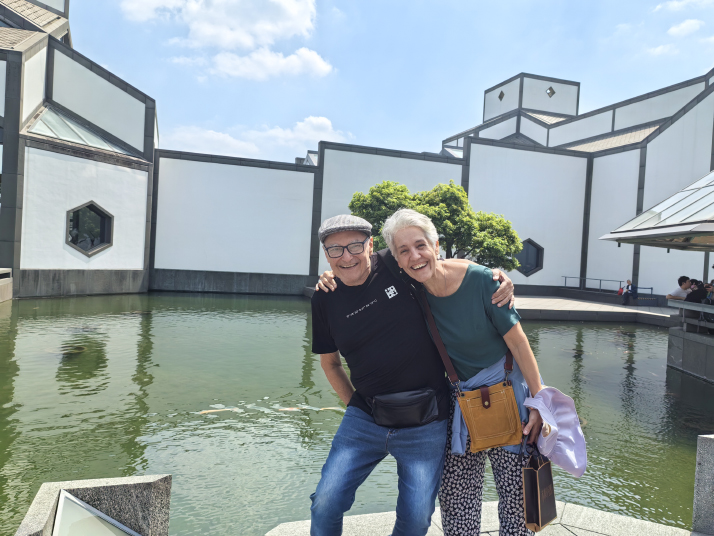 Ronaldo Alves da Cunha (left), President of the Darcy Ribeiro Foundation, and Gisele Jacon de Araújo Moreira, the foundation’s Vice President, visit the Suzhou Museum in Suzhou, Jiangsu Province, in April (COURTESY PHOTO)
Cultural proximity In 2026, China and Brazil will launch a series of activities to mark their Year of Culture, a designation that goes beyond a diplomatic gesture and serves as a recognition of the vital role culture plays in fostering genuine connection. "Cultural proximity is the most intimate, sensitive and respectful connection that can exist between different peoples," Alves da Cunha said. He added that the Chinese translation of O Povo Brasileiro is timely, and allows Chinese readers to perceive Brazil not merely as an economic partner but as a civilization rich with its own distinct cultural narrative. Zerbetto, with his extensive experience living in China, added another crucial dimension. He observed that much of the literature on Brazil available in China originates from American or European authors—"that is, from those who colonized us, those who view the Global South through their own lens. Our own voices, our own ways of presenting ourselves, are absent." He argued that translating Brazilian classics, allowing Chinese readers to hear Brazil speak for itself, is the very foundation for an equitable dialogue. This sentiment was echoed by Alves da Cunha's call for cultural respect, which begins with the fundamental act of allowing others to articulate their own narratives. O Povo Brasileiro, unlike many historical accounts, pulsates with an optimism for what lies ahead. Alves da Cunha underscored this forward-looking spirit, emphasizing, "This book contains a will for the future. This will for the future is our capacity for self-transformation, our ability to take our destiny into our own hands, both individually and collectively." His hopes for the younger generation, who carry the weight of the future, are deeply humanistic. "The most important thing for young people today, both in China and Brazil, is to have a good perspective on life. I believe that, even without grand missions, living peacefully and ethically and having good relationships with others are at the core of what all peoples who desire peace truly want," he said. Zerbetto, reflecting on the potential for mutual learning between the two civilizations, returned to their core national characteristics. "Brazil is a civilization in construction, thus more open to what comes from outside; China is a civilization established over millennia, with a more traditional organization," he noted. "Yet, both face the same challenge: how to absorb beneficial external elements without losing their own characteristics." With the China-Brazil Year of Culture now underway, the dialogue between these two nations is in the spotlight. The release of O Povo Brasileiro in Chinese not only presents a vivid portrayal of a complex and forward-looking Brazil to Chinese readers but also allows figures like Alves da Cunha and Moreira to experience firsthand the depth and inclusivity of China. In this burgeoning encounter of civilizations, two nations separated by vast oceans are working to become neighbors. This, perhaps, is the most fundamental reason to pursue mutual cultural learning. (Print Edition Title: Civilizations in Construction) Copyedited by G.P. Wilson Comments to yanwei@cicgamericas.com |
|
||||||||||||||||||||||||||||
|