
|
| World |
| China-U.S. relations: toward more balanced engagement | |
|
|
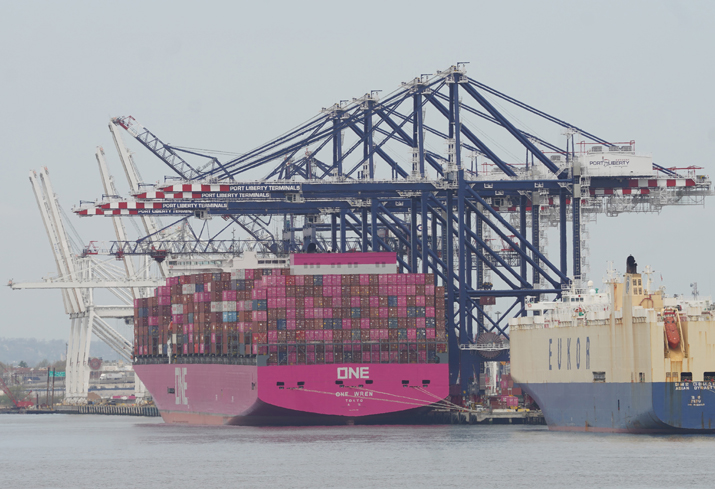 A loaded ship at a container terminal at the Port of New York and New Jersey, which serves as a critical gateway for trade and a major logistics hub for the northeast of the U.S., in New York on April 15 (XINHUA)
Nine years after his first state visit to China, U.S. President Donald Trump concluded his second trip to the country on May 15. According to Wang Dong, a tenured professor at School of International Studies, Peking University, Washington now appears to have adopted a markedly more pragmatic and urgent agenda. The era in which the United States could unilaterally dominate the agenda and "hold all the cards" is gone. China-U.S. relations are shifting from a pattern of "one side pressuring and the other responding" toward a more balanced and mutually dependent framework. Both sides increasingly recognize that dialogue must be conducted on an equal footing and that consensus must be mutually beneficial, an important sign that major-country coordination is returning to rationality.
The following are edited excerpts of Wang's exclusive interview with Beijing Review:
From unilateral dominance to balanced interaction
At the leaders' meeting in Busan, the Republic of Korea, last year, the U.S. still sought to maintain a position of dominance in setting the agenda. This time, however, Washington has taken the initiative to push forward dialogue and shown a clear sense of urgency on issues ranging from trade to regional security. This is not merely a tactical adjustment, but rather the inevitable result of changes in the international landscape and the evolving balance of power between China and the United States.
China and the United States are deeply interdependent. Neither side can any longer unilaterally dictate rules or impose conditions on the other. Equal consultation and mutually beneficial cooperation have become the foundation for relations between major countries.
Upholding the red line
The Taiwan question remains the most important and sensitive core issue in China-U.S. relations and constitutes a red line that cannot be crossed. The U.S. should genuinely adhere to the one-China principle and the three China-U.S. joint communiqués issued in 1972, 1978 and 1982, matching words with actions and ceasing efforts to hollow out or distort its one-China policy.
The United States should establish verifiable and enforceable guardrails for behavior: clearly opposing "Taiwan independence" separatist activities, halting arms sales to Taiwan and ending the upgrading of official U.S.-Taiwan exchanges. China remains firmly committed to the prospect of peaceful reunification, which is in the best interests of people on both sides of the Taiwan Straits and most conducive to peace and stability in the region. The United States should support peaceful reunification through concrete actions rather than emboldening separatist forces or fueling division.
Technology competition
China-U.S. technological competition is fundamentally a contest over systems and rules, and Washington's strategy of limited engagement and targeted suppression is becoming increasingly difficult to sustain. Although a comprehensive easing of tensions in the technology sphere remains unlikely in the short term, partial de-escalation and clearer boundary management are entirely possible.
Recently, the U.S. Treasury Department placed several Chinese companies on its "Specially Designated Nationals" list over alleged involvement in Iranian oil transactions. This move is part of a long-standing pattern of unilateral sanctions and improper extraterritorial jurisdiction by the United States. In response, China's Ministry of Commerce invoked the Rules on Counteracting Unjustified Extraterritorial Application of Foreign Legislation and Other Measures, ordering that the U.S. sanctions not be recognized, enforced or complied within China. China's use of the rules is a legitimate act of self-defense aimed at safeguarding its sovereignty and lawful interests.
Should China and the United States reach understandings on technology controls, it could help reduce fragmentation and instability in global innovation chains and prevent the world from splitting into isolated technological blocs.
International issues
The Trump administration remains deeply entangled in the Iran conflict and urgently needs diplomatic channels to ease tensions surrounding the Strait of Hormuz. In this context, China's constructive role on the Iranian nuclear issue has become indispensable. However, China has consistently rejected transactional diplomacy or the exchange of principles for concessions.
The Iran issue concerns regional peace and the global non-proliferation regime and should be resolved politically under the framework of the UN Charter and international law. China and the United States can coordinate on issues such as maritime security and regional de-escalation, but Beijing will not trade concessions on core interests or international principles in exchange for economic gains. Linking unrelated issues together is neither feasible nor in the common interests of the two countries.
Restoring mechanisms
The most likely early breakthrough will be the restoration of crisis-management mechanisms, including military-to-military communication channels, diplomatic and security consultations and macroeconomic policy coordination.
The core value of institutionalized communication is not necessarily the elimination of differences, but rather the prevention of misunderstandings, miscalculations and unintended conflict. Such mechanisms cannot remove competition, but they can place competition "inside a cage," keeping major-country relations fundamentally stable and preventing escalation out of control.
A pragmatic path forward
A look back at the history of China-U.S. relations shows periods of broader tension have often still allowed breakthroughs in relatively low-sensitivity areas such as people-to-people exchange, counternarcotics cooperation and environmental protection. Ahead of the meeting between Xi and Trump, both sides signaled willingness to cooperate on issues such as fentanyl control and climate action.
Areas such as fentanyl control and cultural exchange--issues with lower political sensitivity but broader consensus--are the most likely to produce tangible results. Though seemingly modest, these "small but practical" forms of cooperation can help rebuild trust, accumulate goodwill and stabilize the broader atmosphere, creating conditions for negotiations on more sensitive issues such as trade and technology. Using low-sensitivity areas to break the ice and relying on functional cooperation to stabilize major-country relations are the most pragmatic path toward steady and sustainable China-U.S. ties.
Copyedited by G.P. Wilson
Comments to liwenhan@cicgamericas.com
|
|
||||||||||||||||||||||||||||||
|