|
| World |
| A retired American teacher returns to China after 26 years to find a forest, and a friend | |
|
|
|
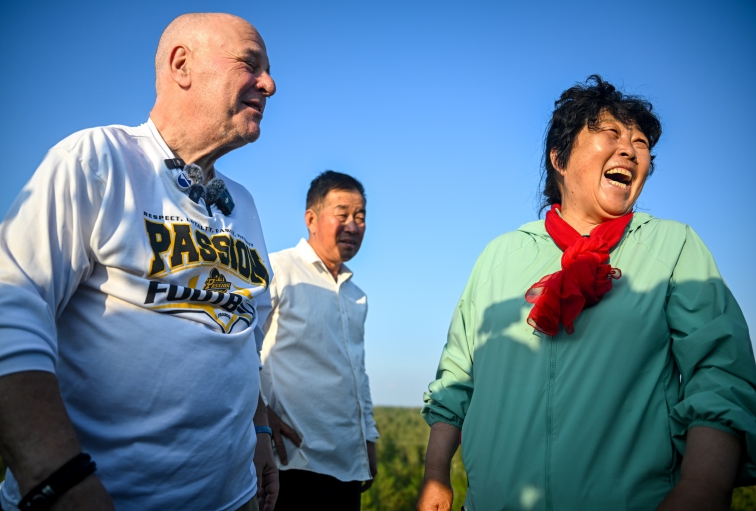
Yin Yuzhen (right), Bai Wanxiang and Ronald Sakolsky visit Maowusu sandy land in Inner Mongolia Autonomous Region on August 24 (XINHUA) On August 24, the courtyard of Yin Yuzhen's home in Uxin Banner, Ordos, Inner Mongolia Autonomous Region, was prepared for a reunion 26 years in the making. Ronald Sakolsky, a retired American teacher from Pennsylvania, had brought Yin a Pittsburgh Steelers scarf and baseball hat. As he helped her put them on, he explained that winters in the sandy land could be cold and that he hoped they would keep her warm. Yin had also spent weeks preparing gifts for Sakolsky: homemade mooncakes, roses grown on the once-barren land and a piece of cross-stitch embroidery that took her more than two months to complete. The embroidery showed a dove embracing Earth beneath the words "One Earth, One Dream." "Although we come from two different countries, we live on the same Earth," Yin said. Sakolsky first came to China through a school teacher exchange program in the late 1990s. What began with an American teacher watching a television report about a Chinese woman planting trees in the desert, eventually grew into a friendship between two families that has lasted for more than a quarter of a century. Their story is one of the many people-to-people connections that have continued to link China and the United States through education, local exchanges, sports, historical memory, cultural programs and personal friendships. In recent years, students, teachers, athletes, local officials, descendants of wartime friends and ordinary families from both countries have continued to meet and reconnect. Chinese President Xi Jinping has repeatedly said the hope of China-U.S. relations lies in the people and that their future depends on the youth. More than 50,000 young Americans have visited China for exchange and study programs since the launch of the 50,000 in Five Years initiative in 2023. A donation that took root While teaching English in Luoyang, Henan Province, in 1999, a television report introduced Sakolsky to Yin, who had already spent years planting trees in Maowusu, a sandy land covering more than 42,200 square km in northwest China, with her husband, Bai Wanxiang. For Yin, desertification was not a distant environmental issue. Strong winds could once bury the entrance to the family's dugout home, while sand found its way into their food and drinking water. "I honestly cannot tell you what moved me by Ms. Yin's story," Sakolsky told Beijing Review. "All I know is that I got very, very excited and I began crying because it was such a touching story." He eventually raised $5,000 for Yin and her husband. The money was used to buy saplings, and those saplings later grew into more than 50,000 trees. Sakolsky later traveled to Maowusu and planted a tree with Yin. At the time, he was not convinced the small saplings could survive in such harsh conditions. He recalled that he had even told Yin, "This is impossible." Yet Yin continued planting. Over more than four decades, Yin and her family have planted trees across more than 46 square km. For years, Sakolsky and Yin lost direct contact. This May, Yin recorded a video in the forest and invited him to return to China to see what had grown from the money he had sent. The video circulated widely online, and the two were reconnected within little over a day. "When Ms. Yin called me and we spoke once again, I teared up," Sakolsky said. "Twenty-seven years later, I am talking to this hero of China. And she has even gone so far as to learn a little English to be able to speak to me. She is truly a sister to me, as I can only hope that I can be a brother to her." He said the story still seemed improbable even to him. "A simple teacher from Pittsburgh, Pennsylvania, sees a story about a simple desert-dwelling lady beautifying China, and together they create this magnificent forest. This is a story written in Hollywood, not a reality. But Ms. Yin and I are experiencing this magnificent moment." Returning to the tree On the afternoon of August 24, Yin took Sakolsky back into Maowusu. A new granite monument had replaced the original brick marker bearing his Chinese name. Beside the monument, Sakolsky bent down and drew an "S," a tree, a heart and the word "Yin." He then filled a glass jar with sand from the site, saying he wanted to take it home as a reminder of the connection between the two countries and the people who had become part of his life in China. Yin and her husband then led him to the tree they had planted together during his first visit. In an old photograph, the sapling was little more than 1 meter high. This time, Sakolsky found a tree more than 10 meters tall and stretched his arms around its trunk. The group recreated the photograph they had taken more than two decades earlier, before planting several new Mongolian Scots pines nearby. "I never thought I would see her again," Sakolsky said after arriving in Ordos. Yin, meanwhile, had asked her children and other family members to return home for the reunion. "I want my children and grandchildren to remember it," she told Xinhua News Agency. More channels for exchange Sakolsky's return to China came against a wider backdrop of renewed exchange at different levels. On August 25, the third China-U.S. Track 1.5 Dialogue was underway in Beijing. "Track 1.5" diplomacy generally refers to discussions that bring together government officials participating in an unofficial capacity and non-governmental experts, creating a channel that is less formal than official government-to-government diplomacy but more closely connected to policymaking than purely non-governmental exchange. Wang Huning, Chairman of the National Committee of the Chinese People's Political Consultative Conference, the top political advisory body, met with the U.S. delegation the day before. He said China is ready to work with the U.S. to implement the consensus reached by the two heads of state, foster correct mutual understanding, respect each other's core interests, strengthen practical cooperation and properly manage differences. The U.S. delegates said the bilateral relationship is at a special juncture and also called for expanding people-to-people and cultural exchange. In April, China and the U.S. marked the 55th anniversary of Ping-Pong Diplomacy. In April 1971, a U.S. table tennis team delegation became the first Americans to visit China in decades. The historic trip was the beginning of what later became known as Ping-Pong Diplomacy, which helped lay the groundwork for the establishment of official diplomatic relations between the two countries. Throughout June and July, a series of youth exchanges brought young people from both countries into direct contact. These initiatives were anchored by the historic legacy of Kuliang in Fujian Province, a hillside retreat where expatriates built summer villas in the late 19th century, and the Flying Tigers, the American volunteer air squadron that fought alongside the Chinese against Japanese invaders during World War II. Additionally, several sports programs served as dynamic bridges for cross-cultural engagement. Foreign Ministry spokesperson Mao Ning said such activities show that, despite differences, bonds of mutual appreciation and friendship continue to exist between the two peoples. Subnational ties provide another channel. China and the U.S. have developed networks of sister provinces, states and cities, while schools, universities and social organizations continue to organize educational and cultural programs. At the eighth China-U.S. Sister Cities Conference this year, participants from both countries discussed cooperation in areas including urban development, education, culture and youth exchange. Sakolsky's own connection with China began through one of these educational channels. He arrived as a teacher, saw Yin's story by chance, raised money for someone he had never met and later traveled to the desert to plant trees with her. More than two decades later, that teacher exchange has become a friendship extending to their families and younger generations. "I hope the friendship between our two families will last for generations," Yin said during the reunion. Sakolsky expressed a similar hope. He said that he and Yin might be like the trunk of a tree, while younger people were the branches that would continue growing outward and connecting more people. (Tao Zihui contributed to this article) (Print Edition Title: What Grew From $5,000?) Copyedited by Elsbeth van Paridon Comments to liwenhan@cicgamericas.com |
|
||
|
||||||||||||||||||||||||||||
|