
|
| Business |
| TCL founder Li Dongsheng says Chinese manufacturing must expand globally | |
|
|
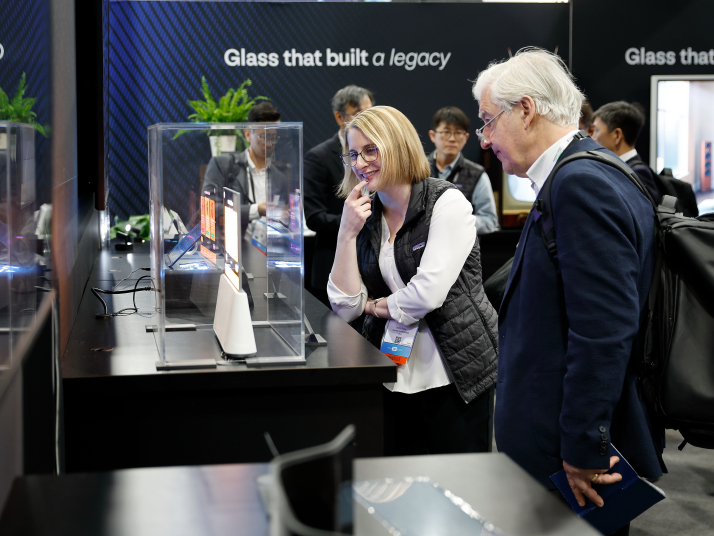 Visitors learn about TCL AiMe, the world's first modular AI companion robot, at the TCL booth during the Consumer Electronics Show in Las Vegas, the U.S., on January 8 (XINHUA)
Li Dongsheng, founder and Chairman of TCL, has spent more than four decades transforming the company from the small audio cassette manufacturer it began as in 1981 into a multinational company with its business scope spanning consumer electronics, display technology and clean energy, operating in more than 160 markets. Through this journey, he has not only witnessed Chinese manufacturing's rise up the global value chain, but also played an active role in driving it. On the sidelines of the 2026 Summer Davos, also known as the World Economic Forum's Annual Meeting of the New Champions, in Dalian, Liaoning Province, on June 24, Li spoke to Beijing Review reporter Peng Jiawei about innovation at scale and why Chinese manufacturers must move beyond exports to build deeper roots in overseas markets. Edited excerpts of their conversation follow: Beijing Review: Under the theme of Innovating at Scale, this year's Summer Davos highlights a critical global priority. How do you view China's progress in driving and scaling innovation? Li Dongsheng: The country's capacity for innovation has grown substantially. In the past, innovation in China was often about breakthroughs at specific points in the technology chain. Today, it is increasingly about breakthroughs across entire industries. Previously, much of the advancement was concentrated at the application end. Now it extends further upstream, into basic material and the broader industrial ecosystem. As both the depth and breadth of innovation have expanded, innovation itself has begun to generate economies of scale. Manufacturing is a good example. China now leads globally in a range of manufacturing sectors, and innovation has been central to that progress. The semiconductor display industry, in which TCL operates, offers a useful case in point. Chinese companies entered this field only about 20 years ago. Yet in such a sector defined by advanced technology, heavy capital investment and long development cycles, China has emerged as one of the global leaders in a remarkably short time. That transformation was not the result of a single technological leap. It came from multi-dimensional innovation across the industry as a whole: from learning and catching up, to gradually building competitive advantages, and eventually forming scale advantages across the industrial chain. Today, China accounts for more than 70 percent of global LCD display output. That scale, in turn, provides a stronger foundation for continued innovation. The same dynamic is playing out in other industries, most notably in new-energy vehicles (NEV). China's NEV industry did not emerge overnight; it is the result of years of sustained efforts. Its rise shows how innovation in China is increasingly taking place at scale. 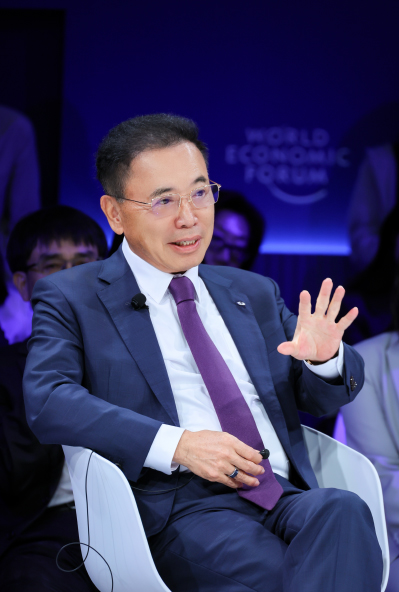 Li Dongsheng, founder and Chairman of TCL, speaks at a panel titled Supply Chains Reborn? during the 2026 Summer Davos, also known as the World Economic Forum’s 17th Annual Meeting of the New Champions, in Dalian, Liaoning Province, on June 24 (COURTESY PHOTO)
Chinese manufacturers have long built scale through exports. But as supply chains become more fragmented, how should Chinese companies rethink their global strategies? One thing I'd like to note is that China is not simply trying to maximize its trade surplus. The annual China International Import Expo (CIIE) is a case in point: It is designed to open the domestic market and encourage imports. (The CIIE, launched in 2018, is the world's first national-level expo dedicated to imports—Ed.) As Premier Li Qiang noted in his speech at the opening plenary of this year's Summer Davos, China's imports grew by about 20 percent in the first five months of 2026, which outpaces the export growth rate over the same period. (Data released by China's Ministry of Commerce show that exports rose by 11.8 percent during the period—Ed.) The future of Chinese manufacturing is unlikely to rest simply on shipping ever more goods abroad. As I have often mentioned, China must move beyond merely exporting products and toward co-creating ecosystems in which all partners can develop their industrial capabilities. Chinese manufacturing exports reached a staggering $1.9 trillion last year. But relying on product exports alone will become increasingly difficult. Chinese firms must increasingly anchor their industrial and supply chains directly within their host markets. Only then will they find greater room for growth. The many shifts underway in the global economic landscape also require us to restructure our supply chains—not because we wish to, but because the rules that underpin global commerce are changing. Supply chains were once judged mainly by efficiency: How swiftly and how cost-effectively goods could move through them. Efficiency remains essential. But it is no longer sufficient. Security, stability and resilience now matter too. The COVID-19 pandemic and trade frictions have exposed the fragility of highly specialized production systems. Companies that can make their supply chains more secure and reliable will therefore be better able to cope with changing circumstances. For Chinese manufacturers, this entails establishing localized operations with a relatively high degree of autonomy. These operations should not revolve around Chinese firms alone, but should foster a collaborative local industrial ecosystem. Chinese companies need to be firmly rooted in the markets where they operate and contribute more visibly to local economic and social development. That is also what a shifting global economic landscape now demands: growth that is more balanced, more localized and more widely shared. This is the direction TCL has been pursuing. We have five major overseas business regions: North America, Latin America, Europe, Asia-Pacific, and the Middle East and Africa. Our goal is to turn each regional branch into a standalone business entity. Since conditions differ across these regions, each of them will adopt a tailored organizational form. Take Latin America as an example. The region is far from a single market. Trade rules differ sharply from one country to another. In many of its big markets, barriers to entry are high and local production is a necessity. We are still trying to work out the solutions. But the direction is clear: TCL, like other Chinese manufacturers, must adapt to the reshaping of the global economy. What will the next chapter of globalization look like for Chinese manufacturers? Globalization remains an opportunity for Chinese manufacturers. The question is not simply whether globalization is good or bad. It is whether a company has the ability to achieve its global ambitions. Seen from a broader perspective, Chinese manufacturing may need a different way of thinking about its future. The question is no longer only how much manufacturing should contribute to China's gross domestic product (GDP). It is also how much Chinese manufacturing—especially the manufacturing capacity of large companies—can contribute to China's gross national product (GNP). (GDP measures the value created within a country's borders, regardless of whether it is produced by domestic or foreign companies. GNP measures the value created by a country's companies and citizens, regardless of where in the world that value is produced. In this context, shifting the focus from GDP to GNP means looking beyond how much manufacturing remains physically located in China, and also examining how much value Chinese manufacturers can generate globally through overseas operations—Ed.) This is not a new path. Many developed economies have gone through a similar transition: Their manufacturers now create far more value around the world than they produce within their own borders. Chinese manufacturing is likely to follow a similar trajectory. And that is closely tied to our globalization strategy. If we can localize our supply chains and build more regionalized operations, we will be in a much better position to balance our global investments. The country's economic development has reached a stage where this kind of mindset shift has become necessary. (Print edition title: From Routes to Roots) Copyedited by G.P. Wilson Comments to yanwei@cicgamericas.com |
|
||||||||||||||||||||||||||||
|