
|
| China |
| Fostering new industries for a robust economy | |
|
|
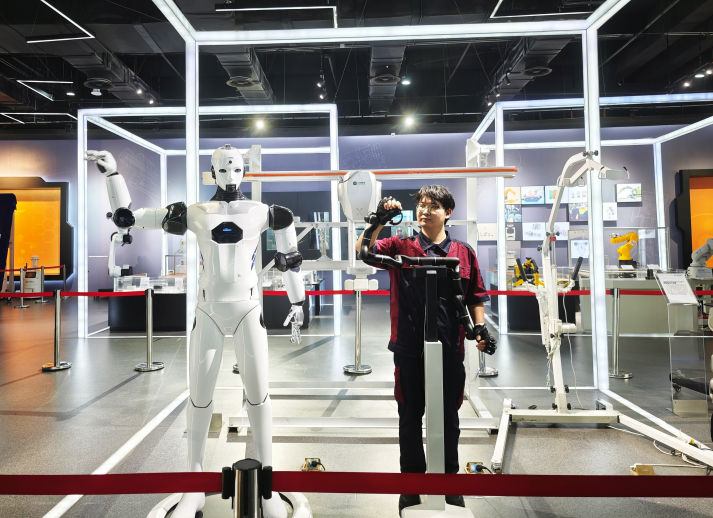 A staff member gives a demonstration of a humanoid robot at the Anhui Innovation Museum in Hefei, Anhui Province, on August 3 (LU YAN)
In August, at the Grand Union of Innovation, a platform in Hefei of Anhui Province, dedicated to incubating innovative enterprises and promoting the commercialization of research achievements, a robot equipped with a small black box was demonstrating a series of movements based on real-time computation. Standing beside it was 24-year-old Bai Yinqi, a second-year master's student in AI at the University of Science and Technology of China (USTC), and co-founder, CEO and CTO of Baize Tongjing Technology Co. Ltd.
This small box is the embodied intelligence "brain" developed by the Baize Tongjing team, which focuses on developing world models in AI, models that have an understanding of the laws governing their environment and "how their world works." "When we usually see robots dancing or performing, they mostly rely on pre-programmed routines, and that's more like the robot's 'cerebellum,'" Bai explained to Beijing Review. "A world model is like the robot's whole 'brain.' By receiving environmental images and learning the laws of physics, it helps the robot independently judge what to do next. If the model merely memorizes the trajectory of a falling apple, it may fail when the object becomes an orange, a banana or a stone; but if it truly learns "gravity," then any object will follow the same law. This is precisely the starting point of his company's entire technical framework. Bai established the company with two other co-founders in June, with a technical team composed entirely of individuals born after 2000. The company name Baize derives from a divine beast said to "comprehend all things," described in the ancient Chinese classic compilation of early geography and myth The Classic of Mountains and Seas. Though only a few months old, the company has already been valued at over 300 million yuan ($45 million) at its first funding round. This young person's entrepreneurial story reflects a deeper change taking place in China's future industries: Cutting-edge technology, talent, policy ecosystems and industrial demand are all growing simultaneously in the same soil. 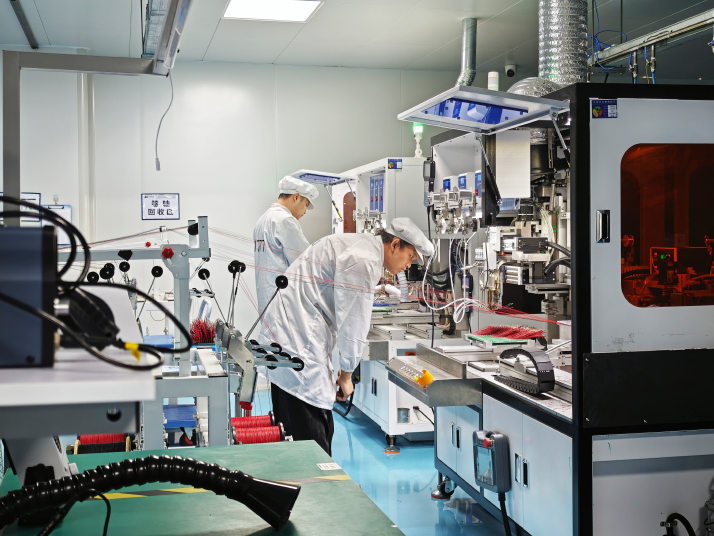 Technicians work at the factory of a semiconductor company in Lu’an, Anhui, on August 7 (LU YAN) Venture into the future Future industries are new industries integrated with advanced technologies, such as humanoid robots, brain-computer interfaces and quantum information. A government guideline released in January 2024 called for efforts to develop signature products, enrich application scenarios and optimize industrial supporting systems for future industries, with a particular focus on six key fields including manufacturing, information, materials, energy, space and health. Bai's company operates at the intersection of embodied intelligence and intelligent robotics. "World models are still in a period in which different technical routes are being explored in parallel and no single approach has emerged as the definitive leader," Bai said. For young researchers, this uncertainty is both a challenge and a rare opportunity. As an undergraduate at USTC, he was one of 108 students selected for the inaugural National Natural Science Foundation of China Young Student Basic Research Project. Continuing to a doctoral degree or joining a leading tech company would both have been excellent choices. But Bai said he believed that if he waited until after completing a Ph.D., the window for world models might have already closed. "World models ultimately won't be born from papers, but from the real world," he said. Bai added that if financing goes smoothly, the team will continue to improve its world model training data system, accelerate model iteration, and carry out data collection and application validation in real industrial scenarios, so that this "robot brain" can move faster toward practical application. 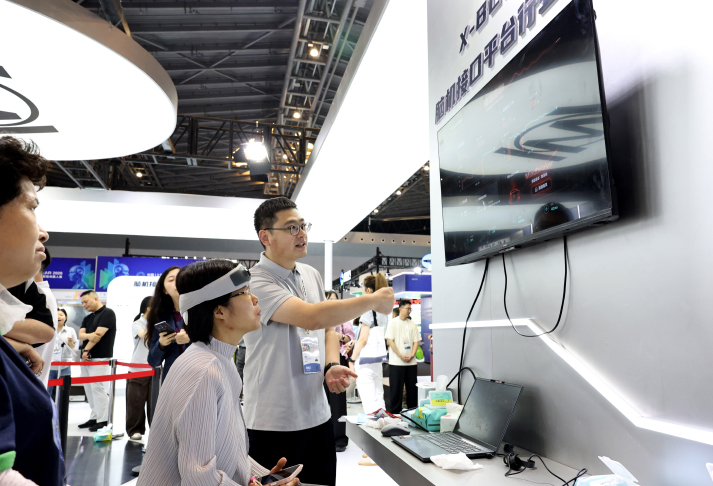 A staff member explains to visitors how to use a wearable brain-computer interface device at the 12th China (Shanghai) International Technology Fair in Shanghai on June 11 (XINHUA)
Home for innovators Moving from the laboratory to the market is never easy. Baize Tongjing relies on the Grand Union of Innovation's ecosystem and has moved into the Kepiao Station, a platform from which the company can receive support such as office space and industrial resource connections. Kepiao means "science and technology drifters," referring to researchers and tech entrepreneurs who come to Hefei from other places, without local roots, looking for opportunities. And Kepiao Station is thus a "waystation for tech drifters," a landing point where these incoming researchers can get free temporary housing, office space and other support while they decide whether to settle in Hefei and build their companies there. In the early stage of starting a business, teams can use talent apartments and office workstations free of charge for 15 days. If they decide to stay, they can receive up to six months of support during the launch period; and better-performing companies can also receive rent-free office space of up to 300 square meters for up to 12 months. The station's core philosophy is "We only collect dreams, not rent." "Tech startup teams generally face two major challenges in the early stage of landing: first, high office and living costs, which create heavy pressure at the start; second, unfamiliarity with the local environment and a lack of channels for resource connections. That's why this distinctive service platform came into being," said Wu Dan, Secretary General of the Anhui Association for Science and Technology and Industry Integration and Innovation, a main operator and service provider of the station. Hefei now has 10 such stations in operation. Wu said the station and his association focus on three things: connecting people, connecting money and building platforms and real-world scenarios. The station uses big-data matching and a database of high-level talent profiles to connect tech startups with the right people. Fei Hongfei, founder of Hefei Xiaobei Zhiyan Technology Co. Ltd., is one of the beneficiaries of the Kepiao Station's services. Founded in 2024, the company focuses on the application of large AI models. Fei was formerly deputy director of operations at a leading domestic AI company, where he witnessed the entire journey of large models from the lab to industrialization. Explaining why he chose to start his own business, he said: "Large AI models create the most value not as general-purpose tools, but when they are adapted to specific industries or niches. However, small and medium-sized enterprises lack the ability to apply them. We want to be an 'AI translator,' so the technology truly reaches the demand side." In the early days of his startup, Fei looked at other major tech hubs like Shanghai and Hangzhou before ultimately choosing Hefei. Beyond the fact that Hefei is his hometown, a key reason was the Kepiao Station. Fei summed up his startup project in a business plan, with clear short-, medium- and long-term goals and a list of the help he needed. "After reading my plan, within two days the staff at the station came to me and offered six months of free office space," he said. And so, Fei began his "startup experience" there in March 2025. To connect supply and demand, you first need to put yourself out there and raise your visibility. In April this year, Fei wanted to organize a themed salon on large-model applications and invite companies to attend. Where should he hold it? Where could he rent professional equipment? He had meant only to ask, but once he spoke up, the station took care of everything. "The station arranged the venue and equipment for the salon, and even prepared bottled water for each guest," Fei said. The salon was a success, drawing heads of relevant departments from big firms such as Sungrow Power Supply and iFlytek. "Being seen is a form of encouragement for entrepreneurs like me," he said. Building an ecosystem Anhui, a rising tech hub, has been working to attract talent in the industries of the future and help them thrive. Kepiao Stations are just one example. The province has also rolled out an action plan to better connect government, industry, academia, research, finance, services and end users. The plan promotes collaboration across these areas, linking research with industry, application, funding and services, while strengthening both the role of companies and government support. Together, these measures give universities clear direction and a solid institutional foundation for turning their research into real-world results. Over the past three years, Anhui has revamped more than 4,000 specialty programs to keep pace with emerging industries like integrated circuits, AI, quantum technology and new energy. It has also approved provincial-level modern industry colleges, about 86 percent of which serve emerging industries. These efforts are part of a broader national push. China's six major emerging pillar industries, namely, integrated circuits, aviation and aerospace, biomedicine, the low-altitude economy, new types of energy storage and intelligent robots, had a combined output value approaching 6 trillion yuan ($895 billion) in 2025, and this is expected to expand to over 10 trillion yuan ($1.49 trillion) by 2030, according to statistics from the National Development and Reform Commission. Specifically, in quantum communication, China holds a globally leading share of technology patents and has successfully built a 300-km fully connected quantum direct communication network. In invasive brain-computer interface technology, China has become the second country in the world to enter clinical trials. In sixth-generation mobile communications, China has moved from technology accumulation toward preparation for industrialization. On the local level, official statistics show that more than 60 provincial-level future industry pilot zones have already been established across the Beijing-Tianjin-Hebei, Yangtze River Delta and Guangdong-Hong Kong-Macao Greater Bay Area regions. Provinces and cities are taking differentiated approaches based on their local strengths: Beijing has organized its future industries into three tiers based on technology maturity, while Shanghai is focusing on quantum technology, brain-computer interfaces and controlled nuclear fusion. Zhejiang has cultivated 36 provincial-level pilot zones covering hydrogen energy, flexible electronics and the low-altitude economy. However, there's still a long way to go before China's future industries can fully meet their need for talent. Data from recruitment platform Zhaopin.com for the second quarter of 2026 show that positions with year-on-year growth in demand and existing shortages are concentrated in areas driven by new quality productive forces. Clinical research and trial roles in biomedicine, for instance, grew 38.2 percent year on year, with a demand-to-supply ratio of 4.82, nearly five openings for every job seeker. AI engineers, chip engineers, and electronics, electrical and automation engineers are also in short supply. "The speed of industrial development exceeds the speed of talent cultivation, and job requirements are changing faster than workers can update their skills," Li Qiang, Vice President of Zhaopin Group, told Outlook Weekly magazine. Zhang Jun, a member of the Chinese Academy of Engineering, said he believes future industries often grow out of scientific discoveries and technological explorations that are not yet fully mature. Yet in practice, what tends to get noticed, assessed and showcased most readily are things like industrial park construction, project implementation, company recruitment and the opening of application scenarios. When some localities plan for future industries, their first questions are whether a technology is viable, whether projects can be landed, and whether an industrial park can take shape quickly, while paying less attention to the underlying basic science, key technology roadmaps and foundational capacity support. Moreover, for many key technologies, the journey from a laboratory breakthrough to stable application requires long-term theoretical refinement, process optimization, reliability verification, and the maturing of supporting industries. A laboratory result does not automatically become an industry, nor does a prototype mean market competitiveness. Many frontier achievements are not stuck on "whether they can be made," but on "whether they can be made reliably, at scale and sustainably." "Developing future industries hinges on placing basic research in a more prominent position, and nourishing industrial development with sustained, source-level innovation," Zhang wrote in an article published by Qiushi Journal in June. (Print Edition Title: Seeds of the future) (Reporting from Anhui Province) Copyedited by G.P. Wilson Comments to luyan@cicgamericas.com |
|
||||||||||||||||||||||||||||||
|