
|
| China |
| The foundation of future progress | |
|
|
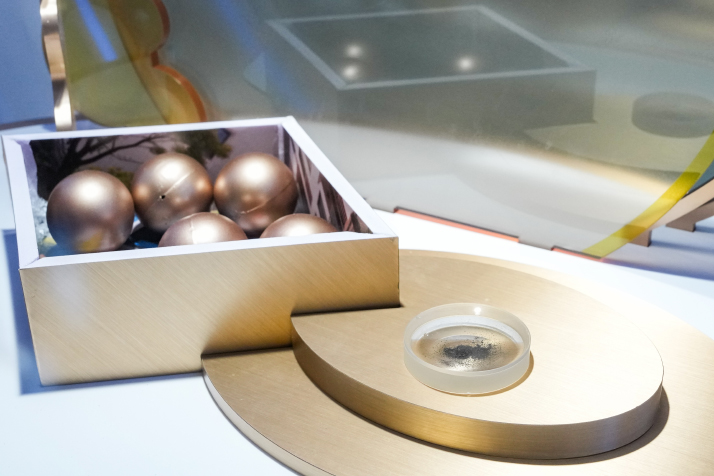 Lunar soil samples brought to Earth by the Chang’e-6 mission on display at a space science exhibition held as part of the 11th China Space Day in Chengdu, Sichuan Province, on April 24 (XINHUA)
In the grand architecture of national development, basic research stands not merely as a component of scientific enterprise, but as the primary source for all technological progress and the bedrock of a nation's sovereign strength. History has shown that every major industrial and societal transformation has been ignited by fundamental discoveries. The classical mechanics system paved the way for the steam engine, sparking the First Industrial Revolution; British physicist and chemist Michael Faraday's law of electromagnetic induction catalyzed the invention of the electric generator, fueling the Second Industrial Revolution; and British mathematician and logician Alan Turing's computational theory laid the groundwork for the electronic computer, ushering in the information age. In an era defined by rapid technological shifts and intensifying global competition, China has elevated scientific and technological innovation to the core of its national strategy. The leadership recognizes that achieving high-level self-reliance in science and technology is the only viable path to realizing the rejuvenation of the Chinese nation and securing a position at the forefront of the global scientific community. During an April symposium on strengthening basic research in Shanghai, President Xi Jinping called for greater efforts and more concrete measures to strengthen basic research, enhance the nation's capacity for original innovation, and further solidify the foundation for building the country's strength in science and technology. Over the past decade, China has made historic leaps in basic research, transforming its scientific landscape from one of quantitative accumulation to one of qualitative transformation. 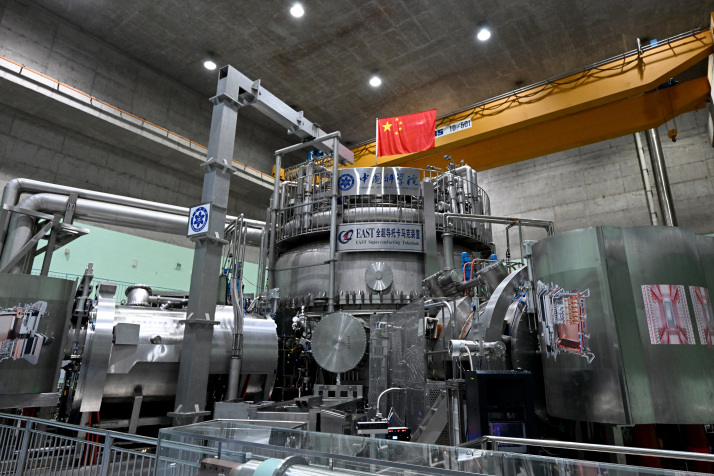 The EAST (Experimental Advanced Superconducting Tokamak), a large-scale facility for controlled nuclear fusion that has achieved steady-state operation at 100 million degrees Celsius, in Hefei, Anhui Province, on January 15, 2025 (XINHUA)
An innovation surge The country's top 10 scientific advances of 2025 reflect this profound shift. The list includes the Chang'e-6 mission's return with lunar rock samples, which are reshaping our understanding of the moon's formation and evolution, and the EAST (Experimental Advanced Superconducting Tokamak), a large-scale facility for controlled nuclear fusion that has achieved steady-state operation at 100 million degrees Celsius. These breakthroughs, showcased at the 2026 Zhongguancun Forum Annual Conference in Beijing in March, represent the culmination of basic research achievements during the 14th Five-Year Plan (2021-25) period. These achievements are grounded in basic research and demonstrated progress in this regard. The success of these projects underscores the effectiveness of China's broader strategic focus, which has propelled its research institutions into top-tier global rankings and fueled a consistent rise in scientific output. Seventy-two tertiary institutions from the Chinese mainland are listed in the QS World University Rankings 2026, published in June last year, the third highest globally, behind only the United States and the United Kingdom. Over 1,500 of the world's top universities, from over 100 countries and regions around the world, were included in the 2026 edition of the rankings. The 2026 Nature Index Research Leaders rankings, released in June, shows that China remains the world's leading contributor to research output. Published regularly by an institution under Springer Nature, the Nature Index is widely regarded as one of the world's key indicators for measuring research contributions. It is based on a database that tracks high-quality research output across 82 selected natural science journals, ranking institutions and countries by their contributions. Among the seven subject areas covered by the Nature Index, China ranked first globally for research contributions in physical sciences, chemistry, biological sciences, applied sciences, and Earth and environmental sciences. This momentum is mirrored in patent filings; according to a report issued by the World Intellectual Property Organization in November last year, China led the world with 1.8 million patent applications in 2024, followed by the United States (501,831), Japan (419,132), the Republic of Korea (295,722) and Germany (133,485). 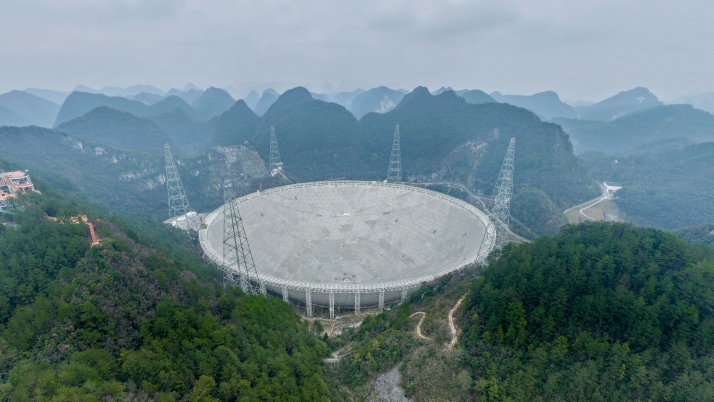 The Five-Hundred-Meter Aperture Spherical Radio Telescope, or FAST, the world’s largest single-dish radio telescope, in Qiannan Bouyei and Miao Autonomous Prefecture, Guizhou Province, on January 16 (XINHUA)
Policy and funding support This progress is the result of stable, long-term policy support. Financial support has seen a massive increase, with the share of government funding for basic research rising significantly within total research and development (R&D) expenditure. Guangdong Province, for instance, has mandated that at least one third of its provincial-level fiscal special funds for science and technology be allocated to basic research, while Jiangsu Province has established dedicated funds for basic research and continues to ramp up its investment. These regional efforts reflect a broader national trajectory: According to the National Bureau of Statistics, from 2012 to 2025, China's total expenditure on basic research surged from approximately 49.9 billion yuan ($7.4 billion) to nearly 280 billion yuan ($42 billion). Simultaneously, the share of basic research within the nation's total R&D spending increased from 4.8 percent to 7.08 percent. Optimizing the support system is essential for encouraging researchers to explore with single-minded focus. In a May 2021 address, Xi said it is critical to prioritize fundamental reforms such as improving the evaluation system, adhering to an orientation that centers on quality, performance and contribution. He delivered the address at a meeting combining the general assemblies of the members of the Chinese Academy of Sciences and the Chinese Academy of Engineering, and the National Congress of the China Association for Science and Technology. Following this guidance, eight departments, including the Ministry of Science and Technology, issued the Work Plan on Pilot Reform of Evaluation for Sci-Tech Experts in 2022. The goal of the two-year pilot program is to explore different evaluation indexes and methods for sci-tech professionals engaged in different types of innovative activities, thus improving mechanisms for identifying, training, using and motivating those professionals, so that they can better serve national sci-tech innovation. The plan prioritized the innovation value, competency and contribution of experts, instead of only considering their education background, the number of research papers they have published, or the prizes they have won. International collaboration remains another pillar of this progress. In December 2025, a batch of critical components for the International Thermonuclear Experimental Reactor, an experimental fusion reactor, was completed in Hefei, Anhui Province. As a participant in this global project, which involves over 30 nations, the Institute of Plasma Physics of the Hefei Institutes of Physical Science, under the Chinese Academy of Sciences, maintains close collaborative ties with over 120 other research institutions worldwide. Navigating challenges Despite these achievements, China's basic research landscape still faces systemic hurdles. A critical issue is the gap between the volume of scientific output and the number of truly game-changing original discoveries. Furthermore, while the influx of capital is robust, the current innovation ecosystem still faces structural inefficiencies, including an evaluation system that, in some areas, remains overly focused on short-term metrics like publication counts rather than the long-term, high-impact value of the research itself. To address these shortcomings, China is promoting a two-pronged strategy: "free exploration" and "goal-oriented research." Dou Xiankang, President of the National Natural Science Foundation of China, told People's Daily newspaper: "On one hand, we should vigorously support 'free exploration,' safeguarding scientists' curiosity, particularly about unconventional, high-risk and disruptive ideas, and encourage bold support and tolerance for failure. On the other hand, we need to strengthen 'goal-oriented research,' proactively aligning with industrial, regional and national needs, thereby enabling basic research to truly become the wellspring of new quality productive forces." New quality productive forces are economic drivers based on new technologies such as AI, big data and cleaner energy. "We are implementing differentiated evaluation systems across all projects. For free exploration projects, we prioritize originality and scientific value. For goal-oriented projects, we emphasize practical effectiveness and contributions to solving critical issues," he added. China's continued commitment to basic research is ensuring that it will continue to grow as a cornerstone of global scientific progress, driving innovation that benefits not only its own development but the broader human endeavor. Copyedited by G.P. Wilson Comments to jijing@cicgamericas.com |
|
||||||||||||||||||||||||||||||
|








