
|
| China |
| The wheel moves first | |
|
|
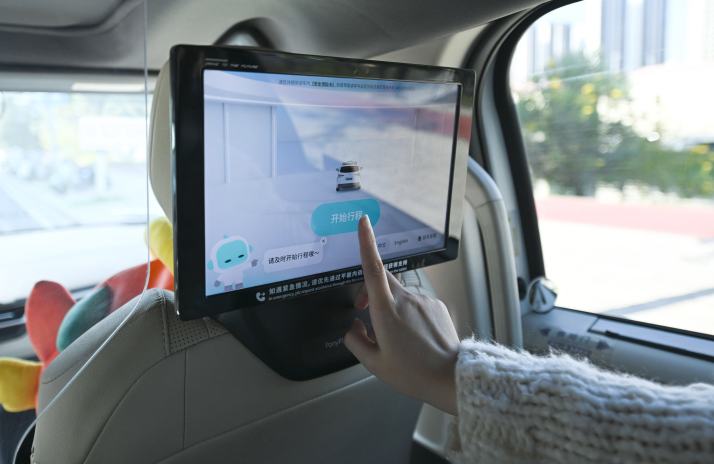 A passenger taps Start Trip inside a commercial autonomous taxi in Nansha District on March 11 (XINHUA)
Sitting on the backseat of a self-driving taxi, the first thing I noticed was the steering wheel. It turned on its own. No human sat in the front seat. It was late August and I was on a work trip to Guangzhou's Nansha District, a pilot free trade zone in Guangdong Province that sits at the heart of the Guangdong-Hong Kong-Macao Greater Bay Area. The district made headlines when fully driverless vehicles began commercial operations there back in 2024, taking autonomous driving off closed test tracks and onto public city streets. So when I was on a business trip in the district, I decided to hail one of China's robotaxis—almost on a whim. A white Pony.ai taxi pulled up—Pony.ai being a major Guangdong-based autonomous driving firm. Its side panels bore the company's blue mascot, and a sensor suite sat atop the roof. The car looked startlingly unremarkable. I opened the door, slid in and fastened my seatbelt. The door sealed shut automatically. The car then began to move. It pulled away from the curb and merged into traffic of this unfamiliar city. Sitting alone in the car, an eerie phrase popped into my head: "Ghost car." This "ghost car" is just one ripple in China's surging wave of autonomous driving. Pilots I had been in one of these driverless cars before. A year earlier, I visited the Beijing Economic-Technological Development Area, also known as Beijing E-Town. The district is famous for its development and deployment of driverless cars and humanoid robots, with driverless sanitation vehicles cleaning streets on pre-set routes, and autonomous minibuses traveling along tree-lined avenues. I rode a driverless car there as part of a reporting trip. Several journalists and staff members shared the ride. We took photos and videos, swapped our observations and wondered about the sight of self-driving cars making their way along Beijing's public roads in the future. Many cities across China now host zones for autonomous vehicle testing and demonstration operations. The complex, real-world traffic environments of Guangzhou, Beijing, Wuhan (Hubei Province) and Shenzhen (Guangdong) serve as training grounds for self-driving systems. Most of these vehicles operate at Level-4 autonomy. Under China's five-level national driving-automation classification, this designation means a car can perform all driving tasks within a defined service area, with no human present to monitor the road or stand ready to take over. They carry LiDAR (the acronym for "light detection and ranging") units on the roof, with cameras and millimeter-wave radars fitted around the body to form mobile sensor arrays. No human driver is necessary as remote safety supervisors track each vehicle in real time and can intervene during rare extreme situations. According to a blue paper on China's autonomous driving large-scale application in 2026, the penetration rate of Level-2 driver assistance in domestic passenger cars has surpassed 70 percent. At this grade, the system controls both steering and acceleration or braking within limited scenarios, while the human driver must monitor traffic nonstop and remain ready to take charge at all times. Urban Navigate on Autopilot, a system that pairs navigation with city-road driver assistance, has surpassed a 20-percent penetration rate, and is spreading to mainstream models priced below 200,000 yuan ($29,820). Robotaxis and unmanned delivery vehicles at Level 4 are operating in regular pilot deployments. For some leading firms, individual vehicles have generated enough revenue to cover operating costs, demonstrating early operational profitability, in selected operating areas. This progress rests on the fast rise of homegrown core components. Domestic LiDAR suppliers hold more than 60 percent of China's market. Intelligent-driving chips from tech titans such as Horizon Robotics and Huawei support use cases from Level 2 up to Level 4. 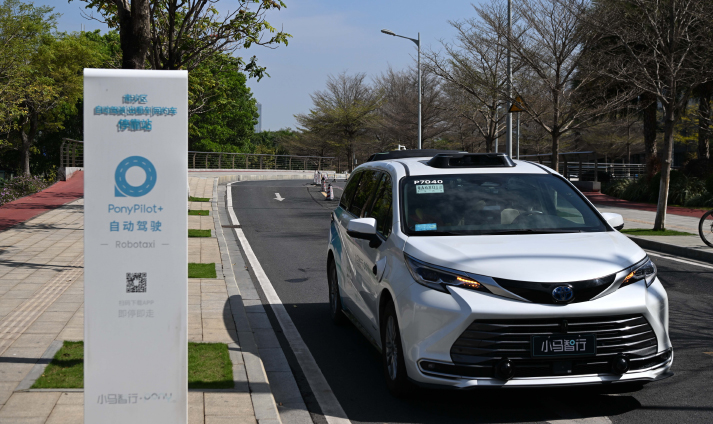 A commercial autonomous taxi sits at a robotaxi stop in Nansha District, Guangzhou, Guangdong Province, on March 11 (XINHUA)
What ifs Inside my taxi at that very moment in Nansha District, the steering wheel continued turning by itself. My attention fixed on a round plastic cover clipped over the steering wheel. I guessed it was put there to stop passengers from grabbing and moving the wheel. To me, it looked just like a cake container. I kept my eyes locked on the wheel moving inside that cake container. It turned slightly left then gently back right. Its movements were smooth, yet my anxiety kept rising. I have driven manual gasoline cars for more than a decade. My first vehicle is nearly worn out. I have been debating whether to switch to an electric car or stick with gas. But right then, instead of analyzing the two options, my mind flooded with a string of "what ifs." What if its radars failed to spot the person riding an electric scooter ahead? What if the large truck beside us suddenly cut into our lane? What if the signal dropped, the system crashed or mud blocked the cameras? Every time we passed another road user, the central screen displayed a live schematic. Nearby cars and pedestrians appeared as moving shapes on the display. It was a clear showcase of advanced technology. Still, I could only think about how the car's cameras captured images and fed them into the system. What if one camera malfunctioned? What if data transmission lagged? The trip spanned only 2.6 km. But inside my head, I lived through an entire disaster movie. I moved between wonder and regret, uncertainty and unease. A quiet sadness settled over me. How did I become someone who's apparently afraid of new technology? I have worked in media for 20 years, with more than a decade centered on new media work. I always thought I kept pace with technological change. I was an early adopter of smartphones, mobile payments and facial recognition. So why did fear come before excitement when I sat alone inside this driverless vehicle? Had age simply made me more cautious? Or had I overestimated how ready I was to embrace technological disruption? The taxi gave me little time for introspection. It glided smoothly to the curb. The screen showed a message: You have reached your destination. Please exit and keep an eye out for surrounding traffic. I had arrived. Safe and sound. Final stop I stepped out and stood on the curb. I looked back at the taxi. It turned on its hazard lights and glided smoothly back into traffic, off to pick up its next customer. A notification popped up on my phone. After a new-user discount, my fare came to 5.6 yuan ($0.83). I tapped the screen to complete payment, and suddenly a sense of absurdity washed over me. None of my worst-case "what ifs" had come true. There was no loss of control. No system crash. No collision with another vehicle. It had simply carried me from point A to point B like a seasoned human driver. In that very moment, a realization settled in. My generation may be going through a unique technological "midlife shift." We grew up in a world without smartphones and now live amid the explosive rise of AI. We still enjoy the tactile control of a manual gearbox and the rumble of combustion engines. Yet we must confront the reality that the steering wheel is slipping out of human hands. What we fear may not be technology itself, but rather the feeling of no longer being needed. But this robotaxi taught me something different. Technology is not built to replace people. It exists to free us from repetitive and stressful tasks. It echoes earlier shifts I have already accepted. I stopped memorizing maps once I began using navigation apps. I left physical wallets behind with mobile payments. Every major technological change brings fear first, before acceptance slowly follows. I had reached my destination safely. And I knew I would hop into one of these driverless taxis again next time I visit Nansha. BR Copyedited by Elsbeth van Paridon Comments to xubei@cicgamericas.com |
|
||||||||||||||||||||||||||||
|