
|
| Voice |
| From secure borders to secure futures | |
|
|
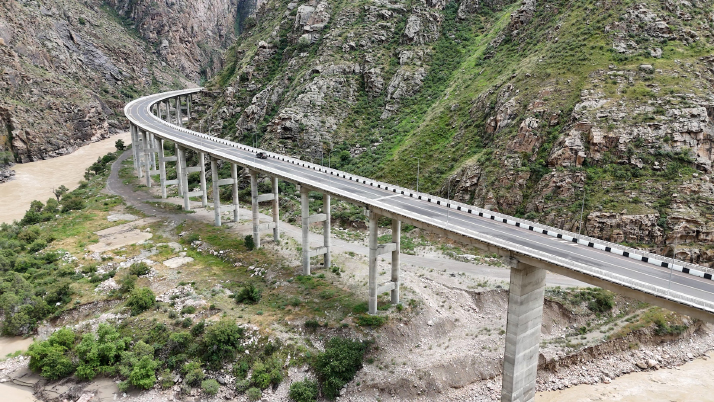 A highway bridge spanning the Naryn River, in Jalalabad District of Kyrgyzstan, on June 2, 2025 (XINHUA)
The state visit of Chinese President Xi Jinping to Kyrgyzstan and his participation in the Shanghai Cooperation Organization (SCO) Summit 2026 in Bishkek marked a key stage in the transformation of Kyrgyzstan-China relations. From August 30 to September 1, Xi attended the SCO summit and paid a state visit to Kyrgyzstan. The visit's significance goes far beyond protocol. In 34 years, Kyrgyzstan-China relations have evolved from resolving border issues and establishing diplomatic contacts into a comprehensive strategic partnership centered on trade, infrastructure, energy, and regional connectivity. Political foundation Kyrgyzstan and China established diplomatic relations in January 1992. The first decade after that focused on creating a stable legal and security environment. The 1,096-km border inherited from the Soviet period was particularly sensitive. The two countries signed the principal border agreement in July 1996, followed by a supplementary agreement in August 1999, gradually completing the legal settlement of the frontier. This was strategically important for both sides. For Kyrgyzstan, a newly independent state back then, secure borders were essential to sovereignty. For China, stability along its western frontier was inseparable from the security of Xinjiang Uygur Autonomous Region. China's Torugart and Irkeshtam crossings subsequently became the principal gateways for bilateral trade and wider Central Asian commerce. At the same time, China, Kazakhstan, Kyrgyzstan, Russia and Tajikistan developed the Shanghai Five mechanism, whose 1996 and 1997 agreements on military confidence-building and troop reductions created the institutional foundation for the SCO's establishment in 2001. Good neighborliness The signing of the treaty of good-neighborliness, friendship and cooperation in Beijing on June 24, 2002, gave bilateral relations a long-term legal framework. The agreement covered trade, investment, transport, telecommunications, agriculture, mining, energy and infrastructure, while also strengthening security cooperation. The SCO provided another institutional pillar. Kyrgyzstan became one of the six founding members in 2001, alongside China, Russia, Kazakhstan, Tajikistan and Uzbekistan. During the decade, cooperation increasingly shifted from border security toward economic connectivity. Road infrastructure, particularly the Bishkek-Naryn-Torugart route, became a key channel for Chinese goods entering Kyrgyzstan and neighboring markets. By the end of that first decade, bilateral trade had surpassed $1 billion, demonstrating that China was becoming a structural component of the Kyrgyz economy. Transformation The decisive turning point came after the launch of the Belt and Road Initiative, which aims to boost connectivity along and beyond the ancient Silk Road routes, in 2013. During Xi's same-year visit to Bishkek, the two countries established a strategic partnership, and economic cooperation moved toward large infrastructure projects. The energy sector illustrates the scale of this transformation. The $389 million Datka-Kemin project created a 500-kilovolt (kv) transmission corridor linking Kyrgyzstan's northern and southern power systems and was completed in 2015. The Export-Import Bank of China (China Eximbank) financed the $386 million modernization project of the Bishkek Thermal Power Plant, completed in 2017, which substantially expanded the plant's generating and heating capabilities. Transport infrastructure expanded simultaneously. The 433-km alternative north-south highway was designed at an estimated cost of $850 million, with Chinese financing supporting its major phases. The project was intended to reduce Kyrgyzstan's dependence on the Bishkek-Osh corridor and improve internal and regional connectivity. These projects also changed the financial structure of bilateral relations. China Eximbank became Kyrgyzstan's largest external creditor. Its lending peaked at about $1.9 billion. By June of this year, outstanding debt to the bank had fallen to about $1.414 billion, while Kyrgyz President Sadyr Japarov has said the country intends to repay the remaining Chinese debt in full by 2035. The two countries elevated the relationship to a comprehensive strategic partnership in 2023. The most consequential development is the China-Kyrgyzstan-Uzbekistan Railway, whose construction was officially launched on December 27, 2024. The railway will be 532.53 km long, with about 304 km inside Kyrgyzstan. Current plans envisage 20 stations, while the Kyrgyz section requires roughly 50 bridges and 29 tunnels totaling about 120 km. Thus, almost 40 percent of the Kyrgyz route will consist of bridges and tunnels, a remarkable engineering challenge in the Tien Shan (Tianshan) Mountains. The project will cost about $4.7 billion. In December 2025, Chinese banks agreed to provide about $2.3 billion through a 35-year loan. The remaining $2.3 billion will be equity, divided among the three countries. The railway is expected to transport up to 15 million tons of cargo annually, shorten China-Europe and China-Middle East delivery times by roughly seven days and create a new east-west corridor independent of existing routes. Trade has expanded dramatically alongside this infrastructure. Chinese customs data reportedly put bilateral trade at a record $27.2 billion in 2025. China has also become Kyrgyzstan's leading source of foreign investment. Preliminary 2025 data indicate that Chinese investors accounted for 38.4 percent of total foreign direct investment inflows. Future prospects Green energy is becoming the next frontier. The partnership is gradually moving beyond coal, thermal generation and traditional infrastructure. In 2026, China Energy Engineering Investment Co. Ltd. said it is ready to invest up to $1 billion in Kyrgyz solar and wind projects totaling 700 megawatt (mw)-500 mw of solar and 200 mw of wind capacity. A separate 250-mw solar project in Batken covers 669.3 hectares and is scheduled for completion in 2027. Another important innovation is the Chinese-funded Bishkek waste-to-energy plant. Its first phase processes 1,000 tons of waste daily, with a designed capacity of 3,000 tons, generating approximately 146 million kilowatt-hours annually and reducing carbon dioxide emissions by about 100,000 tons. The next logical step is cross-border electricity cooperation. Kyrgyzstan is considering 220-500 kv transmission links toward Irkeshtam and Torugart, potentially allowing surplus renewable and hydropower generation to reach Xinjiang. Such infrastructure could transform Kyrgyzstan from an electricity-deficit economy into a regional exporter. The future therefore lies in integrating transport, energy, logistics and industrial production. The China-Kyrgyzstan-Uzbekistan Railway can become the backbone for logistics centers, warehouses, manufacturing and agricultural exports; renewable-energy projects can supply new industrial capacity; and the China-Central Asia cooperation mechanism can connect bilateral initiatives with wider regional financing and markets. The strategic meaning of Xi's visit is consequently clear. Kyrgyzstan-China relations have passed through three distinct stages—border stabilization, institutionalization and infrastructure integration—and are now entering a fourth: economic connectivity on a transcontinental scale. Kyrgyzstan no longer faces the question of whether to cooperate with China, but how to convert Chinese capital, technology and market access into sustainable domestic industrialization, export capacity and energy security. If managed effectively, the relationship can become a central pillar of Kyrgyzstan's transformation into a major Central Asian transit and energy hub. The author is former prime minister of Kyrgyzstan, a distinguished professor of the Belt and Road School at Beijing Normal University and author of the book Central Asia's Economic Rebirth in the Shadow of the New Great Game (2023) Copyedited by G.P. Wilson Comments to dingying@cicgamericas.com |
|
||||||||||||||||||||||||||||
|








