
|
| Xinjiang Today |
| Greater harvests on the horizon | |
|
|
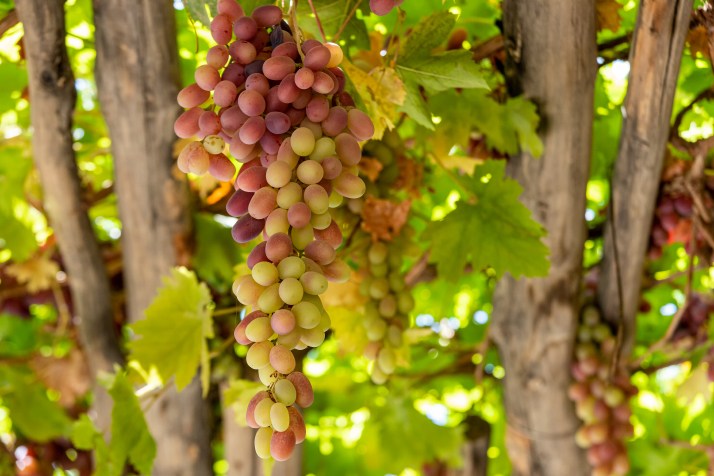 A vineyard in Tulufan (Turpan) on August 28, 2019 (VCG)
September ushers in harvest season across the lands north and south of the Tianshan mountains.
In an orchard in Tuokexunyakoutan Village, Aqiatage Township, Wushi County, Aksu Prefecture, farmers are busy picking walnuts still wrapped in their green husks. Plump nuts carpet the drying yard and the villagers' faces light up with undisguised delight. In the high-standard rice fields of Sikeshu Town, Wusu City, Tacheng Prefecture, spanning more than 660 hectares in all, combine harvesters move back and forth, reaping, threshing and loading in a single pass. Full mechanization saves both time and labor. High-standard farmland refers to cultivated land that is typically well-equipped with facilities and can ensure stable and high yields. In a 13.3-hectare demonstration cotton field run by the agricultural science institute of the Second Division of the Xinjiang Production and Construction Corps (XPCC), the plants stand in neat rows, bolls full. No farmhands are in sight, only a multispectral drone gliding along a preset route, surveying the entire field in under 20 minutes. The XPCC is a highly organized paramilitary force, combining the functions of production, administration and defense. "The weather has been favorable this year and the rice is growing well. We expect about 7.5 tons per hectare," Luo Yongju, a farmer from the town's Hadashengbulege Village, said. "The town has built high-standard farmland with complete irrigation networks. It gives us real confidence for next year's harvest." From cotton fields to orchards to vast grain bases, scenes like these embody what it means for Xinjiang to serve as a national supply base for high-quality agricultural and livestock products. That designation is rooted in the region's distinctive natural endowments: abundant sunshine, vast tracts of land and a relatively dry climate, all of which make Xinjiang ideal for cotton, grain, fruit trees and animal husbandry. For the region itself, it means expanding agricultural output through modern farming, food processing and industrial upgrading, creating jobs, revitalizing rural areas and forging closer ties with markets at home and abroad. With the destination set, how will the course be charted? On September 10, as the harvest came into view, the region held a press conference to map out its top-level design for agricultural development and rural revitalization during the 15th Five-Year Plan period (2026-30), unveiling its priorities for the farm sector. 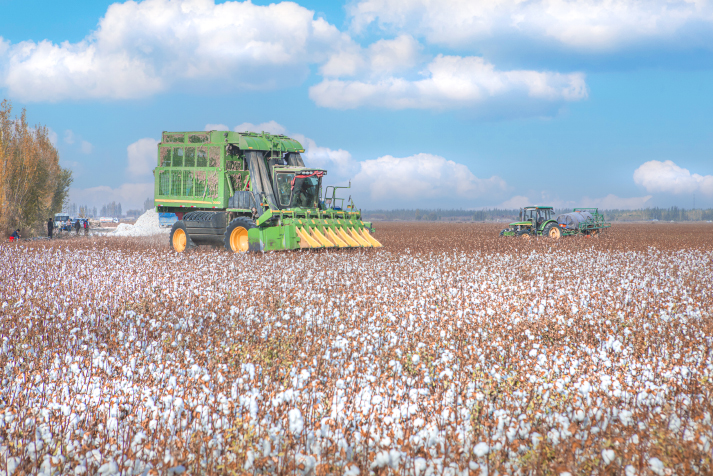 Mechanized long-staple cotton harvest in Aksu Prefecture on October 20, 2021 (VCG)
New targets The figures released at the press conference speak to the confidence behind this "granary of west China." During the 14th Five-Year Plan period (2021-25), Xinjiang lifted its cumulative grain output by 8.49 million tons, the largest increase in the country—a leap that has turned Xinjiang from a self-sufficient region into a net grain exporter for the country. Looking ahead to the 15th Five-Year Plan period, its ambitions have grown even clearer. By 2030, Xinjiang aims to become, in large part, a major national supply base for high-quality agricultural and livestock products. The targets set out at the press conference are highly specific: high-quality grain output is expected to reach around 26 million tons, with more than 5 million tons shipped out of the region each year; premium cotton is set to hold steady at about 5.6 million tons, with high-quality cotton accounting for over 50 percent of the total; premium fruit output is projected to stay at roughly 15.5 million tons, with market-grade rates above 86 percent and annual supplies to domestic markets nearing 10 million tons. Total meat production is expected to exceed 2.35 million tons, while milk output should remain stable at around 1.7 million tons. Annual shipments beyond Xinjiang are planned to top 150,000 tons of beef and 200,000 tons of dairy products. Behind these figures lies Xinjiang's drive to build further on its natural advantages and a measure of its rising weight in China's food and farm-produce supply chain. 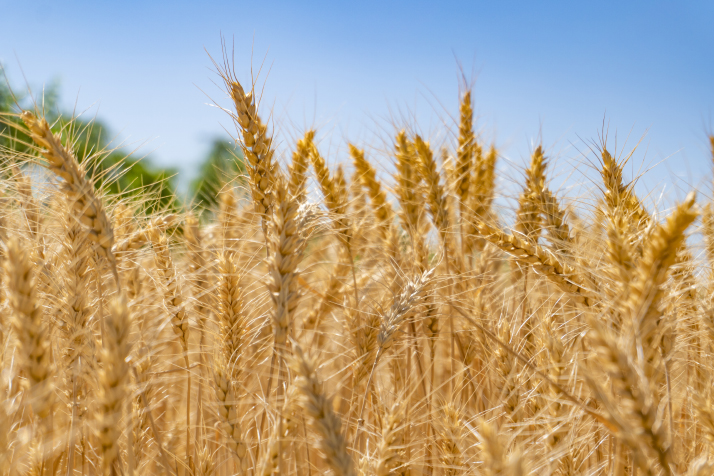 Wheat fields in Kashi (Kashgar) Prefecture on June 5, 2021 (VCG)
Land, seeds and drones How will these targets be met? Xie Yingzhou, head of the Department of Agriculture and Rural Affairs of Xinjiang, laid out five approaches at the press conference. At their core lies a single idea: getting more out of limited resources. First, Xinjiang will strengthen farmland protection and integrated land use. The region will continue to coordinate the protection of farmland quantity, quality and ecology, while improving saline-alkali soil, gradually restoring abandoned farmland, and making scientific use of non-arable land, including Gobi and desert areas, for facility agriculture and specialty crop cultivation. Second, it will advance high-standard farmland construction. Guided by standards for leveled fields, irrigation and road access, and by improvements in soil fertility, yield and efficiency, Xinjiang plans to develop modern farmland suited to mechanized farming, resilient to drought and flooding, and capable of delivering stable, high yields. Third, it will accelerate the development of a modern seed industry base. Xinjiang will expand national-level seed production bases for wheat, corn and cotton, building a more concentrated and specialized seed industry to support both higher output and better quality. Fourth, it will develop new quality productive forces in agriculture tailored to local conditions. Xinjiang plans to advance smart agriculture by promoting drones, the Internet of Things and robotics, while cultivating smart farms, ranches and fisheries. Fifth, it will improve disaster monitoring and early-warning systems at the regional, prefectural and county levels, promote green pest-control measures, and strengthen agricultural disaster prevention and mitigation to help safeguard stable harvests. The transformation underway in Tacheng's cotton fields offers a glimpse of how high-standard farmland and full mechanization are reshaping agriculture. Set along the middle reaches of the Tianshan's northern foothills, Tacheng is one of north Xinjiang's major cotton-producing areas. According to the Bureau of Agriculture and Rural Affairs of Shawan City, local cotton planting has already reached roughly 109,710 hectares this year, with mechanized operations accounting for more than 99 percent of all farming activities. From planting and field management to harvesting, nearly every stage has been mechanized. Thirty-five-year-old cotton farmer Lu Dewen has been especially busy these days. Working 100 hectares of cotton, he bought a cotton picker in 2022 capable of harvesting around 1.3 hectares an hour. By late September, even before turning to his own fields, he had already filled his schedule with orders from farmers near and far, some extending as far as south Xinjiang, thousands of kilometers away. Gazing at his cotton picker with a look of anticipation, Lu said, "Going forward, whether it's expanding to more fields or pushing for even better yields, there's still plenty of potential to tap." The weight of quality "'Dinosaur eggs' were a rare fruit just a few years ago. Now they're grown in many places. So how do we hold on to our market? Our secret is quality," Tang Dailong of Aksu Jindian Trading Co. Ltd. told news portal Tianshannet on September 23. "Dinosaur egg" is the local nickname for the pluot, an apricot-plum hybrid. To grow fruit of the highest quality, the company built its plantation at the foot of Mount Tuomuer in the Tianshan range, where the trees are watered by snowmelt and tended under expert guidance, yielding "dinosaur eggs" that are large and uniform, with fine, sweet, juicy flesh. So how can Xinjiang shore up its reputation for quality on a larger scale? The answer set out at the press conference spans the entire supply chain—from source control and standardized production to regulation and traceability. At the source, Xinjiang will promote high-yielding, high-quality, stress-resistant crop varieties suited to mechanized harvesting, while continuing to cut the use of fertilizers, pesticides and plastic mulch. At the standardization stage, it will refine breeding and grading standards across product categories, using standardized production to ensure consistent quality. On the oversight front, it will close the loop from farm inspections and random sampling to risk screening, enforcement and penalties, and fully implement a certification system under which producers guarantee that their edible agricultural products meet national standards. One line from the press conference carried particular weight. As Xie put it, "We should make quality the most distinctive hallmark of Xinjiang's farm products." From a single pluot to an entire industry, from one field to a brand, it is at once a promise and a path. With the implementation of the 15th Five-Year Plan, there is a palpable confidence in Xinjiang's potential to become one of China's finest granaries, orchards, ranches and fisheries—putting more of its grain into the nation's rice bowls, bringing more of its distinctive flavors to dinner tables across the country, and carrying more of its premium agricultural and livestock products from this northwestern frontier to markets nationwide and beyond. Comments to xiangyuting@cicgamericas.com |
|
||||||||||||||||||||||||||||
|