
|
| Xinjiang Today |
| Everyday life tells the story | |
| Overseas visitors encounter Xinjiang culture beyond stereotypes | |
|
|
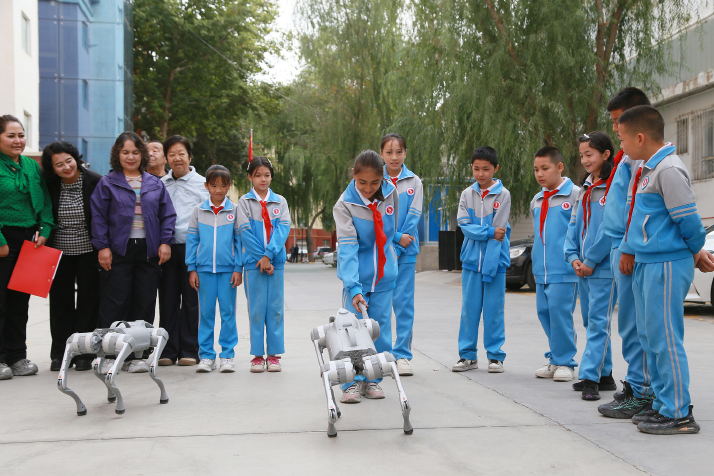 Visitors interact with robot dogs outside the science museum at Wenming Community in Awati Town, Awati County, Aksu Prefecture, on October 1 (VCG)
From a spontaneous dance at the iconic Xinjiang International Grand Bazaar in Urumqi to a robot dog monitoring greenhouse crops, two media professionals discover stories that transcend Xinjiang's scenery. Kushairi Bin Abang of Malaysia and Al Mamun Harun Ur Rashid of Bangladesh explore connections between cultural traditions and modern development through bustling markets, language classrooms and agricultural technology. Their accounts reveal how tradition lives on in daily life, from music and handicrafts to ancient irrigation systems, while documenting encounters that challenged their initial impressions. Through these personal perspectives, they invite readers to look more closely, listen carefully and see the people behind the landscape.
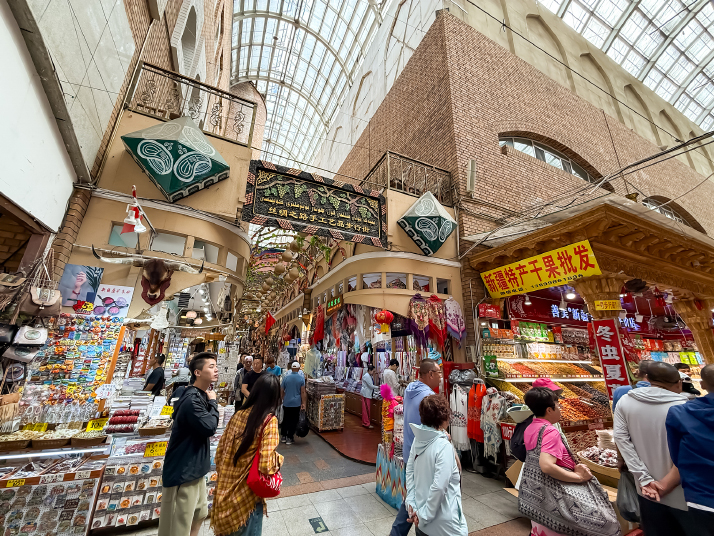 Tourists at the Xinjiang International Grand Bazaar in Urumqi on September 4 (VCG)
Kushairi Bin Abang, CEO of the Sarawak Media Group in Malaysia The scene I most wanted to film in Xinjiang was not a landmark. At the Xinjiang International Grand Bazaar in Urumqi, Uygur merchants bargained fluently in standard Chinese, Kazak girls danced spontaneously in the square, and Han Chinese tourists captured the moments on their phones. Different communities occupied the same frame, sharing the rhythms of an ordinary day. For me, that was where the story began: not with geography, but with people. As a media professional from Sarawak, Malaysia, I look for a story's emotional center. Here, I found it in families sharing lunch, young people wearing traditional dress with pride and elders sitting together playing Muqam (a traditional art of the Uygur ethnic group that combines songs, dances, and folk and classical music—Ed.). These were the scenes I wanted audiences back home to see. Perhaps my own background made Xinjiang feel unexpectedly familiar. In Sarawak, indigenous longhouses, sape music and rainforest traditions are part of our cultural identity. In Xinjiang, music, dance and the bustle of bazaars offered a different expression of something I recognized: heritage carried through everyday life. The landscapes were unlike home, but the relationship between people and culture felt similar. Over five days, I experienced Urumqi's modern urban pace, Tulufan (Turpan)'s layers of history and Tacheng's cross-border vitality. Each offered a different perspective. Together, they challenged my tendency to understand Xinjiang principally through its vast landscape. What interested me most was how people live within it, making a living, sustaining traditions and connecting with visitors. For Malaysian travelers, that combination of cultural richness and culinary variety holds a particularly strong appeal. The Xinjiang International Grand Bazaar brought those relationships into focus. Handicrafts stood beside livestreaming booths run by young entrepreneurs. Traditional medicinal tea stalls faced shops selling imported chocolates. I recognized something of the markets in Kuching and Sibu, where commerce and social life meet. Here, too, culture was neither separate from business nor confined to a display case. It was part of the working economy. For me, those neighboring stalls offered a concrete way to think about development. Traditional products and new forms of selling occupied the same marketplace. Rather than treating heritage and modern enterprise as opposites, I could see them operating side by side, each offering a story worth following. Tulufan added another dimension. The Jiaohe Ancient City Ruins, one of the best-preserved ancient earthen cities that was strategically located along the ancient Silk Road dating back 2,300 years, drew my attention to the lives and civilizations that preceded us. The Karez Wells system, an impressive feat of hydraulic engineering and a cultural achievement with a history of more than 2,000 years, uses underground waterways to divert water by gravity—demonstrating how infrastructure can embody knowledge of the land. Its adaptation to an arid environment reminded me of the knowledge Sarawak's indigenous communities have passed down through generations in their relationship with the rainforest. One encounter at the grand bazaar in Urumqi stayed with me. A stall holder introduced her lavender soaps to foreign tourists in fluent English, speaking with ease and warmth. It was a small exchange, but it gave openness a human face. Such moments deserve attention without being asked to prove more than they can. Five days cannot provide a complete account of a region, and a welcoming encounter cannot represent everyone's experience. That distinction matters to me as a journalist. Firsthand observation should add detail to our understanding, not replace one simplified picture with another. The people I encountered were not abstractions: They were merchants, musicians, families and entrepreneurs. Their daily lives belong in the story, alongside the context needed to understand them. I returned thinking about the phrase "unity in diversity." What gave it meaning for me was that scene in the square: different languages, a spontaneous dance and people sharing a public space. I would not reduce Sarawak to a distant image of jungle or remote Borneo. Xinjiang deserves the same care. My strongest impression was not of a place explained completely, but of people worth listening to more closely. 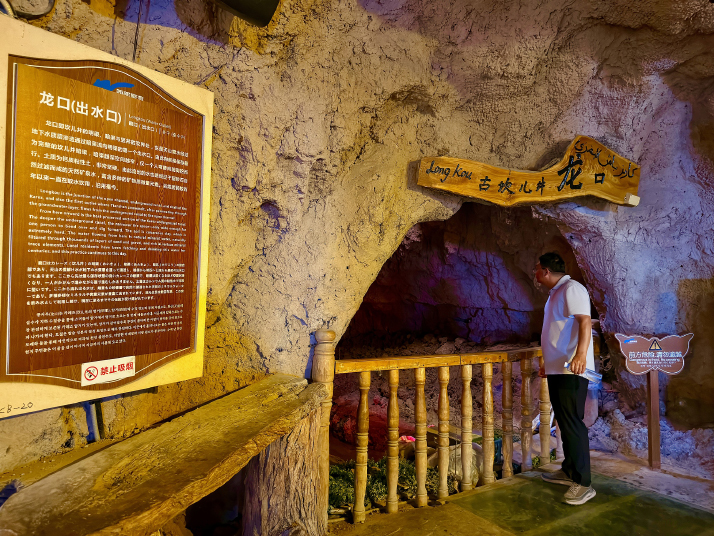 A tourist visits a Karez well site in Tulufan (Turpan) on July 12. Museums, displays and other attractions at the site showcase the ancient irrigation system's principles, techniques and cultural heritage (VCG)
Al Mamun Harun Ur Rashid, a Bangladeshi journalist and diplomatic correspondent of the English daily The New Nation From the aircraft window, I saw glass and steel beneath the snow-capped Tianshan Mountains. Arriving in Urumqi in May, I found a skyline quite different from the desolate landscape I had imagined. That first impression stayed with me: Xinjiang was no longer only a subject of international reporting. It was a place I could begin to observe for myself. As a journalist, I had arrived conscious of the geopolitical tensions surrounding the region. My journey brought another perspective into focus: expanding urban infrastructure, university classrooms, agricultural technology and a marketplace where cultural traditions met commerce. These were parts of Xinjiang that deserved attention, without being asked to explain everything about it. Across Urumqi, the pomegranate appeared repeatedly as an official symbol of ethnic unity. Its closely packed seeds offer a memorable image of what the local government describes as a shared future. I found myself returning to that metaphor while considering the relationship between cultural identity, education and economic opportunity. At Changji University, which was founded in 1959 and located in Changji, a city west of Urumqi, I visited Uygur language classes. The experience gave a concrete setting to questions about cultural preservation. Here was language being taught, not simply invoked as an abstract idea. It gave me something specific to report: Uygur language teaching at this university formed part of the educational landscape I encountered. An exhibition marking Xinjiang Uygur Autonomous Region's 70th anniversary of founding presented another perspective on unity. One prominent image shows the Uygur farmer Kurban Tulum shaking hands with Chinese leader Mao Zedong in 1958. The exhibition used his story to connect personal memory with national history. At the Xinjiang Agricultural Expo Park, which is located in Changji and opened to the public in 2011, the focus shifted from historical images to working technology. A robot dog moved through greenhouses, monitoring plant growth and leaf conditions. Vegetables grew without soil in a controlled environment. Among all the scenes of the trip, this was one of the clearest examples of development taking a form I had not expected. Yan Ji, the operations director, explained the approach, "We are using smart technology together with AI applications to make agriculture even smarter." His description connected the demonstration to a practical task: using information about plants to guide their care. Infrastructure, in this setting, meant more than buildings. It included the systems supporting food production. The Xinjiang International Grand Bazaar offered a different kind of activity. Architecture, traditional cuisine, handicrafts and entertainment brought several dimensions of local culture into one place. I was struck by how naturally a visitor moved between them. The bazaar made cultural exchange tangible through the everyday business of buying, selling and discovering something unfamiliar. Food gave that experience another point of connection. The region's varied cuisines drew my attention to shared ingredients and dining customs as well as distinctive traditions. Cultural diversity is not only something to describe in broad terms; it is something a visitor can encounter through a meal and the setting around it. Leaving Urumqi, I returned to the pomegranate image. Within the broader Chinese family, every "seed" in the pomegranate is being directed toward a shared future. It seems that shared prosperity is the ground upon which Xinjiang is being built for the future generation. What remained most vivid, however, were the particular places behind the symbolism: a language classroom, a greenhouse and a bazaar. They gave my understanding texture. Comments to zhaowei@cicgamericas.com |
|
||||||||||||||||||||||||||||
|