
|
| Xinjiang Today |
| Sharing the best of Xinjiang | |
|
|
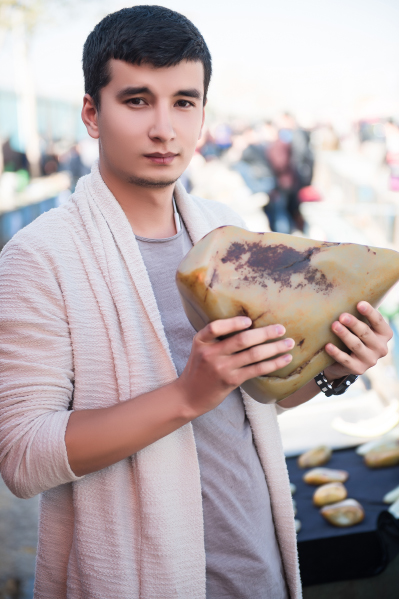 Abulikemu Aibibula poses for a photo holding a piece of raw jade (COURTESY PHOTO)
Abulikemu Aibibula's story
When I was in college, I started thinking about how to make money and how to become a successful entrepreneur. However, my background presented a challenge: Growing in Hetian (Hotan), the southernmost city in Xinjiang, and attending an ethnic school, I was not proficient in standard Chinese language. (Ethnic schools are specially established schools that mainly enroll ethnic minority students, receiving additional state support in teachers, funding and facilities—Ed.) I figured I should lean into what I'm good at. I love socializing and making friends. So why not try my hand at being a tour guide? My logic was simple: Most people who travel have seen the world, so perhaps they could teach me a thing or two about life. Additionally, they might even buy some Hetian jade along the way and I could practice my standard spoken Chinese with them. (Hetian is historically renowned for its jade, especially the prized "mutton-fat" white variety, valued for its fine texture and warm luster—Ed.) Seeing it as a mutually beneficial opportunity, I kept posting on forums, offering free guided tours to anyone visiting Hetian. My efforts paid off. A woman surnamed Wu from Guangdong Province reached out, saying she wanted to bring her five-year-old son to Hetian for an in-depth trip. I was a little surprised. Back then, due to some false rumors, Xinjiang was painted as "a scary place." As a result, tourism was in the dumps and most people outside the region were hesitant to visit. But Wu didn't just visit. She bought me a plane ticket from Urumqi to Hetian. I was really touched and determined to show her the real Hetian and help her get to know the local culture. 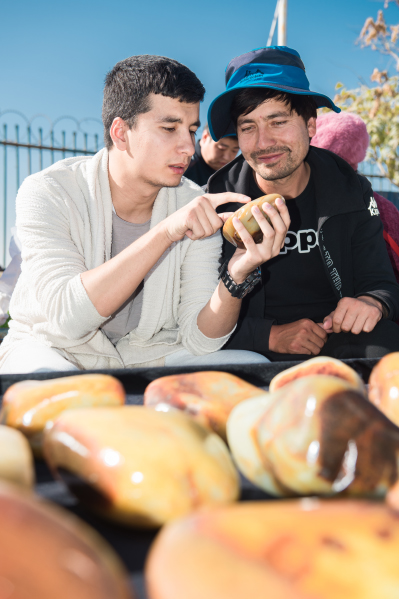 Abulikemu Aibibula (left) assesses a piece of Hetian jade with a friend (COURTESY PHOTO)
I took her to a friend's wedding in Yutian County. It was buzzing, everyone singing and dancing, while she and I just sat there grinning, since neither of us was much of a dancer. After that I took her to a relative's home in the countryside to try kumaiqi, a traditional Uygur baked flatbread stuffed with mutton and onions. We also sampled every kind of fruit in the orchards of local villagers. She asked me, "Do you have to pay for eating fruit from a neighbor's tree? I don't want to cause trouble." But that question had never even crossed my mind. In Xinjiang, picking fruit from someone's tree is a compliment, meaning that their harvest is something to be proud of. Sometimes the owner will even point up at the tree and say, "That one's sweeter." Every family plants grapes and mulberries by their gate, hoping a hungry passerby can grab a bite. If you helped yourself to the fruit and then knocked on the door just to pay, that would be the weird part. They might even think you were being standoffish. Impressed by my ability to read what people needed, Wu thought I had a knack for business. She encouraged me to start my own company, telling me to reach out to her whenever I got stuck. I was genuinely moved. After all, a dozen years ago entrepreneurship was still a relatively unfamiliar concept in Hetian. In 2013, I finally started a Hetian jade studio. At first, I was completely lost. I wanted to dive into e-commerce, but in a small city where smartphones were still a rarity and few people had even heard of online marketplace Taobao or search engine Baidu, almost nobody had any idea what the business was. Fortunately, with family and friends behind me, I stuck with it and made my first real profit. In 2015, I registered my company officially and put down roots in the Hetian jade market. There, I met plenty of people who dressed plainly but were surprisingly wealthy. From them, I learned the value of keeping a low profile and picked up real professional skills, such as how to recognize Hetian jade of different origins and from different mining areas. My business gradually flourished and along the way I made more and more friends from outside Xinjiang. Among them, the one who left the deepest impression on me was Chen Ruijun, who once worked in Xinjiang as part of the paired assistance program (a national initiative launched in 1997 under which several provincial-level regions, Central Government agencies and centrally administered state-owned enterprises have been designated to assist specific areas of Xinjiang—Ed.). Why did he stand out? Because I'd never met an outsider who understood Hetian so well, respected its people so much and loved my hometown so deeply. He shot a huge collection of photographs of Hetian, wrote a book that moved me deeply, Nanjiang Feihong, or Flying Swans of South Xinjiang in English, and composed a song that brings people to tears, titled Dreaming Back to Hetian. In 2017, the rapid rise of short-video platforms, alongside increased government promotion of Xinjiang, attracted numerous content creators to the region. This surge in visibility significantly boosted my business. That year, the market where my company was located was closed for renovations, so I used all my savings to buy an office outright in the Hetian Yudu International Grand Bazaar in order to keep operating. My team also began growing. We now have over 80 employees and have served more than 40,000 customers. Even without advertising, people come looking for us. Word of mouth built it all. My goal for the near future is to open a tourism company. This idea actually came from Chen. He shared insights and data on the prospects of Hetian's tourism market, and something just clicked. It may sound odd, but even though I'm from Hetian, I had rarely visited Tuancheng, the city's old town center. Seeing the crowd and feeling the energy at a concert Chen held there, I sensed an opportunity. I want to offer tailored services for people seeking immersive experiences. After all, my biggest dream is to put my hometown on the map, to let the world see how kind, hardworking and warm its people are, and how beautiful this place is. 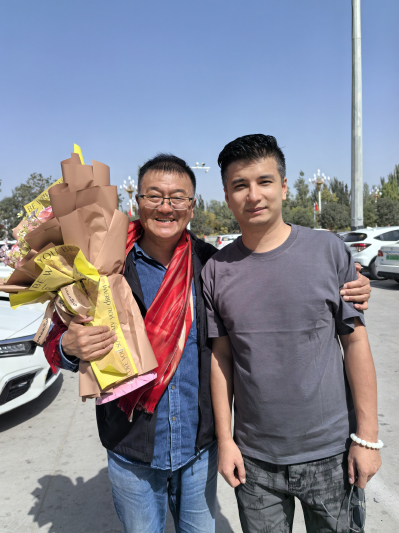 Abulikemu Aibibula (right) picks up Chen Ruijun at an airport in Hetian in April (COURTESY PHOTO)
Chen Ruijun's words More than 10 years ago, I was digging up material online for an article about Hetian when I came across a young local man calling himself Abu. He was enthusiastically introducing his hometown and had left his contact information, offering to be a free tour guide for anyone visiting there. I reached out to him. He was warm, talkative and full of energy, his words brimming with enthusiasm and plain sincerity. We started by talking about Hetian's folk customs. The more we talked, the deeper our conversation went. Eventually we got into his school days, his confusion about starting a business and his dreams. Having worked in Hetian and developed a deep affection for the land, I quickly befriended Abu, whose full name is Abulikemu Aibibula, despite our age gap. We stayed in touch. Whenever he hit a rough patch, I would encourage him, help him overcome his financial difficulties and cheer on his dreams and his persistence. In the summer of 2016, I happened to be back in Hetian on a business trip. During our first face-to-face meeting, he said my philosophical reflections on jade and other pieces had broadened his perspective. Before that, all he knew was how to tell real from fake and how to grade the stone. He had no idea about where Hetian jade came from, why people revered it, what it stood for or what role it played in Chinese civilization. After we talked and he read what I had written, he became genuinely captivated by Hetian jade culture. He asked for reading recommendations, eager to deepen his understanding. So I decided to send him my entire personal collection of books on the subject—every single one I had collected over the years. Abu also gave me a big surprise. He had quietly taken note of the walnut wood carved fruit plates and Uygur herbal teas I admired during my trip, bought them without a word and mailed them straight to me in Beijing. This gesture made me marvel once again at his sincerity and kindness and that of his friends in Hetian, and reinforced my resolve to honor the promise I had made: to devote my life to helping Xinjiang. Comments to luyan@cicgamericas.com |
|
||||||||||||||||||||||||||||
|