
|
| Xinjiang Today |
| A first love that became a lifelong bond | |
|
|
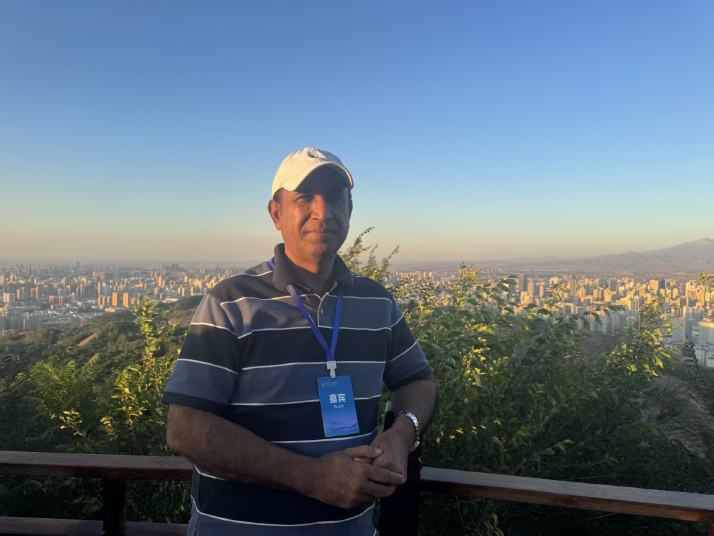 Muhammad Asghar
For me, Kashi (Kashgar) is more than a historic city in the far west of China. It is a place deeply connected to my childhood curiosity, my first experience of international travel and a lifetime of memories. Although my professional career has taken me across Europe, Africa and many parts of Asia, Kashi has always held a special place in my heart. My relationship with Kashi began in 1992, when I traveled with two friends from Islamabad to Xinjiang by road. It was my first overseas journey and the experience left such a strong impression that more than three decades later I can still recall details of the trip. I chose to travel to Kashi rather than go to London, New York or another major capital. It was so unique. The city was my first love and I think it will also remain my last love. The journey was the culmination of a curiosity that had begun during my childhood. When I was about 10 years old, I encountered the name Kashi in the poetry of Allama Muhammad Iqbal, one of South Asia's most celebrated poets and philosophers. At the time, Kashi was simply a distant name appearing in poetry. I did not yet know where it was or what it looked like. As I grew older, however, I learned that Kashi was an ancient city in Xinjiang, with a long history as a crossroads linking different parts of Asia. The name that had first captured my imagination through poetry gradually became a real place in my mind. Eventually, I decided that I wanted to see it for myself. That opportunity came in 1992. 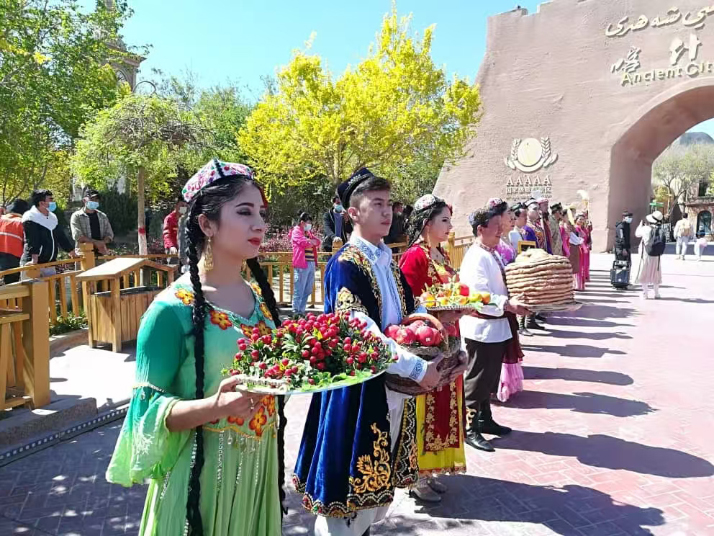 A welcome ceremony at the entrance of the Ancient City of Kashi, a tourist attraction that preserves the traditions of Kashi, an ancient Silk Road hub (MUHAMMAD ASGHAR)
A road journey into Xinjiang The journey from Islamabad was very different from the experience of traveling to Kashi today. Two companions and I made the long journey by road, turning our first overseas adventure into a journey of discovery even before we reached our destination. Upon arriving in Kashi, our immediate concern was finding accommodation. We stayed at the Qinibagh Hotel, which at the time was only a three- or four-story building. The cost was modest even by the standards of that period. The travelers paid just 10 yuan ($1.8) per person per night. But it was the city outside the hotel that made the deepest impression. The Kashi I encountered in the early 1990s was more modest than the city I would see on later visits. Around the Id Kah Mosque, one of the city's best-known landmarks, the streets were filled with farmers and local vendors selling fruits, vegetables and other goods. Produce was often spread directly on the ground, creating a large open-air market that brought together farmers, traders and local residents. The streets also had a different rhythm. Motorized transportation was limited, while bicycles and donkey-drawn carts were common sights. Rather than relying on taxis or organized tours, my friends and I decided to explore the city on bicycles. We handed over our passports as security, rented our bikes and set out to see the whole city on our own. It was my first introduction to Kashi and Xinjiang. The experience gave us an unusually close view of everyday life. We explored the streets, visited parks, sampled traditional local food and watched people singing, dancing and socializing. Instead of seeing Kashi simply as a tourist destination, we encountered it as a living city. For me, those ordinary experiences became some of the most enduring memories of my first overseas trip. Returning to a transformed Kashi More than two decades later, I returned to Kashi. When I came back in 2014, I found a city that had changed dramatically. The Qinibagh Hotel I remembered from my first visit had been expanded and was larger and more modern. Elsewhere, new transportation systems, shopping malls and commercial facilities had emerged. Modern and five-star hotels had become part of the city's landscape. I was so surprised at how fast an ordinary city can become a fully-equipped modern one. For me, the significance of the transformation was magnified by my memories of the city in 1992. I was not seeing the changes simply as a first-time visitor. I could compare the new Kashi directly with the city I had explored by bicycle more than 20 years earlier. The contrast between the two periods became an important part of my understanding of Xinjiang. But my interest in the region increasingly extended beyond its physical transformation. As a journalist, I began paying greater attention to the economic and social changes taking place across Xinjiang and to the lives of its people. 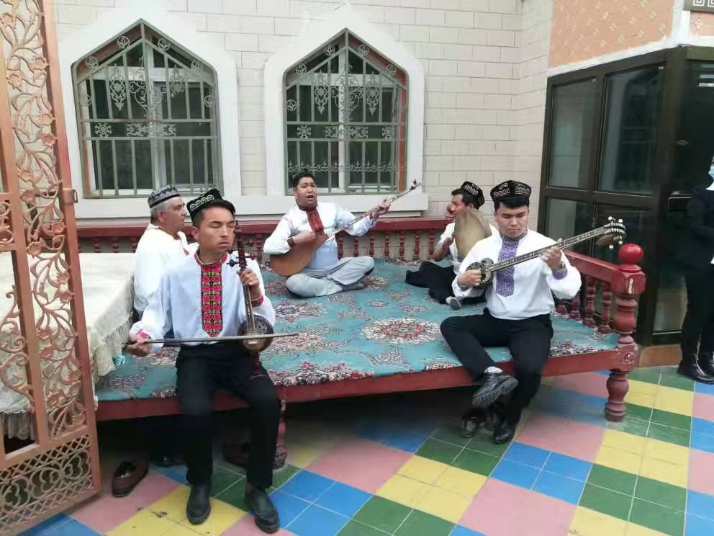 A traditional music performance in Kashi (MUHAMMAD ASGHAR)
From traveler to journalist I subsequently participated in international media delegations visiting different parts of the region. In 2018 or 2019, I was part of a team of five international journalists who visited three education and training facilities—one in Kashi and two in Hetian (Hotan). The facilities had attracted criticism from some international, particularly Western, media outlets. During the visits, the journalists spoke with students and teachers and observed the facilities themselves. I developed my own assessment of what I saw: The centers were places where young people could receive education and technical training designed to provide practical skills and help them participate more fully in society and the economy. The visits became part of my wider reporting on Xinjiang, where competing international narratives have made firsthand observation particularly important to journalists seeking to understand the region. My reporting interests later took me to Aksu, where I investigated international allegations concerning "forced labor" and cotton production. As part of another international media team, I visited a cotton factory in Aksu and a cotton field on the outskirts of Urumqi. Those visits gave me information and perspectives that I later incorporated into my journalism. I wrote articles challenging what I regarded as misconceptions surrounding cotton production and allegations of "forced labor." My approach was shaped by my desire to see the places and speak with people directly rather than rely exclusively on accounts produced elsewhere. Exploring Xinjiang beyond Kashi My travels in Xinjiang continued. On a more recent visit to Kuerle (Korla), I toured agricultural areas and observed chili and fruit cultivation, along with other projects connected with local livelihoods. Such journeys broadened my understanding of the region. My first trip introduced me to a comparatively modest city where bicycles, donkey carts and open-air markets were part of everyday life. Later visits exposed me to modern transportation, agriculture, commercial activity, education and other aspects of regional development. I remember during my first journey poverty was more visible and infrastructure was less developed. Even Urumqi, the regional capital, looked very different from the modern city I encountered during later visits. I attribute much of the subsequent development to policies and investment involving Xinjiang's regional leadership and the Central Government, as well as assistance from other regions of China. In my view, efforts to improve living standards and reduce poverty have fundamentally changed the region. 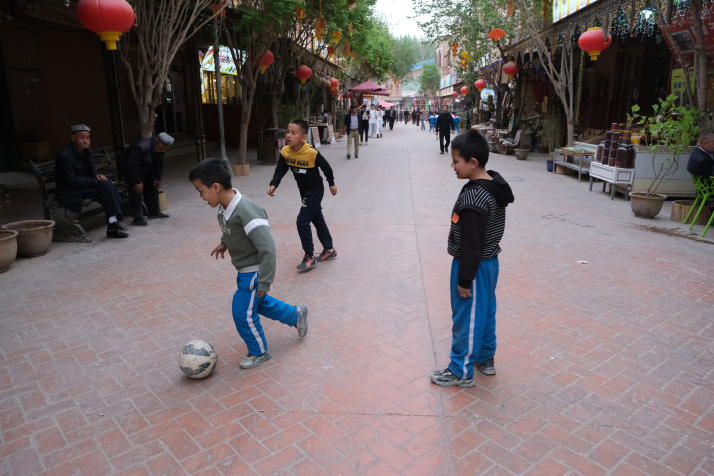 Children play soccer in the Ancient City of Kashi (Kashgar) in April 2024 (VCG)
The people behind the transformation Yet despite my focus on development, the people remain at the center of my memories. Sometimes I feel I don't have enough words to express myself, to tell what actual Xinjiang is. People here are very friendly, very unique, very beautiful and handsome. My repeated visits have given me an appreciation of Xinjiang as a region where rapid modernization exists alongside distinctive cultural traditions. I consider the region's ethnic diversity as an important part of its identity and the coexistence of different communities as a significant feature of life in Xinjiang. For me, the human encounters I experienced during my travels are inseparable from my understanding of the region. The farmers and vendors I saw around the Id Kah Mosque in 1992, the people I encountered in markets and parks, the students and teachers I met during later reporting trips, and the agricultural workers I observed in other parts of Xinjiang all became part of a much larger personal picture. A bond that remains For a journalist who has traveled across continents, Kashi remains an unusually personal destination. London, New York and other major world cities may offer fame, modernity and attractions of their own. But they were never my first choice. Kashi was. The journey that began with friends, a long road trip from Islamabad, a modest hotel and bicycles rented against the security of their passports eventually became something much more enduring. It has grown into a lifelong relationship with a city that introduced me to the world beyond Pakistan. More than three decades after my first journey, I still want to return. My memory of Xinjiang is therefore built from two contrasting images: the Kashi of the early 1990s, with its bicycles, donkey carts and open-air markets, and the modern city I encountered after years of rapid development. The city has changed enormously. But my affection for it has not. For me, Kashi is not simply the first foreign city I visited. It is the beginning of a love affair with travel itself—and a love that, after all these years, I believe will never end. Comments to xubei@cicgamericas.com |
|
||||||||||||||||||||||||||||
|