
|
| Business |
| The advantages of access | |
|
|
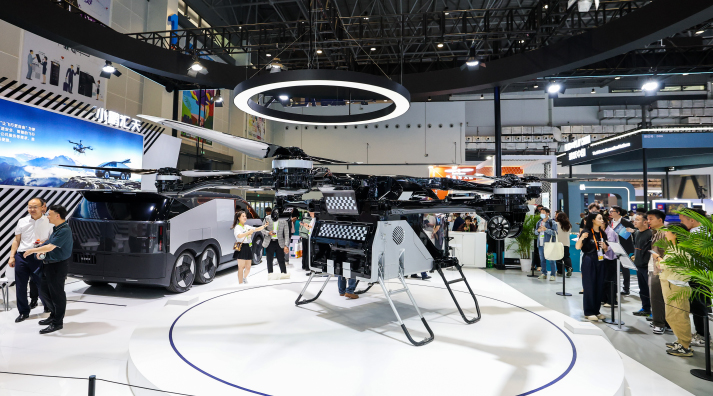 Visitors at the booth of Aridge, an urban air mobility startup, at the Fifth China International Consumer Products Expo in Haikou, Hainan Province, on April 13 (XINHUA)
In November, track-laying began for the Wenling-Yuhuan section of the Hangzhou-Taizhou high-speed railway in Zhejiang Province—China's first high-speed rail line controlled by private capital, which became operational in 2022. Both Wenling and Yuhuan are county-level cities administered by the prefecture-level Taizhou City, and Hangzhou is capital of Zhejiang. The Hangzhou-Taizhou line is among China's first group of high-speed railway projects funded by a public-private partnership (PPP), with 51 percent of its shares held by a consortium of eight private enterprises and the rest by the state-owned China State Railway Group Co. Ltd. and the local provincial and municipal governments. The construction of its 266.9-km original section began in 2017 and the track-laying work was completed in June 2021. China has mainly relied on government investment for railway construction, especially high-speed railways. But in recent years, the sector, characterized by high costs, long return on investment cycle and huge maintenance expenses, has been opened to private investment. In 2016, the National Development and Reform Commission (NDRC) announced the first batch of eight PPP railway projects, the Hangzhou-Taizhou line being one. As part of the latest government measures to boost private investment, more privately funded railway and other infrastructure projects will be launched. In November, the General Office of the State Council, China's highest state administrative organ, released a notice to unveil the measures, including supporting the participation of private capital in key projects in areas including rail and nuclear power, which require approval or verification from the authorities and are profit generating. The document also states that private investors may hold a stake of over 10 percent in eligible projects. Private capital is also encouraged to participate in the construction and operation of new urban infrastructure, the low-altitude economy (defined as economic activities in airspace below 1,000 meters) and commercial aerospace projects, the notice said. It also emphasizes removing access restrictions for market entities in the services sectors, empowering small and medium-sized enterprises through digital transformation and allowing more qualified private investment projects to issue real estate investment trusts (REITs) in the infrastructure sector. Infrastructure REITs allow companies to monetize their infrastructure assets and apply the sale proceeds to finance future projects or reduce debts, according to a report from Moody's Investors Service. Boosting private investment is crucial for driving economic growth, and enhancing the resilience and security of industrial and supply chains, Yang Ping, a researcher with the Macroeconomic Research Institute of the NDRC, said at a recent symposium held by the institute. Dynamic private investment signals positive market expectations, which will drive employment and boost consumption, she added. Private participation The first detachable electric aircraft of Land Aircraft Carrier flying vehicle developed by urban air mobility startup Aridge, previously known as XPENG AEROHT, rolled off the production line at its plant in Guangzhou, Guangdong Province, in early November. It is the world's first production line for the trial production of flying cars. The flying car comprises a ground van and an electric vertical takeoff and landing (eVTOL) aircraft. Headquartered in Guangzhou, Aridge specializes in developing eVTOL vehicles, aiming to provide efficient point-to-point independent travel. It is now Asia's largest flying car company. According to the company, the plant is designed with an annual capacity of 10,000 units, with an initial-phase capacity of 5,000 units. Once operating at full capacity, one flying vehicle will roll off the assembly line every 30 minutes. The emerging low-altitude economy in China is witnessing a surge in participation by private enterprises like Aridge. Guangzhou alone is home to over 300 companies operating within the low-altitude industry. "Today, China's low-altitude economy is developing rapidly with booming enterprises focusing on differentiated sectors," Qiu Mingquan, Vice President of Aridge, told Beijing Review. The major technological barrier of flying vehicles lies in improving production efficiency while controlling costs, according to Qiu. Aridge has conducted extensive research and development (R&D) on core technologies, and achieved mass production of self-developed carbon fiber components. Through leveraging China's intelligent car industrial chains, flying car producers can shorten the cycle from R&D and testing to mass production, Qiu said. He added that Aridge has signed strategic cooperation agreements with local governments to build trial flight and testing bases, explore the application of unmanned aircraft in logistics and tourism, and expand operation, leasing and maintenance services for flying cars. As the eVTOL industry is shifting from R&D to commercialization, Qiu called on the government to play a leading role in building low-altitude infrastructure and move faster to improve related laws, regulations and supporting policies. Companies and related government departments need to work together to build more takeoff and landing sites and demonstration zones, he added. New energy is another sector with expanding private participation. Located under some of China's sunniest skies, the photovoltaic (PV) industry in Ningxia Hui Autonomous Region is developing rapidly, and the proportion of electricity generated by renewable energy there is among the highest in the country. LONGi Green Energy Technology, a world leading supplier of PV solutions, is among the private companies that have contributed substantially to the green transition. Through adopting LONGi's PV facilities, a power plant in Ningxia's Lingwu City generates about more than 328 million kilowatt-hours of power annually. Each year, the project replaces 115,000 tons of standard coal equivalent, cutting roughly 10,000 tons of sulfur dioxide and 300,000 tons of carbon dioxide emissions. The LONGi monocrystalline modules used in this project provide enhanced power generation capacity and reliability across diverse climates. These installations boost electricity output and lower power costs, and also help expand vegetation coverage by reducing water evaporation and mitigating strong winds, according to the company. Annual water evaporation in the area can be up to nine times the local rainfall. As grassland conditions improve, the region has also implemented a model of grazing sheep beneath the solar panels, further increasing income for local farmers. Removing barriers Currently, over 60 percent of China's A-share listed companies are private enterprises. In particular, private companies account for 74 percent of listings on the Nasdaq-style Science and Technology Innovation Board at the Shanghai Stock Exchange, known as STAR Market, according to a report by the state broadcaster China Central Television. In recent years, China has introduced regulations, laws and supportive policies to create a more favorable market environment for private investment. In May, the country's first fundamental law specifically focusing on promoting the private economy came into effect. The law provides legal provisions on breaking down barriers, optimizing services and guiding financial institutions to increase support for private enterprises. China's financial system has also been expanding financing access for private companies. According to the People's Bank of China, the country's central bank, outstanding inclusive loans for small and micro enterprises, mostly private businesses, surged from 15.1 trillion yuan ($2.1 trillion) at the end of 2020 to 35.6 trillion yuan ($5 trillion) by the end of June. According to Yang, the global economic slowdowns and external technological containment create pressure on some private enterprises in the short term, but the large Chinese market and its talent pool are able to hedge against external volatility. "During the shift to new growth drivers, private enterprises are adjusting their investment strategies to adapt to the new innovation landscape. The more cautious decisions of private investors and a phased slowdown in investment growth are driven by market changes, but the trend will turn around as the new industrial ecosystem matures," she said. The Communist Party of China Central Committee's recommendations for formulating the country's 15th Five-Year Plan (2026-30), unveiled in October, state that efforts will be made to improve the long-term mechanisms for facilitating the participation of private enterprises in major projects and better leverage the guiding role of government investment funds, so as to spur private investment, increase its overall share and boost growth momentum for market-driven effective investment. "The document suggests that private investment is embracing broader development opportunities," Yang said. BR Copyedited by G.P. Wilson Comments to lixiaoyang@cicgamericas.com |
|
||||||||||||||||||||||||||||||
|