
|
| Business |
| Doubling down on China | |
|
|
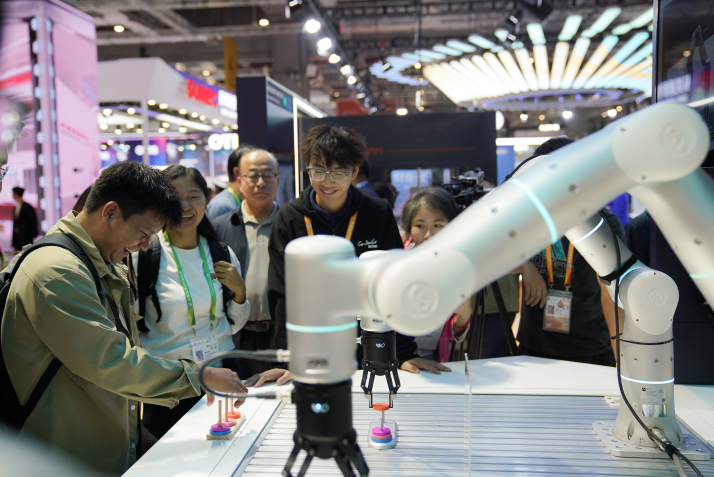 Visitors try out AI-powered products at the Siemens booth during the Eighth China International Import Expo in Shanghai on November 7, 2025 (XINHUA)
At a time of global economic volatility, multinational companies are continuing to place long-term bets on China—looking beyond short-term gains and embracing it as a strategic priority. Over the past three years, the number of overseas-invested enterprises operating in China has continued to grow. Data released by the Ministry of Commerce (MOFCOM) on May 23 showed that the country is home to more than 530,000 such companies, with total accumulated foreign direct investment (FDI) exceeding $3.6 trillion. In the first four months of 2026, 20,113 overseas-invested enterprises were established in China, up 6.8 percent year on year. More than 3,000 overseas-invested enterprises further expanded their investment in China, expanding their business scope, during the same period. Last year, more than 8,000 overseas-invested companies made additional investment in China within their original business scope, up more than 10 percent year on year, the ministry said. As China pursues its goal of further opening up to the outside world, it has expanded market access, lifted foreign ownership restrictions in manufacturing, and shortened its negative list, which lists the areas out of bounds for foreign investors, to 29 items. Expanding presence China's position as a leading global investment destination continues to strengthen. According to the 2026 Special Report on the State of Business in South China released by the American Chamber of Commerce in South China (AmCham South China) earlier this year, based on data collected in late 2025, 45 percent of the surveyed companies ranked China as their top global investment priority, representing a notable 6-percentage-point average annual increase from 2024. Accredited in 1995 by the U.S. Chamber of Commerce in Washington, D.C., AmCham South China, based in Guangzhou, Guangdong Province, represents more than 2,300 corporate and individual members. It provides support for American and international companies doing business in south China. A total of 426 companies participated in the survey. According to the report, 37 percent of the respondents generated more than 60 percent of their global revenue from China, another 6-percentage-point average annual increase from 2024, AmCham South China said. The report shows 95 percent of participating companies reaffirmed their commitment to maintaining operations in China. Among the 28 percent that relocated a portion of their investments, 79 percent shifted less than 30 percent of their investment to outside China. It also highlights that 75 percent of the companies surveyed plan to reinvest in China this year. Collectively, member companies have earmarked an estimated $13.79 billion from profits in China for reinvestment over the next three to five years, the report said. Many foreign brands are doubling down on localization to adapt to changes in the Chinese market. On April 30, Starbucks China announced a co-branding partnership with the Chinese dance drama A Tapestry of a Legendary Land, bringing traditional Chinese aesthetics into everyday coffee culture. Inspired by an iconic masterpiece of the Song Dynasty (960-1279), the dance drama has captivated a growing number of audiences in China. As part of the collaboration, Starbucks China has introduced a range of themed products and lifestyle merchandise, and has created installations in stores based on the dance drama. In April, Starbucks China mapped out a three-year expansion plan following the launch of its joint venture with Boyu Capital, an investment firm with Chinese roots, as the coffee chain seeks to expand its business in lower-tier markets and through localized innovation.  An intangible cultural heritage-themed concept store of Starbucks in Hangzhou, Zhejiang Province, in April (COURTESY PHOTO)
Reshuffle of the market MOFCOM data also showed that China's paid-in FDI totaled more than 287 billion yuan ($42 billion) in the first four months of this year, down 10.3 percent on a yearly basis. Zhan Yubo, a research fellow at the Institute of Economics, Shanghai Academy of Social Sciences, said in an interview with news portal Yicai that foreign investment in China is undergoing restructuring, marked by a rise in the number of newly established enterprises along with a decline in paid-in FDI. According to Zhan, many newcomers to the Chinese market are small and medium-sized enterprises. Meanwhile, existing foreign capital is undergoing adjustment. As some sectors lose alignment with growth trends and competition from domestic firms intensifies, these established players are likely to be more cautious about injecting additional investment. China's FDI inflow hit a historical peak in 2022, followed by three consecutive years of decline from 2023 to 2025, Zhan noted. Currently, the country accounts for approximately 12 percent of the global total and maintains its position as the world's second largest destination for foreign investment. China attracts the world not just with its market scale, but increasingly with the strength of its innovation ecosystem. Overseas capital flowing into the country's hi-tech industries surged 20.3 percent year on year to 116.33 billion yuan ($17 billion) in the first four months of 2026, accounting for 40.4 percent of the national total during the same period, according to MOFCOM. The share of FDI flowing into hi-tech industries rose 10.3 percentage points from the same period of last year, it said. In March alone, German industrial giant Siemens Energy unveiled 26 new products in China and announced expanded cooperation with Alibaba Cloud, an arm of Chinese tech company Alibaba Group, with the aim of integrating Siemens' global industrial technologies with the latter's innovation ecosystem. According to Siemens, the two companies will deepen collaboration in industrial infrastructure, automation and AI-enabled applications. Under the partnership, Siemens plans to integrate its simulation software portfolio with Alibaba Cloud's computing infrastructure to provide intelligent engineering services for the Chinese market. The cooperation will support scalable cloud simulation environments, including high-performance computing clusters, allowing engineering teams to conduct complex simulations more efficiently, Siemens said. The two companies will also explore integrating Alibaba's Qwen large language model into Siemens' product lifecycle management software to enhance AI-driven engineering workflows and intelligent product development. The business environment in China is also attracting new companies from overseas. Lujiazui Financial City in Shanghai is China's first and only national-level financial and trade development zone, and has brought together many multinational companies seeking long-term opportunities in the Chinese market. Among them is Dassault Systèmes, a French industrial software company serving sectors including aviation, automotive and engineering. In July 2025, the company launched its Greater China 3DEXPERIENCE Lab in Shanghai's Pudong New Area, the first open innovation laboratory of its kind in China. Focusing on advanced manufacturing, new materials and green infrastructure, the lab collaborates with local universities and research institutes to accelerate innovation and commercialization. "Shanghai's complete industrial ecosystem is what attracted us most," Suo Ailun, innovation business management director of Dassault Systèmes Greater China, told Beijing Review. From supply chain collaboration and technical talent cultivation to resources support, every link is well established in Shanghai, enabling the efficient launch of technological innovation, Suo said. 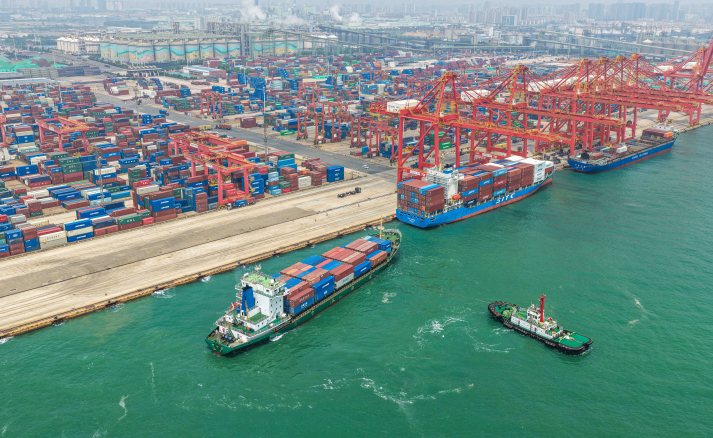 The container terminal of Rizhao Port in Rizhao, Shandong Province, on May 22 (XINHUA)
Opening up service sectors As foreign investment restrictions in China's manufacturing sector have been fully lifted, the services sector has become a key focus of the country's opening up. In the first four months of this year, paid-in FDI in China's services sector reached 204.15 billion yuan ($30 billion), accounting for more than 70 percent of the national total, MOFCOM said. Established in the China Shanghai (Pilot) Free Trade Zone (FTZ) in 2015, Baker McKenzie FenXun (FTZ) Joint Operation Office is China's first approved joint operation between Chinese and foreign law firms. It has participated in multiple STAR Market listings and cross-border merger cases under the pilot's policies for international legal services cooperation. China's Nasdaq-style Science and Technology Innovation Board, also known as the STAR Market, began trading in July 2019 and is designed to support companies in the hi-tech and strategic emerging sectors. According to Shi Miao, a partner at the law firm, the policy in the FTZ has lifted barriers in trade in services, allowing further cooperation between Chinese and international law firms. "We are expanding services to fields including AI and the digital economy to help promote global expansion of Chinese firms," Shi told Beijing Review. Chinese authorities have continuously renewed the negative list for foreign investment access in recent years, including by reducing special management measures in the services sector, and also released a negative list for cross-border trade in services. As of today, the number of comprehensive pilot areas for expanding the opening up of the services sector across the country has reached 20. In key sectors, the Chinese Government has piloted the removal of foreign ownership limits in some value-added telecommunications services and allowed trials for the establishment of wholly foreign-owned hospitals. Still appealing In the first four months of this year, investment into the Chinese mainland from Luxembourg, Switzerland, France and the United States grew 110.3 percent, 60.8 percent, 58.3 percent and 24.5 percent year on year, respectively, according to MOFCOM. Zhan noted that U.S. investment is pivoting toward hi-tech sectors, new energy, biomedicine and high-end consumer goods, which are in great demand in the Chinese market. "China's edges, a complete industrial chain, a vast consumer market, and strong policy support for hi-tech industries, continue to underpin these trends," he said. China will continue to improve its negative list management system for cross-border trade in services, and expand opening up in sectors such as telecommunications, Internet, education, culture and healthcare during the 15th Five-Year Plan period (2026-30), Yan Dong, Vice Minister of Commerce, told a press conference on May 26. "It will attract more multinationals to locate their research and development and manufacturing here, enabling foreign investment to gain stronger innovation momentum," he said. BR Copyedited by G.P. Wilson Comments to lixiaoyang@cicgamericas.com |
|
||||||||||||||||||||||||||||||
|