




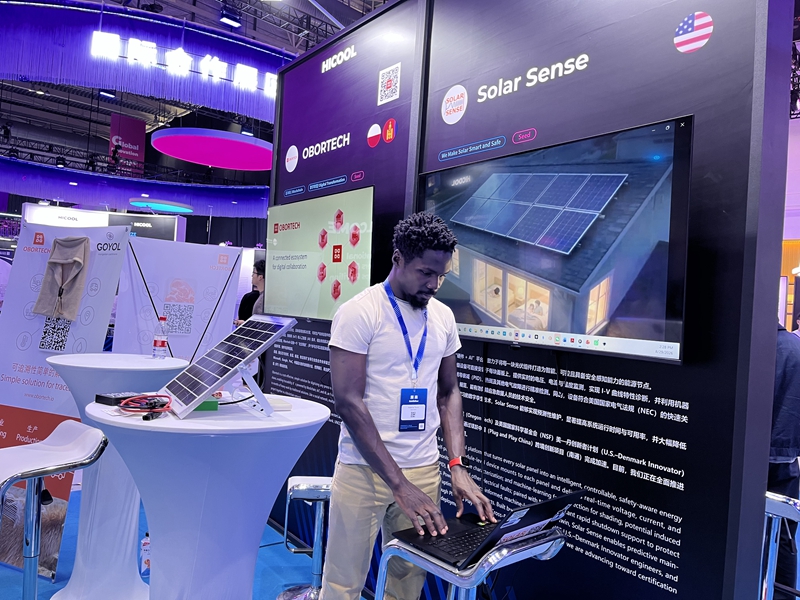
That shift was visible at the HICOOL 2026 Global Entrepreneur Summit in Beijing from August 26 to 29. Themed From Innovation Origins to Industry Frontiers, the event brought together more than 60,000 global participants, including representatives of more than 600 innovative enterprises from over 50 countries and regions, as well as more than 1,000 investors.
Startup magnet
Among them was Adama Toure, the 34-year-old American co-founder and Chief Executive Officer of Solar Sense, a company that makes safety devices for solar panels. Toure and his partners officially registered the company in Nantong, Jiangsu Province, on July 29 as part of their plans to expand manufacturing and commercialization efforts in China. At that time, he first learned about HICOOL from another entrepreneur and, fortunately, the summit still had open exhibition slots.
“I Googled it and thought ‘This is cool,’” Toure told Beijing Review at the summit. Within hours, organizers had approved his participation. The efficiency of entry surprised him. So did the intensity of the environment once he arrived.
Over several days, Toure attended opening ceremonies, networking sessions, company visits and startup roadshows. “I had a chance to pitch at the roadshow on August 29 and get some feedback. A lot of people gave me trade feedback on what to do to improve my chance of succeeding in China,” he said.
“I’m really impressed by the diversity of ideas, how international it is and what China’s place in the future could be,” he said. “I’m pretty sure HICOOL will help me advance to the next stage.”
Toure’s experience reflects a broader shift in how foreign entrepreneurs view China. Beyond market size, many are increasingly drawn by the country’s ability to rapidly transform technologies from concept to commercialization. China’s appeal lies in a combination of industrial scale, manufacturing efficiency, mature supply chains and a highly competitive market environment.
That dynamic has become particularly important in sectors tied to energy transition and advanced manufacturing, including Toure’s.
The China Renewable Energy Development Report 2025, released by the China Renewable Energy Engineering Institute, showed that China’s newly installed renewable energy capacity reached another record high in 2025, accounting for more than 60 percent of global newly added capacity. The country also dominates global solar panel production.
According to Toure, manufacturing the product in the U.S. currently costs his company more than $150 per unit. In China, he believes the same product could eventually be produced for about $21. For early-stage startups with limited capital, lower manufacturing costs and faster supply chains can significantly accelerate commercialization and market adoption.
Toure argues that affordable manufacturing in China would allow his company to sell devices for under $40, making solar safety systems accessible to ordinary homeowners rather than luxury add-ons for wealthier consumers. “The only place on Earth we could do that is here in China,” he said.
China opportunities
The calculation reflects a broader reality confronting many U.S. firms. Despite rising geopolitical tensions, tariffs and export restrictions, China remains deeply embedded in the global innovation ecosystem, not only as a manufacturing hub, but increasingly as a destination where foreign startups can build businesses and scale technologies.
Toure sees climate cooperation as an area where commercial logic and global necessity still overlap despite political friction. “Climate change doesn’t care if it happens in China, America, Africa or Europe,” he said. “We have the same planet.”
He argued that China’s role in driving down solar panel prices globally has already accelerated clean energy adoption far beyond wealthy countries.
Although Washington has imposed restrictions on Chinese solar exports and tightened scrutiny of technology ties, entrepreneurs like Toure question whether long-term restrictions are sustainable in industries requiring both advanced design and mass manufacturing.
“We have faith that this policy is not a sustainable policy—not for the United States and not for the global stability of energy,” Toure said. “We are in a global market. Cooperation between the U.S. and China benefits the whole world.”
A report on American businesses operating in China, released by the Shanghai-based Hurun Research Institute in 2025, found that 70 major U.S. companies generated more than $312 billion in revenue from the Chinese market in 2024, a figure larger than the U.S. trade deficit with China that year. For many American firms, China has become either their largest or second largest market globally. The relationship is no longer defined solely by exports flowing westward; it is increasingly shaped by integrated research, production and commercialization ecosystems operating across borders.
At the HICOOL summit, that integration was everywhere. American startups explored Chinese industrial partnerships. British robotics founders searched for Chinese manufacturers. European incubators connected medical technology firms with local supply chains. Chinese venture capitalists circulated among booths offering not just funding, but direct access to logistics systems and pilot customers. Additionally, there were panels focusing on AI, robotics, clean energy, quantum computing and biotechnology. Universities including Harvard, Stanford, Tsinghua and Cambridge showcased technologies emerging from research laboratories and seeking commercial applications.
That combination of livable cities connected to vast industrial infrastructure increasingly forms the foundation of China’s pitch to global entrepreneurs. The country is no longer simply inviting foreign companies to sell into its market. It is encouraging them to build there, iterate there and grow there. China is increasingly positioning itself as a destination not only for trade, but also for foreign investment and technology commercialization.
According to the 2026 Foreign Direct Investment Confidence Index released by Kearney, a global management consulting firm, multinational corporations’ confidence in China rose by two places to rank fourth globally, while China has remained the top destination in the emerging markets category for three consecutive years.
Foreign investors’ confidence is also reflected in increases in investment. In 2025, China’s paid-in foreign direct investment reached $104.68 billion, remaining above $100 billion for the 16th consecutive year. The number of newly established foreign-invested enterprises exceeded 70,000, up 19.1 percent year on year.
Underpinning this optimism are solid, measurable returns. In 2025, the profit margin of foreign-invested industrial enterprises in China stood at around 6.7 percent, outperforming the 4-5 percent range typical of manufacturing sectors in developed economies.
For many foreign entrepreneurs, China’s attraction today is increasingly visible: It is a place where technologies can be manufactured, tested, refined and brought to market at speed and scale. BR



