
|
| China |
| Beijing and its surrounding regions have been struck by the heaviest rain since records began | |
|
|
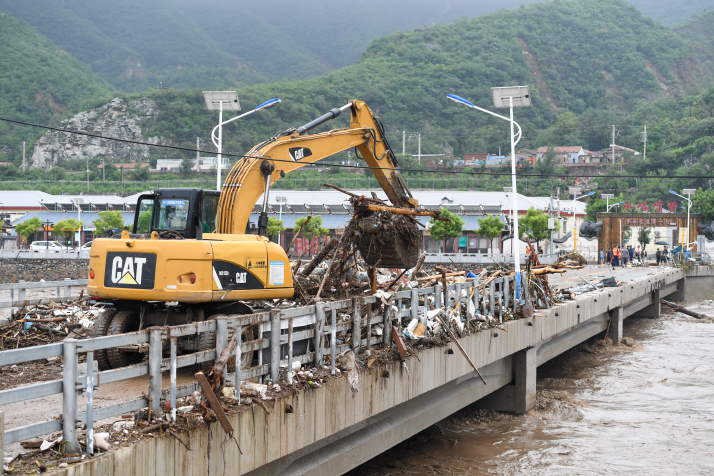 An excavator removes debris from a bridge in Shuiyuzui Village in flood-hit Mentougou District, Beijing, on August 1(XINHUA)
On July 29, China's National Meteorological Center (NMC) upgraded an orange alert for rainstorms to a red alert in Beijing and its surrounding cities. Typhoon Doksuri, which had lashed the Philippines and China's Taiwan region and Fujian Province, had now begun releasing heavy rainfall on this part of north China. China has a four-tier weather warning system, with red representing the most severe warning, followed by orange, yellow and blue. It was the second rainstorm red alert issued since the system was established in 2010, with the previous one issued in 2011. 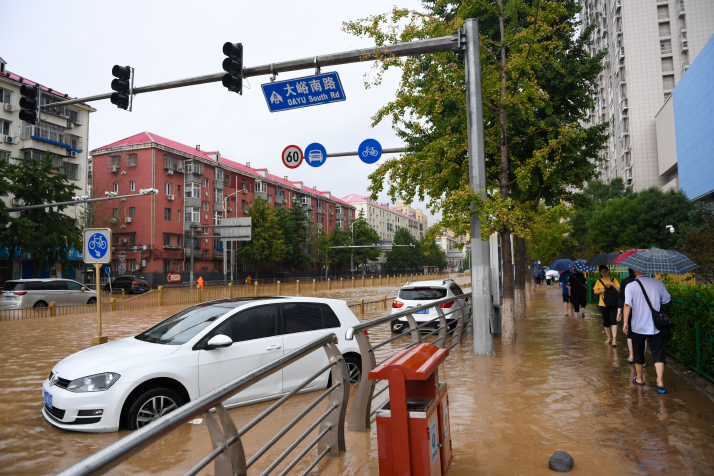 Pedestrians walk through floodwaters in Mentougou District, Beijing, on July 31(XINHUA)
Heavy rainstorms Between the evening of July 29 and the morning of August 2, Beijing recorded an average of 261 mm of rain, with maximum rainfall exceeding 740 mm in a reservoir in Changping District, making it the heaviest deluge to hit the city in 140 years, according to the Beijing Meteorological Service. Another set of data reveals how extreme this round of rainfall was: from 8 p.m. on July 29 to 7 p.m. on August 1, the accumulated rainfall in Xingtai City, 400 km southwest of central Beijing in Hebei Province, exceeded 1,000 mm, which was equivalent to the total average rainfall for two years in the region, Fang Chong, chief forecaster at the NMC, told state broadcaster China Central Television. Fan explained that the spell of rainfall was mainly attributable to the northward movement of Doksuri's residual circulation. It was characterized by prolonged and continuous precipitation, resulting in significant accumulated rainfall and posing a high risk of flooding and related natural disasters. The typhoon's speed was slowed by a high-pressure atmospheric circulation system over East Asia, known as the western North Pacific subtropical high, as well as high pressure over the Taihang Mountains in north China, causing it to linger in the Beijing-Tianjin-Hebei region and increasing the rainfall it released there. The downpours seriously affected over 44,600 people in 13 districts of Beijing and prompted the relocation of around 127,000 others. The flooding had led to the loss of at least 12 lives, including three rescue workers who died in the line of duty, and a further 12 residents who were still missing as of August 3, according to local flood control authorities. "I saw that the road in front of our building had turned into a river on the morning of July 31, and no one dared go out," Han Lu, a 30-year-old resident in Mentougou, one of the hardest-hit districts in Beijing, told Beijing Review. The community she resides in also experienced a water outage in the following two days. After the flood receded, the streets were filled with mud, tree branches and stranded cars, she recalled. A villager in the mountainous area of Mentougou, surnamed He, told the Global Times that authorities there had organized mass evacuations and multiple rescues over the past few days. "From the moment it started raining, we activated the emergency plan to evacuate all villagers," he said. "But the flood came very quickly and we didn't complete the evacuation until the night of July 31." The rainstorms have also caused severe disruptions to train services. On the night of August 1, the China Railway Beijing Bureau Group Co. Ltd. reported that severe water damage had occurred on the Fengtai-Shacheng Railway. Three trains had been stranded in suburban Beijing due to railway closures since noon on July 30. By August 3, all of the nearly 3,000 passengers and crew members aboard the trains had been evacuated to safety.  Rescuers transfer flood-trapped people in Zhuozhou City, Hebei Province, on August 2 (XINHUA)
Tackling disaster On August 1, Chinese President Xi Jinping, also General Secretary of the Communist Party of China Central Committee and Chairman of the Central Military Commission, demanded all-out efforts in the search and rescue of missing people and those trapped by flooding and geological disasters. It is crucial to ensure medical treatment for the injured and provide aid and comfort to the families of the deceased, Xi said, adding the safety of the people's lives and properties as well as social stability must be ensured with the utmost efforts. Beijing has taken multiple measures to tackle the downpour-induced disasters. Liu Xufu, a member of Blue Sky Rescue Team, a Chinese civilian rescue squad, told the Global Times on August 1 that the team had dispatched 563 rescuers and 263 vehicles for rescue efforts in Beijing. They transferred more than 1,680 stranded people and 22 trapped vehicles, and rescued more than 210 people from danger in the severely affected Fangshan and Mentougou districts. Military helicopters were employed to airdrop essential supplies and transfer stranded residents. Water resources departments in Beijing, Tianjin and Hebei have cooperated in discharging water from reservoirs to minimize the overall impact of flooding across the region. So far, Hebei has put seven flood storage and detention basins into use to decrease the impact of the flooding across downstream rivers and important areas. The provincial department of water resources expects it will take up to one month for the water in these basins to recede. Rainstorms had impacted 540,703 people in 87 counties and districts in Hebei by noon on August 1, Xinhua News Agency reported. In Zhuozhou City alone, more than 130,000 residents were affected. More than 150 civilian rescue teams from across the country had arrived in the city as of August 2 to assist the local government's disaster relief operations. Central and local authorities, as well as social organizations, have mobilized resources to accelerate disaster relief and reconstruction. The Central Government has earmarked 100 million yuan ($13.9 million) to support the reconstruction of infrastructure and public service facilities in areas that have been hit hard by rainstorms and floods in Beijing and Hebei, according to the National Development and Reform Commission on August 2. However, the ongoing battles are expected to be exacerbated by a new round of rainfall, predicted to hit Jilin and Heilongjiang provinces in the northeast. Given this adverse situation, authorities urged the utmost efforts to brace for heavy rainfall in the two regions, according to Xinhua. (Print Edition Title: On Red Alert) Copyedited by G.P. Wilson Comments to mamm@cicgamericas.com |
|
||||||||||||||||||||||||||||||
|