
|
| China |
| The evolving essence of China's Spring Festival | |
|
|
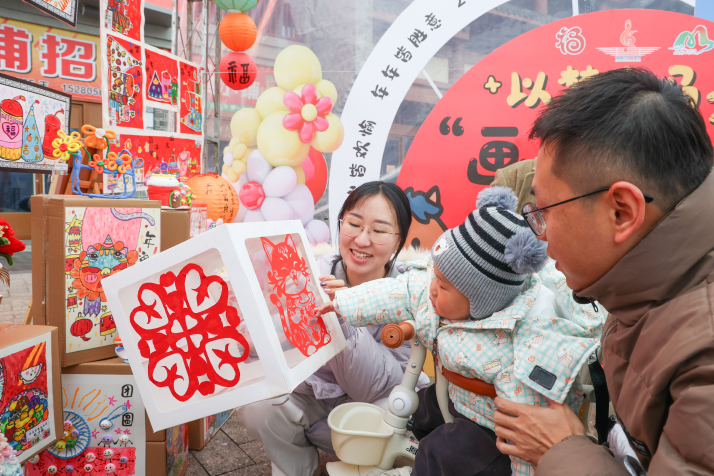 A family visits a New Year-themed children's art work exhibition in Jianning County, Fujian Province, on January 1 (XINHUA)
With the most important festival in China still weeks away, preparations are already underway. "We're short-handed. Can anyone come to help? We'll treat you to a big pig feast!" This is a simple online request sent by a young villager known as "Daidai," who was looking for helping hands for her family's traditional end-of-year pig-slaughtering ceremony in rural Chongqing Municipality. Her father, in his 70s, was no longer strong enough to handle their two pigs alone. The video unexpectedly became a nationwide online sensation in January, tapping into a nostalgia for the countryside and childhood memories of the celebration, which is traditional in southwest China. Overnight, it struck a chord with millions of viewers and attracted 2 million followers for Daidai. On the day of the pig-slaughtering ceremony, what was intended to be a small neighborhood gathering exploded into a revelry of thousands of people, as carloads of netizens descended upon the village to offer help, clogging its narrow lanes. "Having big celebration activities in the countryside and meticulously going through all the procedures of the Chinese New Year was an experience common to the older generations," 29-year-old Sichuan resident Zhou Jialin, told Beijing Review. In recent years, many people have lamented that the traditional taste of Chinese New Year is fading. "I have seen this topic on the hot search list in January for about five years in a row," Zhou said. This viral phenomenon sparked by Daidai exposed a deep, widespread yearning for the festive, communal traditions associated with a seemingly bygone era. Changing flavors It's undeniable that the taste of the Chinese New Year has been evolving with the boom of urbanization and social economic development. The Chinese New Year's Eve Dinner, or nianyefan, once the undisputed centerpiece of family labor and love, prepared over days in a bustling family kitchen, is increasingly outsourced. "When I was a child, my parents used to prepare everything by hand, including meatballs, pastries, pickles, fried nuts and all kinds of meat, beginning at least two weeks before the Spring Festival. This year, we booked our dinner at a famous local restaurant in early November, and even then, we were barely able to secure the last private room," Zhou said. "It's expensive, from my parents' perspective, but it means no one has to spend half a month in the kitchen and then go through another massive clean-up. We just talk, eat and enjoy being together." "Dining out is not a dilution of the festive atmosphere, but rather its reconfiguration in a new era," Wang Jiahua, Secretary of the Communist Party of China Committee of the Advanced Institute of Confucian Studies at Shandong University, told newspaper Qilu Evening News. "The essence of the Spring Festival can be understood across three dimensions: the material, the ritual and the spiritual. The feasting and drinking are at the material level, and visiting relatives and honoring ancestors are rituals of celebration. What lies at the very heart, however, is the spirit of the Chinese New Year—the ethics and familial bonds, which is precisely why reunions hold such fundamental importance for Chinese people during the New Year." The culture of gift-giving has also undergone a quiet revolution. Ostentatious consumption and elaborate packaging are giving way to pragmatism and a focus on intrinsic value. "Gifting a fancy, over-packaged health tonic used to be the norm," Wu Min, a retail manager of chain supermarket Yonghui in Hebei Province, told Beijing Review. "Now, we see consumers, particularly those born in the 1980s and 1990s, choosing practical items like high-quality cooking oil, premium nuts, or even boxes of fresh fruit." Market research firm NielsenIQ's latest report, released on November 10, 2025, also reflected this broad trend. Forecasting retail trends for the 2026 Spring Festival, it notes a clear shift in consumer behavior: Gift-giving is becoming less about brand prestige and more about practical value. Affordable quality goods, health and wellness products, mood-boosting items, and lifestyle goods are gaining traction. The sights and sounds of the festival are also being reshaped. In numerous urban centers, the thunderous fireworks and firecrackers have been replaced by clear, quiet skies and lanterns, a legislated change for environmental and safety reasons. "I miss the excitement of fireworks that meant New Year," Zhou said. "But I don't miss the worry about fires and the smell of smoke the next day. On New Year's Eve now, we can actually see the stars, and the air is clean. It's a different kind of peace." While some mourn the lost exhilaration, cities nationwide are posting notices banning fireworks before and during the festival period, highlighting the benefits: dramatically improved air quality, enhanced public safety and cleaner streets. The celebration's auditory landscape has softened, trading explosive grandeur for peace and calm. Even social rituals have migrated online. The tradition of door-to-door visits on the first day of the New Year is now often replaced by buzzing group chats, video calls and torrents of festive stickers. Hongbao, the iconic red envelopes, have also been digitized. "Sending digital hongbao in our family group on [super app] Weixin has become a game," Zhou said. "Everyone fights for the luckiest amount, and we spend hours designing or choosing the perfect cover [the appearance of the digital hongbao when you click on it]. It's fun and immediate, though my grandparents still insist on giving us the physical red packets. They say the feeling is irreplaceable." 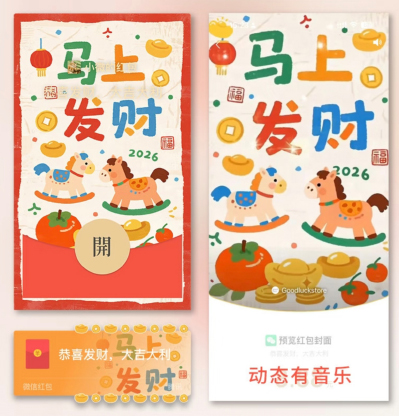 Customized WeChat Hongbao Cover for the Year of the Horse with Dynamic Music Effects (SCREENSHOT)
Persistent pulse However, to declare the taste of Chinese New Year lost based on these changes is to overlook its vigorous and creative persistence in new forms. The essence of the festival—family reunion, cultural continuity and hope for the next year, remains powerfully alive through other forms. The traditional cultural symbols associated with the Spring Festival are experiencing a remarkable revival, often fused with modern tastes and people's new consumption habits. "We were hesitant at first, about blending 1,000-year-old Dunhuang art with supermarket goods," Zhou Miao, general manager of a Chongqing supermarket chain that launched Dunhuang-themed New Year product line, told newspaper Chongqing Daily. The newly launched gift box combines elements of the UNESCO World Heritage-listed Buddhist frescos painted between the 4th and 14th centuries in the caves of Dunhuang, Gansu Province, with intangible cultural heritage food products from southwest China, such as cured meats and chili sauce. "But the response was phenomenal. It wasn't just older customers; young people were buying these boxes as gifts, sharing them on social media. It made the tradition feel relevant, rather than archaic." Nothing underscores the enduring pull of reunion more than the Spring Festival travel rush (chunyun), the largest annual human migration on Earth and possibly the world's greatest annual feat of logistics. "I take the same high-speed train home every year. It's packed; it's tiring; but the moment I step into the station and see that sea of people all heading in the same direction, I feel this incredible sense of belonging," Wang Feng, a migrant worker returning to Henan Province from Tianjin, told Beijing Review on January 19. People's celebration is also expanding geographically. Instead of staying at home, Spring Festival tourism is becoming a new tradition. Trip.com suggests that, the 2026 Spring Festival is expected to set new records in the travel market, with forms of travel becoming more diverse and immersive. "My siblings and I took our parents to Sanya in Hainan Province last year," Xu Jing, a marketing manager from Beijing, told Beijing Review. "We created a new memory and a new family tradition of going on Spring Festival trips. And this year, we have booked tickets for Hong Kong and Macao." "We should allow the evolving times to shape Spring Festival with new expressions of celebration," Li Jin, a professor at the School of History and Culture of Sichuan University, told news portal Cover News. Copyedited by G.P. Wilson Comments to zhangyage@cicgamericas.com |
|
||||||||||||||||||||||||||||||
|