
|
| China |
| How a new airport in Xiamen will solve old problems and shape the future | |
|
|
|
In Xiamen, a picturesque coastal city in Fujian Province, visitors are often amazed by an unusual sight: airplanes flying so low over the city that they appear to skim past buildings and directly above pedestrians' heads.
This striking sight is due to Gaoqi International Airport's location in the heart of the city. The airport's central location provides unmatched traveler convenience, but it has also created challenges. Aircraft noise disrupts daily life for residents in surrounding neighborhoods, and limited space constrains the airport's ability to handle growing passenger traffic. These long-standing issues are set to be addressed by the end of this year, when Xiamen Xiang'an International Airport will officially begin operations. Easing the downtown strain Built on Dadeng Island along Xiamen's coastline in Xiang'an District, the new airport signals a decisive shift in the city's aviation capacity. It has been designed to operate on a different scale from the existing airport. The new airport will be constructed in three phases. The first phase is almost complete and will be put into operation by the end of this year. It will be expanded in the following phases according to need. Currently under the first phase, the airport features one terminal and two runways, including a 3,800-meter northern runway built to safely accommodate the largest and heaviest aircraft in the world. "The terminal complex covers 550,000 square meters and is designed to handle up to 45 million passengers a year—around 17 million more than the maximum capacity of Xiamen's Gaoqi International Airport," Huang Jinfang, Xiamen Xiang'an International Airport project engineer, told Beijing Review. "Once operations move to Xiang'an, long-standing capacity constraints at the downtown airport are expected to ease rapidly." Powering a greener flight Yet scale alone does not define the project; sustainability is embedded throughout. "From the moment the project took shape, reducing carbon emissions was built into its design, construction and daily operation plans. Once fully operational, the airport is expected to cut carbon emissions by about 230,000 tons a year—an impact comparable to planting roughly 200 million trees," Huang said. Much of that effort is visible from above. "Solar panels stretching across the top of terminal buildings as well as cargo facilities and other airport infrastructure will quietly generate clean energy throughout the day. Together, they form a photovoltaic system capable of supplying around one sixth of the airport's electricity needs. The most prominent installation crowns the terminal concourses, where the country's largest airport terminal rooftop solar system will turn sunlight into a steady source of power for the building below," he explained. 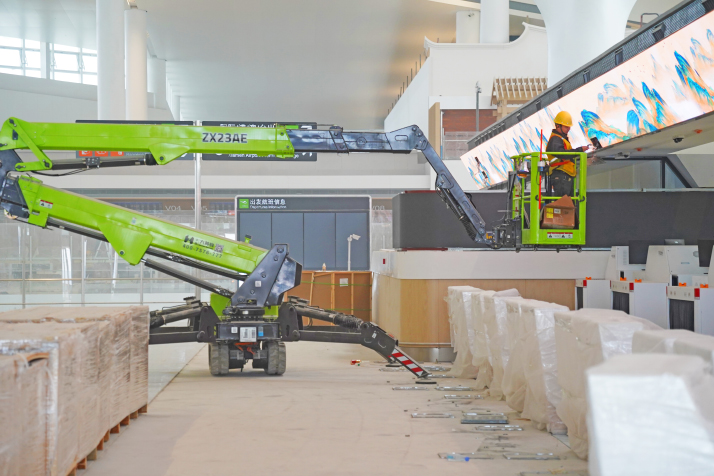 A technician calibrates the 360-degree flight display screens at Xiamen Xiang'an International Airport on January 23 (YINKANG)
Huang added that the terminal itself had already received China's highest three-star green building certification at the design stage, awarded by the Ministry of Housing and Urban-Rural Development. Its facade is engineered to block around 80 percent of solar radiation during summer, while retaining heat in winter. Inside the terminal, a combination of zoned air-conditioning and natural ventilation will reduce energy use while maintaining comfort. Its smart air-conditioning system is designed to use cheaper, nighttime electricity to make and store ice or cold water, easing pressure on the power grid. This way, during the hot daytime, it can use that stored cold to cool buildings. The result is a substantial cut in energy use and emissions, achieved largely out of sight of passengers moving through the terminal. Beyond the buildings, landscaped green spaces spread across the airport zone, acting as a natural carbon sink and reinforcing the airport's low-carbon ambitions. On the apron, aircraft parked at the gate will be able to switch off their auxiliary power units and plug into ground-based electricity and air-conditioning instead. It is a small operational shift with an outsized effect, sharply reducing fuel burn, noise and emissions during ground operations. Linking lands, unlocking potential For a long time, airports were seen primarily as elements of urban transport systems, focused on passenger and cargo movement. Today, as the flows of people, goods, capital and information accelerate, the links between hi-tech industries and aviation services are growing closer and a new development logic is taking shape—one in which airports attract industries, industries energize cities, and cities, in turn, reinforce the role of airports. As a result, the traditional airport is gradually evolving into an "airport city," a major hub that integrates travel, business and leisure. The Xiang'an airport is being planned as the foundation of one such urban hub. "The airport's core development zone covers more than 20 square km, with plans for business districts, bonded zones, logistics parks and research-and-development (R&D) clusters. Commercial activity is being built directly into the terminal experience. Terminal 1 alone will house nearly 40,000 square meters of retail space, with more than 350 shops planned," Huang said. Xiamen's urban structure is defined by the division between its main island and its four mainland districts (collectively known as "off-island"). The island remains the economic center but is constrained by severe land scarcity. To alleviate this, development has been strategically and continuously accelerated on the mainland districts for decades, transforming these areas into major hubs for industry, housing and infrastructure. Located in the "off-island" area, the new airport is expected to play a central role in re-balancing this pattern of growth, channeling passenger, logistics and investment flows into the off-island area and catalyzing cross-bay integration. Supporting this role is a comprehensive ground transportation network of metro lines, high-speed rail and expressways to connect the airport seamlessly with Xiamen and the surrounding region. The system will enable quick commutes—30 minutes to downtown Xiamen, one hour to neighboring cities such as Quanzhou and Zhangzhou and just half a day to other cities within 300 km. The development of the Xiang'an airport aligns with Xiamen's broader plans for the country's 15th Five-Year Plan (2026-30) period, as the city reshapes its spatial structure from a single core to a multi-center, cluster-based layout. The airport also anchors broader industrial development. The Xiamen Marine Hi-Tech Industrial Park, adjacent to the airport, focuses on marine biopharmaceuticals, high-end equipment manufacturing, modern fisheries, logistics and leisure tourism. By leveraging Xiamen's marine resources, it promotes high-quality growth in the city's marine economy, complementing the airport's role as a driver of local economic and urban transformation. (Print Edition Title: Beyond the Runway) Copyedited by Elsbeth van Paridon Comments to kangcaiqi@cicgamericas.com |
|
||||||||||||||||||||||||||||
|