
|
| China |
| Regions across China leverage local advantages to write their own growth stories in 2026 | |
|
|
 A bowling alley at a sports park in Jindong District, Jinhua City, Zhejiang Province, on January 8. In recent years, Jindong has created new consumption scenes for cultural tourism, including sports parks, camping bases and renovated old rural streets (XINHUA)
The annual local Two Sessions, comprising the gatherings of each provincial-level people's congress and committee of the Chinese People's Political Consultative Conference (CPPCC), serve as a window into China's regional economic and social planning. These provincial-level meetings are typically held in January or February, ahead of the national Two Sessions in Beijing—usually held in early March every year.
During the sessions, delegates review the past year's performance and set development priorities for the year ahead. A central task is establishing local economic growth targets and finalizing blueprints for high-quality development. This year, prominent themes alongside growth targets included expanding domestic demand, boosting consumption, accelerating innovation-driven development, improving people's wellbeing and promoting green development. Setting targets As the opening year of the 15th Five-Year Plan (2026-30) period, the economic landscape for 2026 is steadily becoming clearer. A notable trend is the shift in target setting: Some provinces have moved from a specific GDP growth rate to a target range, with most regions clustering around 5 percent. Zhang Wei, chief macroeconomy analyst at Caitong Securities, told The Beijing News newspaper that this trend indicates that the national economic focus for 2026 will lean more toward the pursuit of high-quality development, downplaying a strict adherence to a specific growth rate target. Major provincial economies are pivotal as the "ballast stones" stabilizing overall economic performance and the "locomotives" driving growth, with the top 10 provinces and municipalities by GDP collectively accounting for about 60 percent of national GDP in 2025. This year, Guangdong Province set a range target of 4.5 to 5 percent; Jiangsu Province set it at 5 percent; Shanghai and Hunan, Henan and Fujian provinces are targeting around 5 percent; Shandong Province aims for above 5 percent; Zhejiang Province is targeting 5 to 5.5 percent; while Sichuan and Hubei provinces lead with targets around 5.5 percent. Wu Yaping, a researcher at the Investment Research Institute under the National Development and Reform Commission, told The Beijing News that for provincial economic powerhouses to "take the lead," they must not only expand total economic volume and promote stable economic operation, but also enhance development quality. Wu pointed out that after long periods of large-scale investment, these regions must accelerate their transition toward high-end, digital and green development. 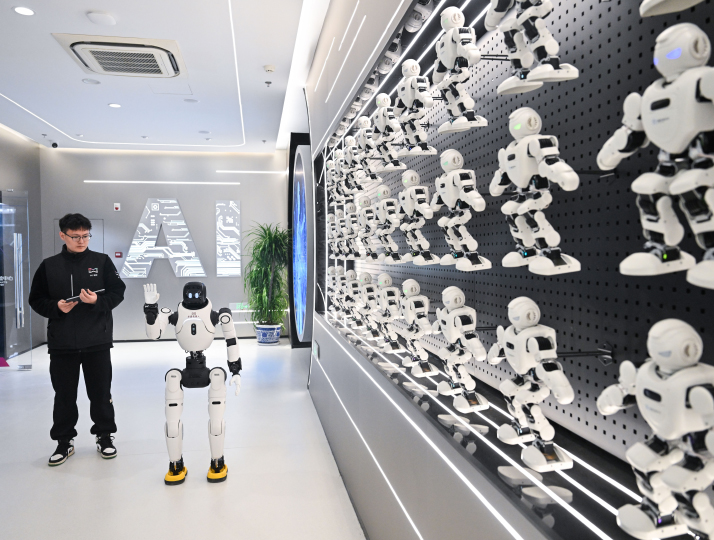 A robot greets visitors at the Nanjing Artificial Intelligence Ecological Block on December 4, 2025. The block has attracted 381 enterprises, including Chinese tech giants Huawei and ZTE, becoming an innovation highland for the city’s AI industry (COURTESY PHOTO)
Innovation as the core In 2026, provinces will focus on modernizing industrial structures. Guangdong plans to foster coordinated development across all sectors by promoting intelligent and green development. It will expand industries such as new energy, new materials, intelligent connected vehicles and intelligent robotics to cultivate new pillar industries. Chen Yuhang, Mayor of Huizhou in Guangdong, affirmed the city's commitment to prioritizing the real economy, driving rapid advancement in AI and robotics, and becoming a new engine for Guangdong's high-quality development. Zhejiang proposed perfecting a modern industrial system anchored by advanced manufacturing, which includes optimizing traditional sectors and cultivating emerging and future industries, setting specific targets for the clustered development of areas like new materials, new energy and integrated circuits. Yuan Haixia, dean of the research institute at China Chengxin International Credit Ratings Co. Ltd., told China Securities Journal newspaper that the core task for these emerging sectors is accelerating the integration of technological innovation and industrial development, emphasizing an application-oriented approach to ensure cutting-edge technology serves production and the real economy. AI is frequently mentioned, with some regions setting specific output value targets and application scenarios. The Zhejiang provincial government work report highlighted the world-leading performance of general models like Qwen and DeepSeek, and proposed the large-scale application of AI technologies. Guangdong similarly emphasized accelerating high-level AI application across all industries. Fu Yifu, a special researcher at Su Merchants Bank based in Nanjing, Jiangsu, told the same newspaper that regions should pursue differentiated paths based on their endowments. Industrial bases can focus on "AI + manufacturing," with, for example, major manufacturing hubs (like the Pearl River Delta or Yangtze River Delta) prioritizing the integration of AI into physical production. Regions rich in research resources can concentrate on large models and algorithmic innovation. For instance, cities with top universities and research institutes, like Beijing, Shanghai or Hefei in Anhui Province, can focus on foundational AI research. He also suggested establishing cross-regional collaboration mechanisms to facilitate the sharing of key factors like computing power and data. This would mean creating formal systems so that the specialized regions don't work in silos but actively support each other. Boosting consumption Expanding domestic demand is recognized as a core priority across all regions. Henan listed promoting consumption as a major task, proposing to optimize and implement policies for trade-ins of consumer goods, accelerating the construction of Zhengzhou and Xinxiang as national pilot cities for retail industry innovation and upgrading, and promoting the "Pangdonglai experience." Pangdonglai is a supermarket chain founded in Xuchang that has been cited for three consecutive years in Henan's government work report due to its excellent service and employee-oriented strategies, becoming a viral "must-visit" destination in its own right. Pangdonglai draws out-of-town visitors who travel specifically to experience the supermarket, and once there, they also spend on hotels, local restaurants and other cultural sites, injecting tourism revenue directly into the broader local economy. Balanced development Regions have deeply integrated key tasks with people's wellbeing and ecological protection. Work to enhance living standards is focused on five core areas: employment, "the elderly and the young" (support for seniors and children), education, healthcare and housing. Support for "the elderly and the young" will be upgraded: Zhejiang plans to add 10,000 senior care nurses and 30,000 senior university slots; Beijing will construct 20 new senior care service centers and add 5,000 home-based elderly care beds; and Henan will transform 1,000 township elderly care centers. Many regions have incorporated childcare subsidies, reductions in fertility-related expenses and long-term care insurance guarantees into their livelihood projects. Furthermore, environmental protection targets have become more stringent and quantifiable. Beijing explicitly targets an annual average PM2.5 concentration of around 29 micrograms per cubic meter; Shandong aims for 32.4 micrograms per cubic meter and Chongqing set a 3.8-percent reduction in carbon emissions per unit of GDP. PM2.5 readings, a key indicator of air quality, are a gauge monitoring inhalable fine particles of 2.5 microns or below in diameter. Tao Chuan, chief economist at Guolian Minsheng Securities Co. Ltd., told The Beijing News that most provinces have made clear deployments regarding the "Dual Carbon" goals (peaking emissions before 2030 and reaching carbon neutrality before 2060). High-energy-consuming industries like steel and cement will be key targets for carbon monitoring and transformation. Copyedited by Elsbeth van Paridon Comments to jijing@cicgamericas.com |
|
||||||||||||||||||||||||||||||
|








