
|
| China |
| Heritage gold is becoming China's most powerful luxury language | |
|
|
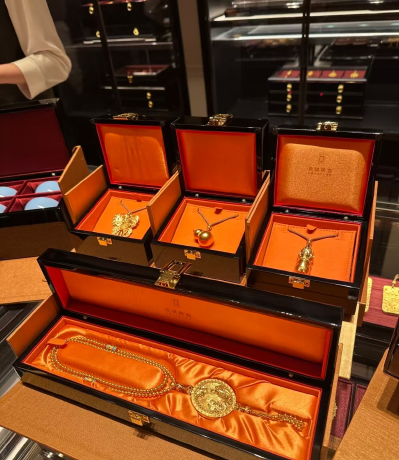 Laopu gold pendants as showcased by a vlogger on lifestyle and e-commerce app Xiaohongshu (RedNote)
In the hushed galleries of Beijing's SKP, often dubbed the world's busiest luxury department store, a scene unfolded in late January and early February that defied conventional market logic. Even as international gold prices soared, crowds still queued for their desired pieces. Some devoted enthusiasts camped overnight in tents to ensure they would be first through the doors in the morning. The objects of their desire were the creations of Laopu Gold, a fast-rising Chinese heritage gold jewelry brand. "I had to stand in line for about four hours to get a plain gold gourd pendant from the store. It's one of the most popular items and often sells out quickly. There were about 30 people ahead of me. I really admire the shop's gold craftsmanship," a Beijing resident surnamed Lin told Beijing Review on February 5. "Plus, the gourd symbolizes fortune and prosperity in Chinese, which makes it perfect for wearing during the Chinese New Year [which falls on February 17 this year]," she added. This phenomenon is no isolated case. From Beijing to Shanghai and Chengdu, stories of consumers waiting for hours to acquire a meticulously crafted gold piece have become commonplace. The long lines at Laopu outlets nationwide are a telling sign of a shift in the luxury market from an era dominated by big foreign brands to one increasingly defined by domestic, value-driven and culturally resonant ones. 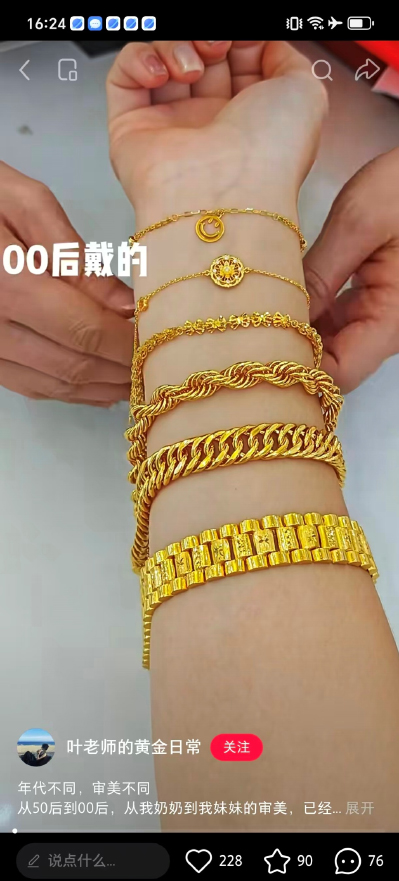 A RedNote user posts about the evolution of gold jewelry from the 1960s up to the 2020s (SCREENSHOT)
Coveted assets For decades, gold jewelry in China was largely transactional—purchased for its intrinsic metal value, often with designs prioritizing weight over aesthetics. It was once considered cumbersome and no match for modern, fashionable jewelry like Akoya pearl necklaces or shell bracelets. "Gold jewelry designs today are completely different from what I remember my mother and grandmother wearing," Yu Xue, a Beijing resident shopping for her "Three Gold Pieces" wedding set, told Beijing Review. "My mother's bracelet was very thick with bold, large patterns, and my grandmother's gold pieces didn't have the smooth finish you see today—they felt more rustic and textured." The Three Gold Pieces, typically a necklace, bracelet and ring, are traditional Chinese betrothal gifts from the groom's family, symbolizing commitment and prosperity. They also functions as a safety net for emergencies, as the gold can be sold if the family requires funds. "There's such a wide variety of styles to choose from nowadays, and even lightweight gold jewelry is beautifully designed. With gold prices so high right now, these smaller pieces are much more budget friendly. I'm thinking about getting a 30-gram gold piece crafted with Chinese heritage techniques, so I can pass it down to my daughters," Yu added. Heritage gold, or gufa huangjin, is not a single technique but a constellation of ancient, manually intensive arts. It encompasses hammering to achieve a soft luster; filigree (literally "flower threads" in Chinese), UNESCO-recognized intangible cultural heritage in which gold is drawn into delicate wires; and chasing, the art of hand engraving. The result is jewelry distinguished by its subtle texture and intricate patterns. This craftsmanship shines through in iconic contemporary pieces. Laopu's Filigree Diamond-Studded Auspicious Cloud Bracelet masterfully combines the brand's signature fine filigree work with discreet diamond accents. Similarly, Chow Tai Fook's Heritage Gold "Fortune Lock" Necklace uses ancient hammering and engraving methods, so that its surface possesses a uniquely soft, silky sheen—a deliberate contrast to the high-polish finish of ordinary gold jewelry. This heritage renaissance is being led by vanguard brands. Laopu Gold has achieved a cult-like status—with staggering success. According to data from HSBC, one of the world's largest and most prominent banking and financial services organizations, the Laopu store in Beijing SKP generated approximately 3 billion yuan ($415.5 million) in annual sales in 2025. Bao Lan, recently backed by investors including French luxury group Kering, stakes its identity on preserving pinnacle filigree craftsmanship. Lamchiu, with orders booked into late 2026, is defined by extreme customization and months-long lead times. "The popularity of heritage gold stems from multiple factors. First, it is driven by cultural identity. Heritage gold employs national-level intangible cultural heritage techniques, aligning with a consumer reverence for traditional culture. Second, it meets evolving aesthetic needs. The younger generation pursues pleasure-based consumption, and heritage gold satisfies both daily wear and the desire for gifts commemorating special occasions. Third, its investment attributes are reinforced. As a safe-haven asset, gold's value becomes more prominent amid global inflation and geopolitical risks. The high added value and scarcity of heritage gold further enhance its investment appeal," Zhan Junhao, founder of Fujian Huace Brand Positioning Consulting, told digital platform Cover News. Value of identity The consumer lining up at Laopu's door is part of a new, sophisticated demographic. According to a survey by business consulting and market research firm Frost and Sullivan, 77.3 percent of Laopu Gold's customers also shop at luxury houses like Louis Vuitton, Hermès, Cartier and Bulgari. This suggests that, when backed by the right brand strategy, Chinese heritage gold is poised to compete directly with, and potentially redefine, the very idea of luxury jewelry in China. "Many people assume that since heritage gold brands use gold as their material, customers are essentially just buying gold, which makes them 'not luxury.' I disagree," Li Ming, a second-hand luxury store owner in Shenzhen, told Beijing Review. "Take Laopu, for instance. Even when the market price of gold was just over 400 yuan ($58) per gram, Laopu's pieces were already selling for over 580 yuan ($83) per gram, and that's before we add the craftsmanship fees and extra charges for other gems set into the gold." "While I don't deny that rising gold prices have drawn more attention to these brands, I believe the mindset behind buying heritage gold jewelry has become very similar to that behind buying luxury goods," Li explained. "It means that customers are increasingly prioritizing design, craftsmanship, emotional value and brand story." "Another key benchmark for luxury goods is their performance in the second-hand market," Li added. "Heritage gold jewelry holds its value exceptionally well there. Pieces from Laopu or Jemper Gold that I received in late 2025 can typically be resold at 75 percent to 80 percent of their original retail price, with popular styles sometimes even exceeding 80 percent. This rate of value retention is notably higher than that of many conventional luxury brands." "This is why I believe that using gold is not a weakness for these premium brands, but rather a strategic strength. It creates a unique appeal across customer segments: Affluent clients are drawn to the sophisticated design coupled with strong brand image, while the mid-tier market appreciates the intrinsic investment value of the raw material itself." The ripple effects of this domestic boom are now being felt globally, positioning heritage gold at the center of the spotlight among luxury brands. In January, British newspaper Financial Times published a new piece analyzing Laopu's performance in its domestic market. The article claimed that the rise of high-end heritage gold brands could undermine the appeal of Western luxury goods in China. "Laopu is one of the first Chinese jewelry brands to build a luxury-like feeling not just selling gold, but turning heritage craft into repeatable retail," Erwan Rambourg, head of luxury at HSBC, told the paper. Financially, the brand's performance is also impossible to ignore. According to its 2025 interim report, Laopu Gold achieved a staggering year-on-year revenue increase of 251 percent to 12.35 billion yuan ($1.78 billion) and a net profit surge of 286 percent to 2.27 billion yuan ($330 million) in the first half of 2025. "Laopu Gold is rooted in Chinese culture. By offering products that showcase intangible cultural heritage and embody cultural expression, it fosters a sense of value perception, immersive experience and shared identity among consumers. This cultivates a 'luxury gene' based on the resonance of consumer values," Zhang Mengxia, Director of the Luxury Research Center at the University of International Business and Economics, told news portal China Economic Net. "Its unique Eastern aesthetics and cultural value are compelling enough to shine on the global luxury stage." Copyedited by Elsbeth van Paridon Comments to zhangyage@cicgamericas.com |
|
||||||||||||||||||||||||||||
|