
|
| China |
| A 20-year chase | |
|
|
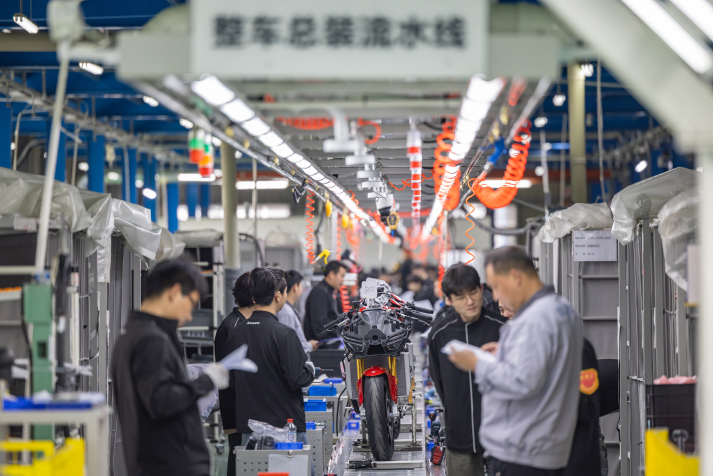 Workers operate on an assembly line at the production workshop of ZXMOTO in Chongqing Municipality on April 1 (XINHUA)
For two decades, Zhang Xue has been pursuing a dream—growing from a teenager who dropped out of school to become a motorcycle repair shop apprentice into a 19-year-old chasing a TV crew through cold rain for a chance to prove himself, and then into an aspiring entrepreneur who borrowed money just to stay afloat. But recently, one weekend in Portugal changed everything. On March 28 and 29, Zhang's Chongqing-based company ZXMOTO secured back-to-back victories in the WorldSSP category at the Superbike World Championship (WSBK) in Portimão, Portugal. French rider Valentin Debise crossed the finish line riding the 820RR-RS motorbike produced by Zhang's company, outpacing other global giants with a commanding lead of nearly four seconds. This was the first time a Chinese-made motorcycle claimed victory in a top-tier international competition, ending decades of dominance by European, American and Japanese brands. "I've waited 20 years for this moment," Zhang told media following the win. 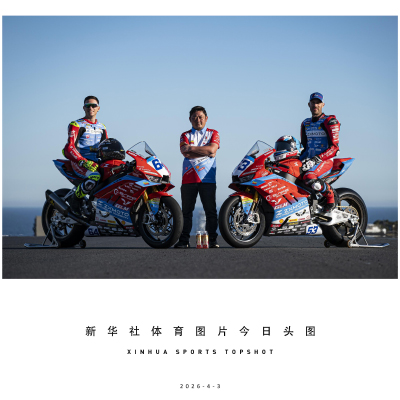 Zhang Xue (center), founder of ZXMOTO, poses with French rider Valentin Debise (right) and Italian rider Federico Caricasulo, at the Phillip Island Grand Prix Circuit in Australia on February 20 (XINHUA)
A self-driven man Zhang's story has the raw texture of a legend. Born in 1987 in a crumbling mud-brick house in rural Hunan Province, he fell in love with motorcycles at 14. He left school and began working in a motorcycle repair shop, harboring a dream to build a world-class, high-performance motorcycle. A turning point came in 2006. The 19-year-old Zhang rode 100 km along muddy roads through pouring rain to intercept a Hunan TV crew. Hoping for exposure that might land him a spot on a professional racing team, he performed daring stunts until his motorcycle broke down. The crew filmed him, the footage aired, and a professional team noticed. Zhang soon joined as a stunt rider and mechanic. That moment, Zhang said, changed everything, because it got him a spot in the industry he loved. Zhang trained hard. But after years of training, he realized his limitations as a race rider. Zhang told the newspaper Global Times. "I started training relatively late, so I never got very far as a racing rider." He saw another path to the podium: building bikes, not riding them. "Deep down, I felt that if the motorcycles I make win a championship, it's just like winning it myself. That belief is what has kept me going all these years," he said. 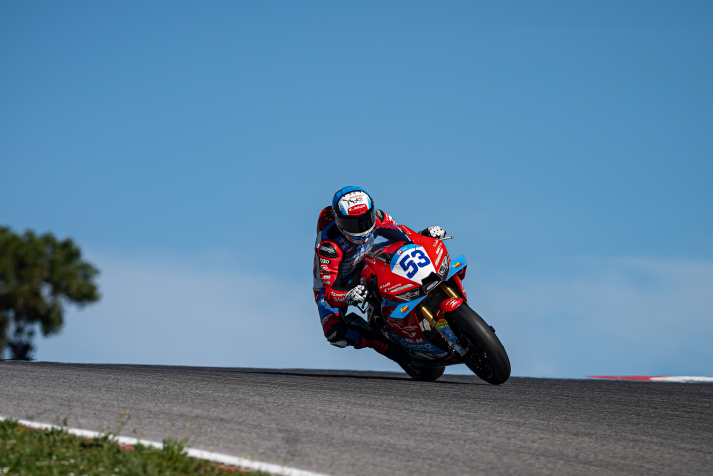 French rider Valentin Debise rides a ZXMOTO 820RR-RS at the Portugal round of the World Superbike Championship (XINHUA)
Changing track Zhang found a job at a motorcycle factory in Zhejiang Province in 2009. He started by learning how to piece together components into a complete motorbike. Four years later, he had gained a thorough understanding of the entire process, from designing new models, to manufacturing, and to managing the supply chain. In 2013, Zhang moved to Chongqing in southwest China, drawn by its strong industrial base. The city is home to major motorcycle manufacturers and parts suppliers. From engines and frames to electronic control systems, most components can be sourced locally. Starting with modifications, he gradually built a team, established a brand, and moved into independent research and development. In 2017, Zhang cofounded Kove Moto. But when he pushed to develop an in-house engine, his partners insisted on using existing engines. Zhang borrowed 10 million yuan ($1.47 million) personally from the company, promising to repay every cent if the project failed. The engine worked. The partnership did not. In March 2024, he resigned from the company he had built. "After careful consideration, I have decided to pursue my own path," he wrote on social media. Within a month, ZXMOTO was born. Within a year, its output value reached 750 million yuan ($104 million). Yet survival was never guaranteed. In February 2025, one month before launching ZXMOTO's first motorbike, the 500RR, Zhang knew he would not be able to pay March salaries. "I borrowed from my landlord, from my friends, from my suppliers," he told Xinhua. "If I knew you, I'd ask you too." He scraped together the money, paid his people, and sold the first batch. The company survived. Beyond the finish line The motorcycle that conquered the WSBK, the 820RR-RS, is nearly identical to the bike customers can buy for 43,800 yuan ($6,361), a fraction of the price of its European and Japanese competitors. Zhang points to two core strengths: lightweight design and performance setup. These gave Debise the ability to outbrake rivals and power out of corners with superior low-end torque. "From the first time I rode it, the feeling was great. Even with European or Japanese manufacturers, during the first test you always have some problems. This time we didn't have anything," Debise recalled his first ride during a recent interview with Xinhua. The impact of the victories has rippled across China's motorcycle market. Preorders for the 820RR surged 200 percent in three days, a livestream drew 6,000 viewers, and limited edition merchandise sold out, according to Xinhua. For many Chinese motorcyclists, ZXMOTO has transcended its role as a manufacturer. "It has broken the long-standing perception that imported high-end motorcycles are superior to domestic brands," a Chengdu-based enthusiast told the Global Times. Zhang himself is characteristically blunt, saying, "In 10 years, I hope there will be no distinction between imported and domestic motorbikes in terms of product quality and performance. ZXMOTO will be an international top-tier brand." He is equally frank about what remains undone. Asked why he didn't use a Chinese rider, he replied: "Because our Chinese riders aren't fast enough yet. There's no training system. There's no racing culture." His company has launched a support program offering a 1-million-yuan ($147,000) annual prize pool for young Chinese riders and hopes to establish a youth academy when annual production reaches 100,000 units—a target he expects to reach in two to three years. BR (Based on materials from the Global Times and Xinhua News Agency) Copyedited by G.P. Wilson Comments to wanghairong@cicgamericas.com |
|
||||||||||||||||||||||||||||
|