




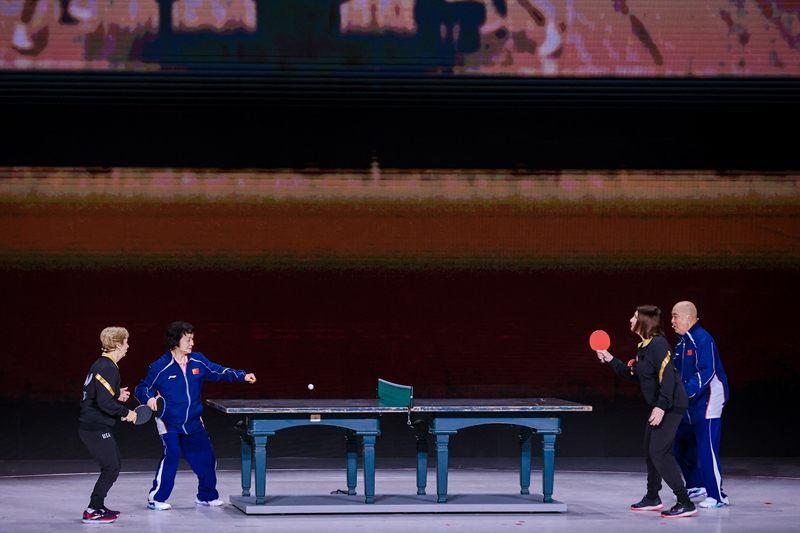
Trophies line the shelves—decades of competition, polished and still. Nearby sits something humbler: a handwoven bamboo basket, its surface worn smooth with age.
The basket appears empty, but for Sweeris, it never has been.
She received it from a rural Chinese weaver in April 1971, during a journey the impact of which no one fully understood at the time—eight days that would come to mark a turning point in one of the world’s most consequential geopolitical relationships. More than half a century later, the basket remains, holding not artifacts but memory: A reminder of how a chance encounter between strangers helped loosen a diplomatic impasse that had lasted for more than two decades and helped two peoples reconnect.
“They help me remember those days,” Sweeris told Beijing Review on April 10 in Beijing, where she attended an event marking the 55th anniversary of Ping-Pong Diplomacy. “Those eight days were enough to cherish for a lifetime.”
A beautiful mistake
Sweeris’ 1971 China trip began with a mistake: a wrong bus. In early April 1971, at the 31st World Table Tennis Championships in Nagoya, Japan, Sweeris’ teammate Glenn Cowan accidentally boarded Team China’s bus. At the time, the United States maintained no formal diplomatic relations with the People’s Republic of China—an estrangement that had endured since the People’s Republic’s founding in 1949. U.S. passports even prohibited travel to communist countries, including China.
The bus fell silent as Cowan realized his mistake. Then Zhuang Zedong, one of China’s leading players, stood up, greeted him and offered a small gift. That simple gesture broke the ice. Soon after, Cowan and another Chinese player Liang Geliang shared an impromptu practice session.
On the final day of the tournament, the Chinese Government extended a historic invitation to the American team. On April 10, 1971, a 15-member U.S. table tennis delegation arrived in Beijing with accompanying reporters, becoming the first American sports delegation to visit China in 22 years. Sweeris, then in her early 20s, was among them. She remembers the mixture of uncertainty and anticipation that accompanied the trip.
“I was a little nervous,” she said. “But I was also excited. We were going to play against the Chinese, who usually rank number one in the world in the sport that I love.”
Over the following eight days, Chinese and U.S. players played friendship matches before packed crowds. At the Capital Stadium in Beijing, Sweeris stepped onto the court before 18,000 spectators—an unimaginable number for a sport that, back home, rarely drew more than a few hundred.
The matches were only part of the story. The players met Premier Zhou Enlai in the Great Hall of the People in Beijing, toured the Great Wall and visited communes and schools, talking to ordinary Chinese.
Communication was often improvised. With few interpreters available, players relied on gestures, smiles and the shared language of sport. “You had a paddle in your hand, and so you might make gestures of how to hit a ball,” Sweeris said. “Or just smile.”
The visit became known as the beginning of Ping-Pong Diplomacy, a turning point that helped pave the way for then U.S. President Richard Nixon’s visit to China the following year and for the normalization of diplomatic ties in 1979.
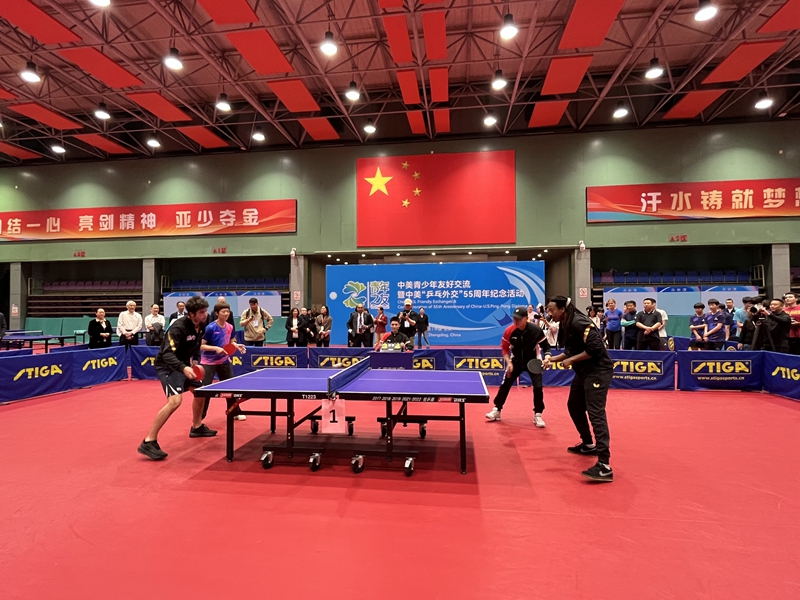
Young table tennis players from China and the United States play a friendly match at the Zhengding National Table Tennis Training Base in Shijiazhuang, Hebei Province, on April 11 (LI NAN)
Five words, 55 years
For Sweeris, the impact of the trip extended far beyond those eight days. Upon returning to the United States, she found herself in demand as a speaker, invited to share her impressions of a country that remained largely unfamiliar to American audiences. She traveled widely, describing not only the matches but also the encounters that surrounded them.
“I felt like an ambassador for peace,” she said. “It was my duty to keep sharing, to keep that connection alive.”
Over the following decades, she returned to China five times, observing changes that she describes in distinctly personal terms. She associates each visit with a single word that reflects her own experience.
In 1971, that word was “anxious:” She was stepping into the unknown. In 1997, it was very “welcoming,” she said, describing both China’s increasing openness and a period of relatively stable bilateral engagement between peoples once separated by decades of distance. In 2006, the trip offered a glimpse of China’s “astounding” pace of development—soaring skylines, busy streets and a society in rapid ascent. In 2011, returning to familiar places and reconnecting with people she had met decades earlier felt “heartwarming.” In 2026, the word she chose was “nostalgic,” though she frames that sentiment less as a longing for the past than as recognition of how much has changed.
Her words, coincidentally, echo the arc of China-U.S. relations over five decades—once distant and uncertain, later open and energetic, and now layered with complexity, memory and enduring ties.
The commemoration of the 55th anniversary of Ping-Pong Diplomacy she attended in Beijing came at a time when relations are again marked by tension—trade disputes and competing narratives. The optimism of earlier decades has given way to a more complicated reality.
And yet, standing in the Chinese capital, she sees not only what has changed, but what endures. “Relationships are like a marriage,” she said. “You’re going to have some ups and downs. You’re never going to agree 100 percent. But through communication, you can begin to understand each other’s cultures and work out those problems.”
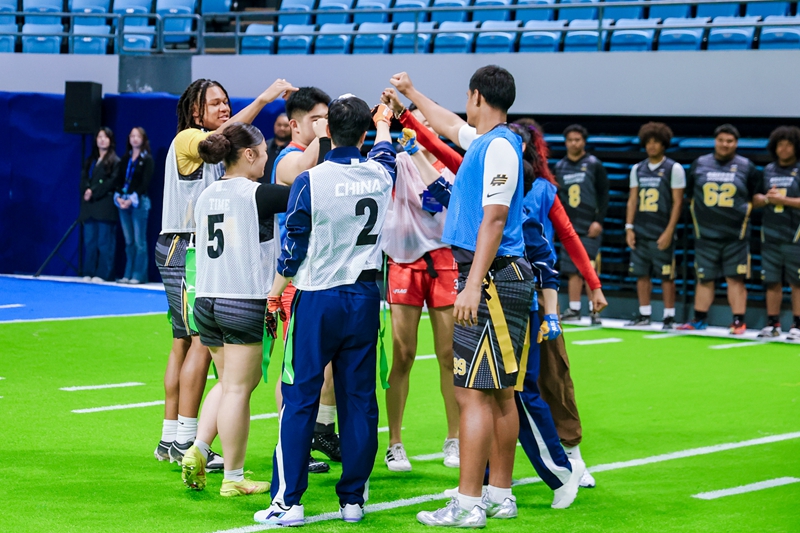
Flag football players from China and the U.S. play a friendship match during an event marking the 55th anniversary of Ping-Pong Diplomacy in Beijing on April 10 (COURTESY PHOTO)
Youth engagement
Time, however, has thinned the ranks of those who first carried the message of Ping-Pong Diplomacy. Of the original 15 American players who traveled to China in 1971, only four are still alive. The youngest are now in their 70s; the oldest in their 90s.
Sweeris, nearing 79, continues to speak, to travel, to tell the story and to encourage young people to carry the Ping-Pong Diplomacy legacy forward and engage in people-to-people exchange. “These exchanges truly enrich your life. In that moment, you become an ambassador for your country,” she said. “If we do so, our two countries can get more on an even keel. And we’ll begin to have, hopefully, global peace.”
Jan Carol Berris echoed her views. As vice president of the National Committee on U.S.-China Relations, she has been deeply engaged in the Ping-Pong Diplomacy anniversary activities since 1972. She believes that the two governments should further support young generations to participate in people-to-people exchanges. “The youth are the future,” she told Beijing Review. “And that’s why I’ve been pleased to see this 55th anniversary celebration is focused really on the youth. There are a lot of young people who have come in from America this year.”
Among those marking the 55th anniversary this year were dozens of young Americans, many visiting China for the first time. Like the players before them, many of them arrived with assumptions shaped at a distance—by headlines, by politics and by the abstractions of geopolitics.
“Back in the United States, I had heard that Chinese people might not be very friendly to foreigners,” said Vihan Bagal, a student at the University of Washington who took part in the anniversary celebrations in Beijing this April. “But when I arrived, that changed quickly. People were incredibly friendly—super helpful.”
For Bagal, table tennis became more than a game. It became a shared language. “Even if we don’t speak the same language, we can connect through playing,” he told Beijing Review. “It was this kind of direct human connection—made possible through Ping-Pong Diplomacy—that allowed such bonds to form.”
The games themselves have evolved. Alongside table tennis, participants in this year’s exchange activities included players of pickleball and flag football. A dozen youth sporting events were held during the anniversary celebrations, each offering a different way to bridge the same divide.
The tools may change. The principle does not. Sweeris said she believes face-to-face exchange remains essential. “It breaks down barriers,” she said. “It promotes understanding between people. Sports can play a role in that.”
Back home, Sweeris’ bamboo basket remains where it has always been.
Unmoved. Unfilled. Unforgotten. BR



