
|
| China |
| A jade carver's quiet philosophy of accepting material, difference and the forms life takes | |
|
|
|
There is a quiet thread that runs through the life of Cheng Lifang, though he rarely names it directly.
It begins in a household filled with the scent of wood shavings. His grandfather was a traditional woodcarving master in Huizhou, a historic region of Anhui Province in east China, known for its intricate architectural carving traditions. As a child, Cheng watched wooden sculptures slowly weather under sun and rain. Beauty, he noticed early on, was fragile when exposed to time. One question stayed with him: What kind of carving could withstand time? His father gave a simple answer: stone. And among stones, jade. He did not fully understand it then, but something had already taken root. Years later, Cheng would enter the field of jade carving, studying in Nanyang, Henan Province, one of China's centers for jade craftsmanship education. But for him, carving was never only about technique. It was about perception. He said sculptural work rests on two foundations: drawing and carving. One is rooted in visual language and sensibility while the other is physical execution. While many students begin with carving technique, Cheng took a different path—he studied painting first. He immersed himself in classical landscape painting styles of the 10th to 14th centuries. Eventually, he found himself drawn to artists including Dong Yuan (ca. 937-962), Mi Fu (1051-1107) and Huang Gongwang (1269-1354). Despite their differences, he noticed a shared quality: an effortless naturalness, a refusal to over-design or force expression. This shared quality became his aesthetic compass. In his words, the role of the carver is not to impose form onto jade, but to "open a window" so that the material's own traits can be seen. In China's contemporary jade industry, perfection is the prevailing standard: no cracks, no impurities and no "flaws." Cheng rejects this. To him, every piece of jade has its own internal structure, its own destiny shaped by geological time. "There is no such thing as good or bad jade," he told Beijing Review. "To judge it too quickly is to block your perception of natural beauty." Landscapes of memory Cheng often speaks of mountains and mist. He grew up near Jiuhua Mountain in Anhui, one of the four sacred mountains of Chinese Buddhism. On rainy days, clouds would descend so low that they seemed to move alongside people. This image stayed with him. Years later, living and working in Beijing, far from his hometown, he began carving a recurring theme: cloud landscapes. But rather than reproducing traditional visual motifs, he sought something more fluid. 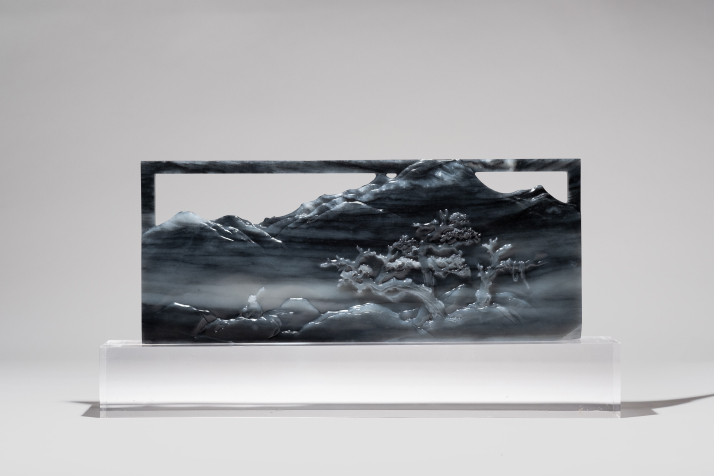 Jade carving Xianwai, part of Cheng Lifang’s New Cloud-Capped Mountain series (COURTESY PHOTO)
In classical Chinese decorative arts, clouds are often rendered through defined patterns of lines, a method refined over centuries for teaching and reproduction. Cheng deliberately moved away from this system. Instead of carving the hard outlines of clouds across the surface of the jade, he developed a technique of creating softer undulations that conform to existing patterns and shapes within the jade. In this way, he allows volume, density and light to emerge from within the jade itself. Through this method, the material's natural contrast of black and white becomes mist and sky. The landscape is no longer drawn; it is revealed. For him, this was not only a stylistic shift but a conceptual one. Clouds, after all, do not have fixed boundaries. They move, dissolve and re-form. To carve them rigidly would be to misunderstand their nature. He calls this style his New Cloud-Capped Mountain—not new in appearance alone, but in intention: a way of expressing flow, impermanence, aiming to evoke a state often described in Buddhist thought—formless, unbound, coming from nowhere and going nowhere. Cheng often describes himself as being "planted" in Song Dynasty (960-1279) aesthetics. Song art, in Chinese cultural history, is known for its restraint, literati spirit and quiet emotional depth. It values suggestion over declaration, atmosphere over spectacle. Yet Cheng is also aware that he is a contemporary individual living in a rapidly changing world. Tradition, for him, is not a destination but a grounding soil. "I want to plant myself in more soils," he said. This desire eventually led him beyond the studio. Seven days in Ethiopia The turning point came through a random conversation with a staff member from the Chinese Embassy in Ethiopia in March 2025. He learned of a school in Addis Ababa, Ethiopia, dedicated to children with Down syndrome. Over five years, the institution had made significant progress in healthcare, nutrition and education. But one challenge remained unresolved: employment. Cheng suggested trying something unusual—introducing Chinese handcraft as a vocational pathway, a project he named Hands and Stars. He chose lacquerware, one of China's oldest craft traditions. Unlike carving, lacquer work is less dependent on precision form and more on repetition, patience and sensory engagement. Multiple layers of natural lacquer are applied, dried and polished over time to reveal depth and texture. For Cheng, this mattered. He saw that the students had something essential for this craft: time, focus and consistency. But there was a problem. Traditional lacquer training requires around 60 days. However, his schedule allowed only seven days to complete it. So he restructured the entire teaching system. He designed what he called a "reverse layered teaching method." Instead of starting from the beginning, students began with the final stage—polishing a nearly finished object. The first day, they experienced completion. Only then did they move backward through the process: applying lacquer, mixing materials, preparing the base. Each step was pre-designed in advance, with prepared kits allowing the workflow to function within a compressed timeframe. He also had to adapt to environmental conditions. Addis Ababa's climate—cool temperatures and high humidity during the rainy season—made traditional drying processes unstable. To solve this, he designed a controlled temperature-humidity system to stabilize production conditions. Seven days later, the students had learned the craft. Working with Abadula Gemeda, former Speaker of the House of Peoples' Representatives, the lower chamber of Ethiopia's parliament, and founder of the Deborah Foundation, a non-profit organization dedicated to improving the lives of Ethiopian youth born with Down syndrome, Cheng also helped establish the 1+2+10+100 Framework: Over one year, two Chinese crafts would be introduced, 10 local teachers trained, and 100 collaborative works created in honor of World Down Syndrome Day (March 21) 2026.  Cheng Lifang, the initiator of Hands and Stars, and Abadula Gemeda, former Speaker of the House of Peoples’ Representatives, the lower chamber of Ethiopia’s parliament , and founder of the Deborah Foundation, jointly sign the 1+2+10+100 Framework in Addis Ababa, Ethiopia, in March 2025 (COURTESY PHOTO)
A year later, the project had grown into something more tangible: 10 Ethiopian teachers are independently leading instruction. Their works were exhibited and sold on World Down Syndrome Day, allowing the program to continue sustainably. "This is the first time Chinese handicraft has taken root in this way in a special education school in Africa," Cheng often tells people. A philosophy of equality What connects Cheng's artistic practice to his educational initiative is not strategy, but perception. In his carving studio, he refuses to rank materials by perfection; in his teaching, he refuses to define people by limitation. For him, jade and human beings share a fundamental trait: shaped by time, environment and variation. Neither needs to be corrected into uniformity in order to have value. In that sense, whether in a piece of jade or in a classroom in Addis Ababa, his approach remains consistent: not to overwrite what exists, but to reveal it—to open a window, and allow what is already there to be seen in a more beautiful way. (Print Edition Title: What Jade Refuses) Copyedited by G.P. Wilson Comments to kangcaiqi@cicgamericas.com |
|
||||||||||||||||||||||||||||
|