
|
| China |
| From fiction to reality | |
|
|
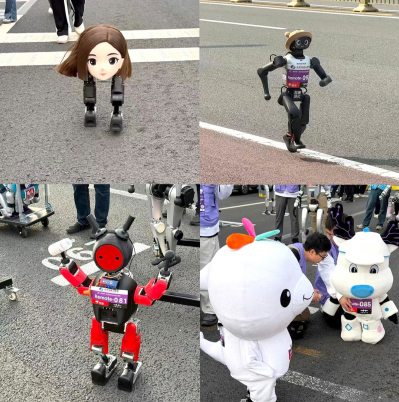 Robots compete at the annual humanoid robot half-marathon, held in the Beijing Economic-Technological Development Area, also known as Yizhuang or E-Town, in Beijing on April 19 (XINHUA)
In 2023, a short story collection titled Living With Robots won China's Nebula Award. Its protagonist is LW31, a warm, clumsy, endearing and utterly unthreatening robot. The author imagined a future in which robots weren't conquerors but roommates. Another writer, Jiang Bo, published The Gate of Machines around the same time, envisioning a darker path: human-machine integration that blurred the line between person and machine. Ask any Chinese science fiction (sci-fi) fan who grew up with these stories, and they'll tell you the same thing: The future arrived faster than anyone expected. "When I was a little girl, I remember reading stories of robots becoming housekeepers and butlers for humanity, taking charge of everything from menial chores to decision making. Twenty years later, robots are already able to run faster than humans, beat humans in physical strength, become chess masters and surpass humans in brain power," 24-year-old sci-fi reader Zhang Moning, told Beijing Review. "I guess I never would have imagined technologies like robotics and autonomous driving would develop so fast." A part of life Zhang's words reflect how the latest achievements of the robot industry are permeating the lives of ordinary people. Discussing robots beating humans in speed, Zhang referred to the recent robot marathon event that has made headlines globally. On April 19, the Beijing Economic-Technological Development Area, also known as Yizhuang or E-Town, in Beijing hosted its second annual humanoid robot half-marathon. More than 300 humanoid robots from research labs and startups across China and even overseas took part in the race alongside human runners. Some robots stumbled. Some needed battery swaps. But some finished entirely autonomously. The event was livestreamed to millions globally. For fans who grew up reading Jiang Bo's Soul of the Machines, seeing robots running through a Beijing suburb was both surreal and ordinary. "Many robots featured in sci-fi stories are either saviors or destroyers of human civilization," Zhang said, "and watching them run is kind of humorous." Off the racetrack, robots are turning sci-fi into reality in other ways. In March 2026, the world's first robot-run senior wellness hub opened its doors in Yizhuang. More than 40 types of robots are spread across a 1,100-square-meter, four-story facility, including cooking robots, massage robots, chess-playing robots, companion robots and exoskeleton robots for rehabilitation. The facility is now serving thousands of residents, with daily foot traffic exceeding 300 visitors. According to data from third-party agency ASKCI Consulting Co. Ltd., released in March, the Chinese market for elderly care robots is expected to reach 10.4 billion yuan ($1.5 billion) by the end of 2026. Stations like this one are turning what was once a "booth product" at tech expos into an everyday reality for ordinary people. "Science is a universal language. The deeper function of sci-fi is that it allows societies to prepare for the future before it arrives," Tian Tian, a Chinese-Japanese sci-fi literary translator, told Beijing Review. A part of the economy Science fiction is no longer just a literary genre; it has become a catalyst for real-world infrastructure and immersive consumer spending. Sci-fi stories are moving off the page and into physical spaces where fans can touch, feel and live inside the imagined worlds they love. The numbers tell part of the story. At the 2026 China Science Fiction Convention alone, held over three days in Beijing's Shougang Park, total foot traffic reached 216,000, up nearly 70 percent from the previous year, generating 5.92 million yuan ($820,000) in revenue. At the center of this shift is the blending of two previously separate fan groups. Tian has observed this convergence from within the fan community. On one side are the traditionalists: readers who discovered sci-fi through Science Fiction World magazine in the 1990s, who debate hard science and philosophical implications. On the other are the new wave: fans who entered through films, games and cosplay, who express their passion through fan fiction, merchandise and themed travel. The entering of fresh forces into the sci-fi fan community gives industries more commercial opportunities. "Traditionally, the 'fan economy'—driven by big-name intellectual properties (IPs) like The Wandering Earth and The Three-Body Problem—and the old-school sci-fi reading crowd hardly overlapped," she said. "Now they are gradually blending." The passion of sci-fi fans fuels the proliferation of sci-fi-themed physical spaces. In March, the Liu Cixin Sci-Fi Comics Universe Exploration Center opened in Beijing's Tongzhou District. The 2,000-square-meter facility, repurposed from a former aluminum factory, translates six of Liu's classic works into five themed immersive experience zones and a panoramic interactive theater. Visitors can join the Earth Defense Force in The Wandering Earth zone or participate in a virtual reality (VR) shooting battle in the Devourer immersive theater. Projected to receive over 70,000 visitors annually, the center serves both as a science education classroom and a pilgrimage site for fans. Dan Fan, former editor at magazine Science Fiction World, said diverse forms of commercialization are key to development of sci-fi. "The importance of adapting sci-fi intellectual property (IP) into other forms, including films and games or offline events, can't be overstated. Without them, the revenue from sci-fi reading wouldn't increase—it would likely decrease," Dan told Beijing Review. "As the biggest sci-fi IP in China right now, The Three-Body Problem has seen many attempts [at adaptation] and achieved a lot of success. TV dramas, LBE experiences, games and films are all on the way, along with some crossover projects." However, Dan believes novels remain the groundwork of IP development. LBE, or location-based entertainment, refers to physical venues, such as VR theaters, theme park attractions and immersive exhibits where people go to experience sci-fi worlds firsthand. "No matter how the experience changes, people need the unique sense of wonder sci-fi provides to remain the same. Many people working on sci-fi games today grew up reading sci-fi novels. So while sci-fi literature may not be the main part of the industry, it still acts as an 'upstream' force through IP adaptation or by influencing the people who make sci-fi content. That said, original IPs from games and films are also a major, and sometimes primary, part of sci-fi's growth," Dan added. The maturation of China's sci-fi IP ecosystem is the momentum behind this industry expansion and explosion. According to data released at the 2026 China Science Fiction Convention in Beijing, sci-fi cultural tourism alone generated 27.77 billion yuan ($3.83 billion) in 2025, with immersive experiences such as VR spaces, themed parks and interactive exhibits growing at double-digit rates. "I believe the path for science fiction will continue to broaden. First, it will appear more frequently in visual formats such as games and films, be seen and discussed more widely on the Internet, and see more cross-industry collaborations," Tian said. "As for sci-fi cultural tourism, it will likely require a stronger base of visual works and a more solid fan following before it can truly take off. In short, sci-fi elements, perspectives and ways of thinking will no longer be confined to the single category of fictions. Instead, they will integrate into works of all kinds, becoming the cultural backdrop of this hi-tech era of our country." Copyedited by G.P. Wilson Comments to zhangyage@cicgamericas.com |
|
||||||||||||||||||||||||||||
|








