
|
| China |
| Architects of dignified old age | |
|
|
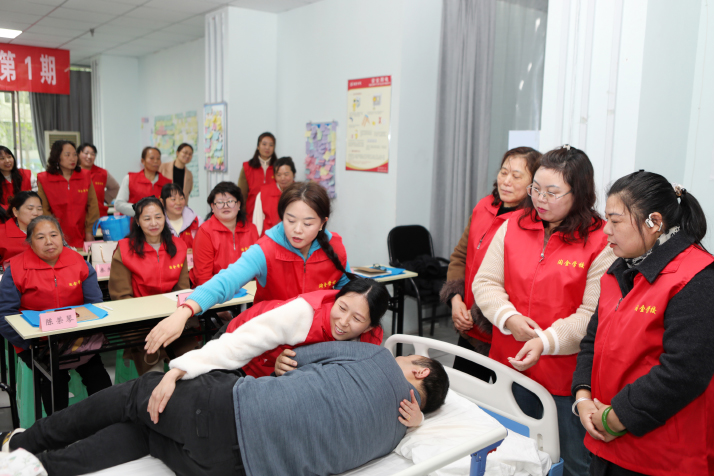 Trainees learn practical senior care skills through a long-term care provider training program at a vocational school in Yongchuan District, Chongqing, on March 23 (VCG)
The traditional perception of caregiving in China, often steeped in familial obligation and informal labor, is undergoing a transformation. A new, professionalized force is emerging: the long-term care providers. No longer mere "caregivers," these individuals are recognized as skilled professionals, meticulously trained and certified to offer specialized support to the nation's growing senior population. Lin Danni (pseudonym), a long-term care provider based in Chengdu, Sichuan Province, exemplifies this shift. Her daily routine, which includes "assisting with turning over, back tapping for sputum removal, oral hygiene, bedsore care," is not a series of generalized tasks but a precise sequence within a framework of standard procedures. As she told Legal Daily newspaper, "We are not caregivers, but professionally trained and certified long-term care providers." The emergence of the long-term care provider as an officially recognized profession, with national occupational standards released in 2024 and skill level certification launched in 2025, is intrinsically linked to the development of China's long-term care insurance (LTC insurance) system. This social safety net, designed to reimburse a substantial proportion of the cost of basic living care and related medical services to individuals unable to care for themselves, has spurred the demand for a trained workforce. Since China began piloting LTC insurance in 2016, nearly 310 million people have enrolled, and over 3.3 million people with disabilities have benefited from the program. As of 2025, it was piloted in 49 cities, mostly megacities, across China. In late March, authorities issued guidelines laying out plans to expand the scheme nationwide by 2028, with funding to come from a combination of employers, individuals, government and social resources. As of 2025, China was home to 323.38 million people aged 60 and above, accounting for 23 percent of the total population. This demographic is projected to surge past 350 million, or over 25 percent of the population, by 2030 as the nation transitions toward a rapidly aging society. Long-term care providers are equipped with comprehensive knowledge in basic life care and nursing, enabling them to deliver services covering daily needs, medical nursing, functional maintenance and psychological support. Currently, eligible insured persons with disabilities can choose from three main types of long-term care services. Home-based care involves designated institutions sending staff to provide services at the client's residence. Community-based care, such as daycare centers, offers non-residential, part-time services conveniently located nearby. Institutional care provides full-time services to individuals residing in designated facilities. Individuals can select the care that best suits their needs. Professional care In total, China now has 12,000 certified long-term care providers. Many have entered this new profession with a sense of purpose. "I chose the profession of long-term care provider because of its professional value and social significance," Lin said. Lin's journey started with a vocational nursing program in senior care, rehabilitation, disability support and psychological comfort. Once in the field, she quickly grasped the profound responsibility of the work. Her clients, mostly frail, partially incapacitated seniors with chronic illnesses, require exceptional skill, making caregiving a difficult but profoundly meaningful calling. "Every time I go to a client's home, I must be completely focused and cannot afford the slightest carelessness," Lin emphasized. She explained that the work is guided by stringent professional standards, operational specifications and precise service procedures, ensuring safety and quality. Traditionally, "informal" caregiving suffered from inconsistent quality. Families often struggled to find suitable caregivers. The LTC insurance system addresses this by implementing strict admission qualifications, systematic vocational training and standardized supervision. This builds a reliable system for service quality. To ensure high-quality, accessible care, the National Healthcare Security Administration (NHSA) has developed a unified national directory of 36 essential long-term care services for severely disabled individuals. This includes daily living care (assistance with eating, bathing and oral hygiene) and basic medical nursing (sputum suction and catheterization). Taking "assisting with eating" as an example, the directory clarifies that completing this service requires seven steps that come with service requirements: Washing hands before meals, cutting and mixing food, maintaining a correct eating posture, testing the temperature of hot foods and liquids, watching for signs of difficulty swallowing, keeping the person sitting upright for at least 30 minutes after the meal to prevent reflux, aspiration or choking, and recording food intake. 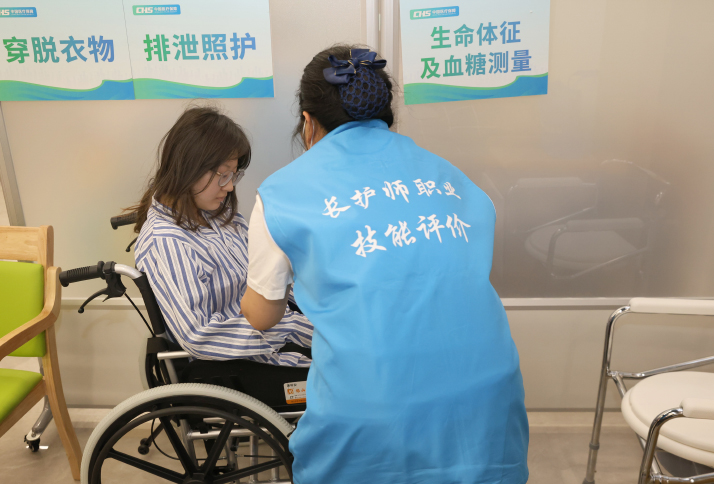 A candidate undergoes a practical skills examination for the long-term care provider occupational skill certification at a test site in Nantong City, Jiangsu Province, on April 19, 2025 (VCG)
Talent gap Currently, long-term care provider services are available in every provincial-level region. However, the number of such providers obviously falls far short of the demand, as approximately 35 million elderly people in China are disabled. This widening gap between the supply of and demand for professional care providers is exacerbated by China's rapidly shifting demographic structure. China's one-child policy, in effect from 1980 to 2015, limited most urban families to a single child. It was succeeded by a two-child policy in 2016 and then a three-child policy in 2021. The one-child policy has led to the "4-2-1" family structure (four grandparents, two parents, one child). As the only child has grown up and gotten married, this couple now faces the dual burden of supporting four elderly parents while also raising their offspring. "The human resources and time that traditional family care relies on are rapidly eroding," Wang Yanyan, Deputy Director of the Medical Insurance Research Office at the Chinese Academy of Labor and Social Security, told People's Daily newspaper. This demographic shift highlights the growing need for professionalized senior care solutions. "As China's population aging intensifies and average life expectancy keeps going up, the time that seniors have to live with chronic illnesses will extend," Wang stated. This will inevitably drive up social demand for long-term care. In terms of duties, the long-term care providers have to deal with individuals with physical or cognitive disabilities rather than general senior care, which means they need to meet much higher requirements. However, before the long-term care providers was recognized as a profession, most caregivers in senior care institutions had been over 45, with many in their 50s. The assessments and standards for long-term care providers are more rigorous and detailed, covering both theory and practical operation, and posing challenges for some older caregivers to adapt. Xu Qian, a manager at a senior care institution in Jiangsu Province who has also obtained a long-term care provider certificate, told People's Daily that the future of this profession needs the influx of more young people. This requires not only a shift in societal perceptions but also a clearer professional advancement pathway, allowing practitioners to envision a predictable trajectory for growth. Recognizing this, the NHSA and the Ministry of Human Resources and Social Security have jointly designed a full-fledged vocational training program for long-term care providers. Improvement in the long-term care system, together with growing technical complexity and professional value, makes it a more attractive and dignified career for young people. Yuan Di, a young provider from Chongqing, told Legal Daily: "The profession has standards and development pathways—these are among the core reasons I chose this career." With the growing formalization of the field, long-term care becomes a career with potential for growth, not just a job. BR Copyedited by Elsbeth van Paridon Comments to jijing@cicgamericas.com |
|
||||||||||||||||||||||||||||||
|