
|
| China |
| Top China-U.S. leaders meet to set a new course for bilateral relations | |
|
|
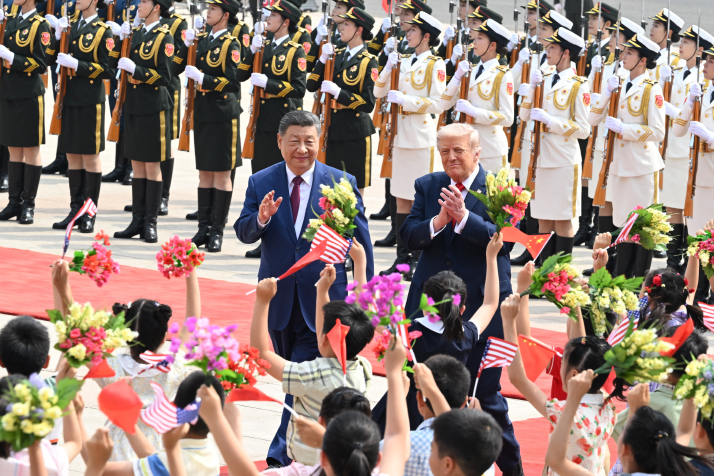 Chinese President Xi Jinping hosts a welcome ceremony as part of U.S. President Donald Trump’s state visit to China, outside the Great Hall of the People in Beijing, on May 14 (XINHUA)
"Achieving the great rejuvenation of the Chinese nation and making America great again can go hand in hand. We can help each other succeed and advance the wellbeing of the whole world," Chinese President Xi Jinping said at the welcome banquet in honor of U.S. President Donald Trump's state visit to China on May 14. It has been nearly a decade since an occupant of the White House in Washington, D.C. last walked into the Great Hall of the People in Beijing. But when Air Force One touched down on the evening of May 13, cutting through the thick haze of geopolitical mistrust, it was not merely a state visit; it was a recalibration. While holding talks with Trump the next day, Xi said that he expects 2026 to be a "historic, landmark year" that opens up a new chapter in China-U.S. relations. The two countries have more common interests than differences. Success in one is an opportunity for the other, and a stable bilateral relationship is good for the world, he said. Noting that China and the United States should be partners instead of rivals, Xi said the two countries should help each other succeed and prosper together, and work toward finding the right way for major countries to get along well in the new era. According to the Chinese leader, both sides have agreed to work toward building a constructive bilateral relationship of strategic stability. According to the Chinese Foreign Ministry readout released on May 14, Xi described this vision as "positive stability with cooperation as the mainstay, healthy stability with competition within proper limits, constant stability with manageable differences and lasting stability with expectable peace." Analysts agreed that the visit was not designed to eliminate all structural differences between the two sides, but to set clear guardrails for competition, resume effective communication channels and guide the overall course of China-U.S. relations amid uncertainties. 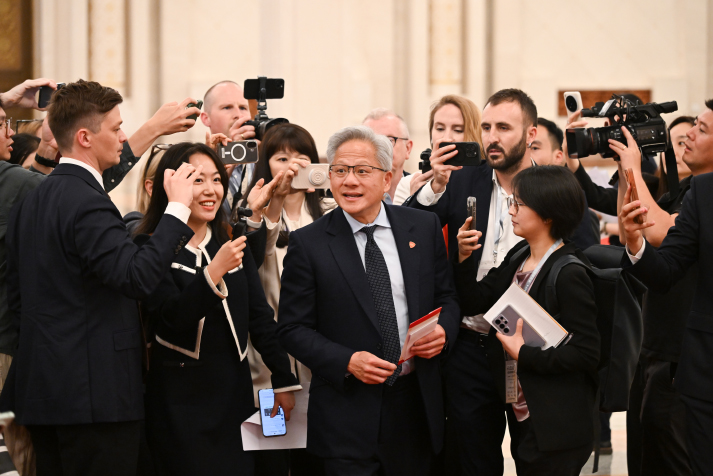 CEO of U.S. tech giant Nvidia Jensen Huang (center), one of the U.S. business community representatives accompanying President Donald Trump on his visit to China, at the Great Hall of the People in Beijing on May 14 (CNSPHOTO)
Steering wheels and red lines
Head-of-state diplomacy serves as the main steering wheel that adjusts the overall trajectory of China-U.S. relations amid complex and evolving bilateral dynamics. Since last year, Xi has had five telephone conversations with Trump, exchanged letters multiple times and held a face-to-face meeting in Busan, the Republic of Korea (ROK), on the sidelines of the 32nd APEC Economic Leaders' Meeting, engaging in strategic communication on China-U.S. relations and the international situation. Gao Fei, President of China Foreign Affairs University, said that the meeting arrived at a pivotal historical time, as bilateral ties have long been trapped in unstable fluctuations. The in-person dialogue helped both sides clarify strategic intentions, reverse the tendency of strategic misjudgment, and lay a foundation for normalized high-level communication. After a period defined by tariff wars, tech curbs, military rivalry and geopolitical fragmentation, this visit was well-timed as both sides aim to stabilize ties without shifting core strategic stances, Einar Tangen, a U.S. commentator and senior fellow with Center for International Governance Innovation, told Beijing Review. Chinese Ambassador to the U.S. Xie Feng reaffirmed that China remains committed to mutual respect, peaceful coexistence and mutually beneficial cooperation. The meeting's most important function was to prevent strategic miscalculation and stop frictions from escalating into full decoupling, Sun Chenghao, a researcher at the Center for International Security and Strategy at Tsinghua University, said. The U.S. delegation accompanying Trump on his visit to China sends dual political and economic signals. Strong business representation underscores that despite strategic rivalry, major U.S. firms view China as central to global manufacturing, supply chains and consumer markets. Politically, it reflects Trump's transactional diplomacy, centered on deals, investment and economic leverage, Tangen said. Meanwhile, consistent with China's long-standing diplomatic stance, core red lines involving national sovereignty, territorial integrity and fundamental development interests remain non-negotiable in all discussions. Noting that the Taiwan question is the most important issue in China-U.S. relations, Xi told Trump that if handled properly, the bilateral relationship will enjoy overall stability. Otherwise, the two countries will have "clashes and even conflicts," putting the entire relationship in great jeopardy, Xi said, emphasizing that "Taiwan independence" and cross-Straits peace are as irreconcilable as fire and water. The Taiwan question is the most important and sensitive core issue in China-U.S. relations, and a red line that cannot be crossed, Wang Dong, Executive Director of the Institute for Global Cooperation and Understanding at Peking University, told Beijing Review. The two sides must form verifiable and supervisable guardrails—opposing separatist acts pursuing "Taiwan independence," stopping arms sales to the island province and ending "high-level official" exchange, he added. 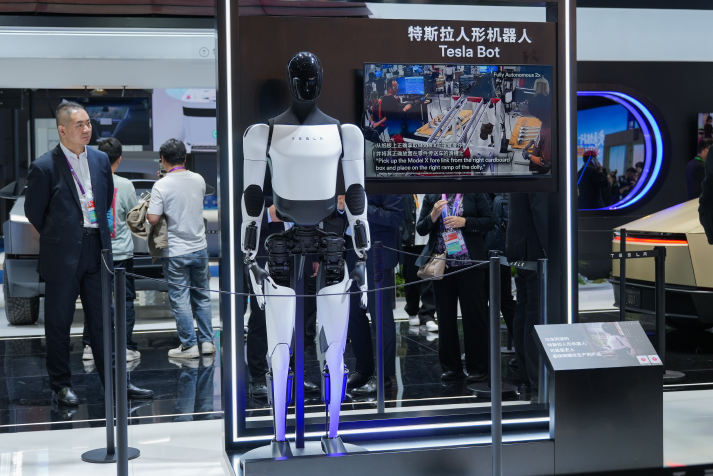 Tesla’s humanoid robot at the Tesla booth of the Eighth China International Import Expo in Shanghai on November 5, 2025 (XINHUA)
Board of Trade Economic and trade cooperation, long regarded as the most solid ballast of China-U.S. relations, stood as the most pragmatic and outcome-oriented topic of the visit. Despite years of trade frictions, tariff adjustments and supply chain restructuring, the economic interdependence between the two largest global economies remains deeply entrenched. According to the General Administration of Customs of China, China is the United States' third largest export market and third largest source of imports, while the U.S. is China's largest goods export market and third largest import source. "The economic gravity between the two countries remains immense," Chen Wenling, a senior researcher at the Academy of Contemporary China and World Studies, told newspaper China Daily. "Even as trade tensions and geopolitical risks cast a shadow, the fundamental drivers of China-U.S. complementarity have not disappeared." Chen said that the U.S. leads in financial markets and retains major hi-tech advantages, while China's edge in market scale, supply chain depth and rapid innovation is equally real. Sean Stein, President of the U.S.-China Business Council, said: "If you just say they're the two largest economies, you're missing the most important part. They're also the two most dynamic and most innovative economies. It is when you add the innovation and dynamism pieces that you truly recognize the need for the two countries to find ways to work together more effectively." Data released by the Chinese Embassy in the U.S. in November showed that more than 80,000 U.S. companies had invested in China, while 7,000 Chinese firms were operating in the U.S. Diao Daming, Vice Dean of the National Academy of Development and Strategy at Renmin University of China, told China Central Television that both countries have strong practical needs to stabilize economic and trade ties. The U.S. focuses on expanding exports of agricultural products and energy goods, optimizing market access conditions and easing domestic industrial and employment pressures, while China prioritizes maintaining the stability of industrial and supply chains, safeguarding the legitimate rights and interests of domestic enterprises, and promoting fair and inclusive bilateral economic competition. He stressed that both sides need to "take a long-term and holistic view" to expand incremental cooperation while properly resolving stock differences. U.S. business and academic circles have delivered positive evaluations of the economic and trade talks that took place during the visit. Harley Seyedin, President of the American Chamber of Commerce in South China, told China Daily that the visit offered a critical opportunity to move beyond confrontation and toward practical cooperation, emphasizing that "cooperation between Washington and Beijing is not simply beneficial for U.S. and Chinese citizens; it is essential for global growth and international confidence." The visit sends a strong stability signal to global markets, curbing widespread market anxiety over bilateral decoupling and confrontation, China-focused author and television producer Robert Lawrence Kuhn said. Sourabh Gupta, senior fellow at the Institute of China-America Studies, and independent think tank, said that stable China-U.S. economic and trade cooperation is essential for global industrial chain security, cross-border investment confidence and global economic recovery. He emphasized that pragmatic negotiation rather than confrontational rhetoric lays a solid foundation for reviving bilateral economic and trade dialogue mechanisms. Xi revealed at the meeting with Trump that the economic and trade teams of the two countries had produced "generally balanced and positive outcomes" in the latest round of bilateral trade talks on May 13 in the ROK. Since the first high-level economic and trade consultations between the two sides were held on May 10, 2025, seven rounds of talks have taken place. "This is good news for the people of the two countries and the world," Xi said, calling on both sides to sustain the positive momentum they have worked hard to create.  Giant panda Qing Bao plays with birthday gifts during her fourth birthday celebration at the Smithsonian’s National Zoo in Washington, D.C., the United States, on September 12, 2025 (XINHUA)
Beyond bilateralism
While differences may remain on trade, security and geopolitical issues, history shows that engagement produces better outcomes than isolation, Seyedin said, adding the U.S. and China are competitors in some areas, but they are also partners in maintaining global prosperity and stability. Sun said that escalating regional hotspot issues have further elevated the necessity of China-U.S. strategic communication. During the visit, both sides conducted in-depth exchanges on the situation in the Middle East, energy security and regional conflict prevention. Such dialogues help prevent regional frictions from spilling over into global energy and financial markets, and avoid further impact on the fragile global economic recovery, he added. On global governance, the two sides conducted in-depth exchanges on climate action, regional security and multilateral trade system maintenance, focusing on pressing global challenges. The two nations share common interests in global economic stability, energy security, climate resilience, public health, AI governance and financial market stability—areas where coordinated action can deliver substantial global benefits, according to Seyedin. Amid growing global unilateralism and fragmentation, effective global governance requires basic coordination between China and the U.S. In recent years, China's development philosophy and the Belt and Road Initiative have received positive responses from over 150 countries. The initiative boosts connectivity along and beyond the ancient Silk Road routes and is based on the principles of extensive consultation, joint contribution and shared benefits. Increasingly regarded as a builder by the international community, China's global recognition continues to rise, Zhang Weiwei, Director of the China Institute at Fudan University in Shanghai, told Beijing Review. The China-proposed four global initiatives—the Global Development Initiative (GDI), Global Security Initiative, Global Civilizations Initiative and Global Governance Initiative—have already earned acclaim from international analysts as a constructive framework for global shifts. William Jones, a veteran international affairs analyst and former White House correspondent, described the four initiatives as pointing toward "a world dominated by harmony and peace." The current multilateral system has largely failed amid growing conflicts and economic distress, Jones said. China's proposals, in his view, offer a viable way out—one that is "understandable to most countries" and could be implemented with sufficient political will. Suisheng Zhao, a professor at the University of Denver and Director of the Center for U.S.-China Cooperation, said the GDI has mobilized more than $20 billion and funded over 1,100 projects—not by imposing political conditions, but by addressing practical development needs. He highlighted complementary potential between China and the U.S., with China's strength in infrastructure and the U.S.'s in financing. These initiatives offer political solutions to conflicts such as the Iran crisis and reduce spillover dangers, Luo Zhenxing, an associate research fellow at the Institute of American Studies at the Chinese Academy of Social Sciences, said. According to Zhang, global governance must abandon the simplistic "democracy vs. authoritarianism" binary and adopt a "good governance vs. poor governance" standard based on real performance—a government delivering tangible benefits to its people. The long view Regarding continuing technology competition between the two countries, Wang said that while comprehensive détente remains difficult, targeted cooling and boundary management are achievable. A consensus on technology controls would help de-risk global innovation chains and prevent the world from splitting into isolated technological blocs. Both countries can cooperate on standards for AI safety, cybersecurity and advanced manufacturing, according to Seyedin, adding joint research partnerships between universities and companies have historically produced breakthroughs in medicine, engineering and clean energy. Wu Xinbo, Dean of Fudan University's Institute of International Studies, said that the visit marked a key recalibration within the new round of bilateral interaction. At a time when the two countries are exploring new interaction norms amid structural competition, the high-level dialogue clarified the basic framework of "competition without confrontation, coexistence with cooperation." It helps both sides abandon zero-sum thinking and establish a predictable long-term interaction paradigm. Kuhn emphasized that head-of-state diplomacy is only a starting point for stabilizing relations, and long-term bilateral stability relies on sustained institutionalized communication and accumulated practical cooperation. According to Wang, the summit is not only a milestone for China-U.S. relations but also a key juncture for bringing bilateral ties back to stability. Priority should be given to restoring crisis management mechanisms and building trust through cooperation in low-sensitivity areas. As Seyedin said, while differences will persist, "engagement produces better outcomes than isolation," and by focusing on practical cooperation and long-term mutual benefit, the two countries can build a more positive relationship that benefits the entire world. (Print Edition Title: A Long March Toward Stability) Copyedited by G.P. Wilson Comments to mamm@cicgamericas.com |
|
||||||||||||||||||||||||||||
|