
|
| China |
| Heaven on earth, order for all | |
|
|
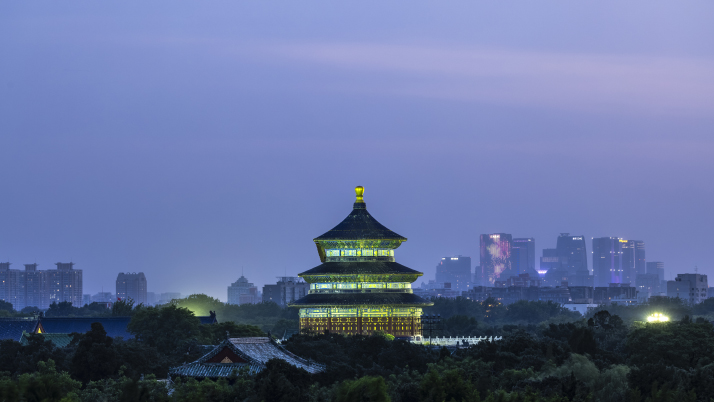 The Hall of Prayer for Good Harvests at the Temple of Heaven in Beijing, illuminated on the evening of May 5 (VCG)
On May 14, U.S. President Donald Trump, on a state visit to China, toured the Temple of Heaven, which is located about 3 km south of Tiananmen Square in Beijing. First built in 1420 during the Ming Dynasty (1368-1644), the Temple of Heaven served as the venue where emperors of the Ming and Qing (1644-1911) dynasties offered sacrifices to heaven and prayed for bountiful harvests. It is currently the largest existing imperial sacrificial architectural complex in China. More than just a masterpiece of architectural art, it embodies ancient Chinese political philosophy, cosmic concepts and governance wisdom. Since the 1970s, it has been a popular "must-visit" for foreign dignitaries visiting China, including U.S. President Gerald R. Ford, Queen Elizabeth II of the United Kingdom, French President François Hollande, European Commission President Ursula von der Leyen and Australian Prime Ministers Gough Whitlam and Anthony Albanese. Former U.S. Secretary of State Dr. Henry Kissinger visited the Temple of Heaven 15 times beginning with his first trip to China in 1971, making him the most frequent international guest on record. The historic role The Temple of Heaven is divided into inner and outer sections, with the main buildings located in the inner part. The inner area is further divided into two architectural groups: one in the north and one in the south. The Altar of Prayer for Good Harvests is situated in the north and was used for praying for good harvests in spring. At its center stands the Hall of Prayer for Good Harvests, a circular, three-tiered building with a conical roof. The Circular Mound Altar is located in the south and was used exclusively by emperors to offer sacrifices to heaven on the winter solstice. It is a round terrace made of marble. The numbers of its steps and stone slates all revolve around the number nine, which symbolizes the "nine circles of heaven," emphasizing heavenly supremacy. The two altars are connected by the Danbi Bridge. The Circular Mound Altar and the Hall of Prayer for Good Harvests (also circular) symbolize the traditional belief that heaven is high and round. The overall altar area is round in the north and square in the south, reflecting the notion that "heaven is round and earth is square." As the only surviving example of an ancient mingtang-style (literally "bright hall"-style) building, the Hall of Prayer for Good Harvests is the most attractive structure to foreign visitors. During her state visit in 1986, Queen Elizabeth II, too, was captivated by its grandeur. The building has a conical roof made of blue glazed tiles that symbolize the heavens. Its unique architectural feature lies in its four inner pillars, 12 middle pillars and 12 outer pillars, representing the four seasons, the 12 lunisolar months and the 12 traditional Chinese hours (each equivalent to two modern hours), respectively. Together, the combined 24 middle and outer pillars symbolize the 24 solar terms of the year. The total of 28 pillars across the three tiers correspond to the 28 constellations in Chinese astronomy. All these ingenious designs express reverence for heaven and the ancient Chinese philosophy of unity of nature and humans (Tian Ren He Yi). This concept emphasizes the harmonious coexistence of humanity and nature, as well as the inherent unity between humans and social order, aligning perfectly with the contemporary pursuit of sustainable development. The Hall of Prayer for Good Harvests embodies the legitimacy of ancient emperors' rule through the "mandate of heaven," as well as the philosophy of "putting agriculture first" and "praying for bountiful harvests." The emperors' sacrificial activities at the Temple of Heaven were divided into two main ceremonies. The winter solstice sacrifice was held at the Circular Mound Altar to worship heaven. This tradition originates from the yin-yang philosophy of seemingly opposite or contrary forces actually complementing each other in the natural world: On the winter solstice, yin reaches its extreme and yang begins to emerge, symbolizing the revival of yang energy (an active, bright and warming energy) in heaven and earth. The spring prayer for harvest, held at the Altar of Prayer for Good Harvests in the first month of spring, reflected the nation's emphasis on agricultural production, praying for a bountiful harvest, national peace and prosperity. The two ceremonies respectively correspond to the two major governance strategies of "revering heaven" and "valuing agriculture," forming a complete system of interaction between nature and humanity. Significance beyond structures The unique status of the Temple of Heaven is also reflected in its role in uniting the diverse yet unified Chinese nation. After the Manchu rulers of the Qing Dynasty seized control of the entire country, they inherited the system of the previous Ming Dynasty. They not only continued the tradition of sacrificial rites at the Temple of Heaven but also carried out large-scale renovations and expansions during the reign of Emperor Qianlong (1735-96), bringing its architecture and rituals to the peak of traditional cultural refinement. After the fall of China's imperial dynasties, the Temple of Heaven was opened to the public as a park in 1918, marking its transition from royal exclusivity to public access. In 1998, it was inscribed on the UNESCO World Heritage List for symbolizing the crucial interaction between heaven and earth that stands at the heart of Chinese cosmology. In 2024, the Beijing Central Axis, a monumental 7.8-km-long north-south spine running through the heart of Beijing and a masterpiece of ancient Chinese urban planning, which includes the Temple of Heaven as one of its 15 components, was inscribed on the World Heritage List. Today, the Temple of Heaven Park has become a public space for daily activities and a famous tourist attraction. This transition, from a sacred place of worship to a public cultural space, mirrors China's historic leap from imperial hierarchy to people's democracy. A royal altar that has endured for over six centuries, this must-visit now re-emerges in the modern era with diverse and profound cultural significance. As a World Cultural Heritage site, it carries precious memories of human civilization; as a public park, it has witnessed the historic transformation of Chinese society. Today, the Temple of Heaven plays an important role in inheriting and promoting China's traditional culture. It serves not only as an important window for cultural exchange between China and the world but also as a Chinese model for the protection and utilization of World Cultural Heritage sites. Copyedited by Elsbeth van Paridon Comments to lanxinzhen@cicgamericas.com |
|
||||||||||||||||||||||||||||
|