
|
| China |
| Strategic shifts | |
|
|
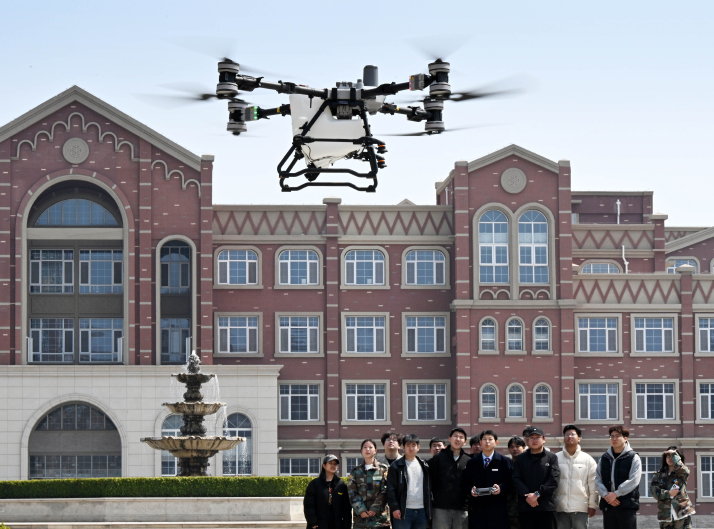 Students learn about drone operation at the Qingdao Vocational College of Aeronautical Science and Technology in Qingdao, Shandong Province, on April 2 (XINHUA)
The landscape of higher education in China is undergoing a transformation, marked by the introduction of 38 new undergraduate programs and a parallel wave of program consolidation. Released by the Ministry of Education (MOE)on April 28, the updated Undergraduate Program Catalog for Regular Higher Education Institutions signals a strategic pivot, with new offerings like Embodied Intelligence, Low-Altitude Economy and Management, Agricultural Robots, Deep Earth Science and Engineering and Legal English set to enroll students this year. This move is part of a broader, more dynamic approach to curriculum development, with China implementing an "annual update system" for its undergraduate program catalog since 2024. This annual revision is rooted in a 2023 guideline to optimize and adjust 20 percent of university program offerings by 2025. The overarching goal is to cultivate new talent aligned with emerging technologies, industries and business models. This shift represents a fundamental departure from the past, where program additions and removals were primarily driven by market demand and a university's internal capacity. While market responsiveness, university autonomy and the ability to anticipate employment trends were once paramount, the accelerating pace of scientific and industrial revolutions, particularly the pervasive influence of AI, has created an urgent demand for educational institutions to realign their focus toward serving national development strategies. New frontiers of talent cultivation The newly unveiled programs directly address these evolving national priorities. Embodied Intelligence and Brain-Computer Interface Science and Technology are poised to spearhead future industrial innovation, while the Semiconductor Technology and Equipment major directly caters to the nation's strategic imperative for self-reliance across the entire integrated circuit supply chain. The establishment of the Rare Earth Science and Engineering major exemplifies this strategic foresight. Rare earth elements are essential strategic resources for high-end manufacturing, national defense and new-energy sectors, positioning them at the forefront of global competition. Li Chaozhong, Vice President of Jiangxi University of Science and Technology and Dean of its School of Rare Earth, told newspaper Nanfang Metropolis Daily that talent cultivation in China's rare earth field has long been dispersed across traditional single disciplines like mining, metallurgy and materials. This has resulted in a shortage of high-end talent with comprehensive, industry-chain-wide training. Creating the new major intends to rectify this by fostering sustainable talent support for the nation's rare earth strategy, leveraging the university's strategic location in Ganzhou, Jiangxi Province, a core rare earth industry hub. Jointly established internship and training bases with industry leaders like China Rare Earth Group Co. Ltd. ensure that teaching directly aligns with the industry's green, high-end and intelligent transformation, addressing the disconnect between academic learning and real-world industrial challenges. Recognizing the urgency of these strategic needs, the MOE has instituted an "extraordinary mechanism" for establishing strategically crucial programs. This "express lane" allows for rapid response in priority areas identified by the Central Government. The introduction of Low-Altitude Technology and Engineering programs at six universities, including Beihang University, last year, and the addition of Embodied Intelligence programs at nine institutions, including the Harbin Institute of Technology, this year, are prime examples of this streamlined approach to cultivating talent for national needs. 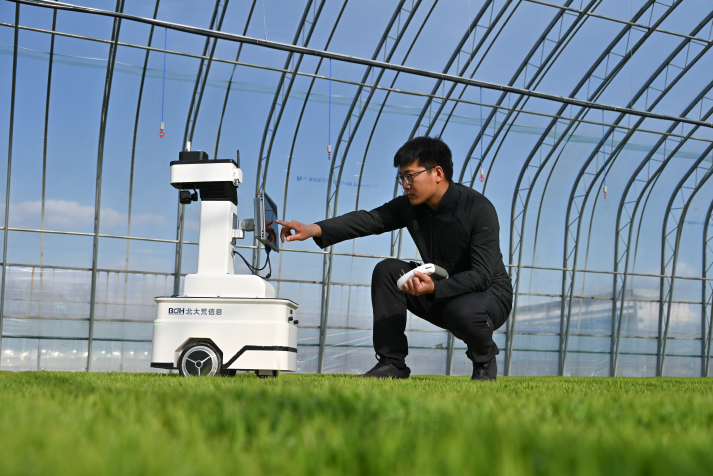 A technician operates an intelligent inspection robot at a rice seedling greenhouse in Raohe County, Heilongjiang Province, on April 29 (XINHUA)
A paradigm shift This fundamental shift in program development reflects a transition from the "small logic" of disciplinary self-development to the "grand logic" of serving national development. Cheng Shuang, Deputy Director of the Heilongjiang Provincial Department of Education, said, "Program adjustment cannot be done behind closed doors, relying on experience. It must meet industrial needs, social needs and development trends." For instance, the rise of AI and rapid advancements in large language models and natural language processing have necessitated the creation of interdisciplinary programs. East China Normal University's School of Foreign Studies, for instance, has launched the Computational Linguistics major. Yang Yanning, Dean of the school, articulated the need for interdisciplinary talent capable of bridging linguistic mechanisms and machine intelligence. He said that traditional computer science graduates often lack deep linguistic training, while foreign language students may lack programming and algorithmic skills. The new program's curriculum integrates linguistic theory and AI technology, equipping students with both theoretical knowledge and practical skills to address complex language data processing. Local universities are also reorienting their strategies to serve regional economic and social development. Cai Jingmin, Director of the Institute of Higher Education at Anhui University, told China Education News newspaper, "The development logic of local universities must deeply integrate with economic and social development. We should train what the region needs." This has led to a recalibration at Anhui University, where nearly 80 percent of its undergraduate programs now directly support the province's 10 emerging industries, including AI, high-end equipment, new materials and the low-altitude economy (referring to airborne economic activities below 1,000 meters). To bolster this regional alignment, the MOE has guided eight provinces and municipalities, including Heilongjiang, Zhejiang and Chongqing, in enhancing the correlation between program offerings and regional development since 2024. Chongqing, for example, has encouraged local universities to introduce urgently needed majors like Low-Altitude Technology and Engineering, and Quantum Information Science. Heilongjiang has also embraced this adaptive strategy. Cheng highlighted the province's proactive approach to capitalizing on Harbin's ice and snow tourism boom by transforming "cold resources" into "hot economy." The Harbin Sport University in Heilongjiang Province, in collaboration with the Harbin Conservatory of Music, has pioneered the Ice and Snow Dance Performance major, a unique program that integrates on-ice performance skills with off-ice artistic training, including foundational ice techniques and choreography. Heilongjiang is also fostering interdisciplinary talent in areas like ice and snow cultural tourism, sports event management and performances to support its burgeoning winter economy. The 'subtraction' aspect Simultaneously, universities are also streamlining and discontinuing programs that are no longer aligned with national or regional priorities. Majors that were once popular, such as Public Affairs Management, Product Design and Translation, are gradually being phased out. This "winnowing" process reflects the accelerating pace of societal change and industrial evolution. In March, the Communication University of China's decision to cut 16 majors, including Translation and Photography, made headlines. Recent reports also highlighted Sichuan University's proposed discontinuation of 39 undergraduate programs, many of which are in humanities and social sciences, including Musicology, Performance, Animation and Insurance. While data indicate a steady increase in science, engineering, agriculture and medicine majors, the discussion around "declining humanities" persists. However, the reality is more nuanced. Shandong University's planned suspensions include both humanities like Logistics Management and World History, alongside engineering fields such as Electronic Information Engineering and Civil Engineering. Shandong University's Vice President Cao Xianqiang said that the university is committed to modernizing its humanities programs while gearing toward technological advancements and national strategic needs. The university is proactively developing interdisciplinary programs integrating AI and humanities, such as digital economy and scientific archaeology, which involves the development and application of scientific techniques to the analysis of archaeological materials. BR Copyedited by Elsbeth van Paridon Comments to jijing@cicgamericas.com |
|
||||||||||||||||||||||||||||
|