
|
| China |
| How a small regional film turned a forgotten history into a box-office miracle | |
|
|
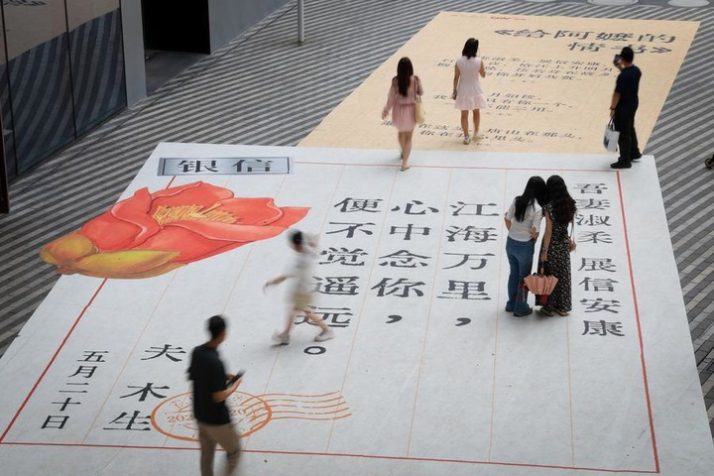 A Dear You-themed installation inside a shopping mall in Shenzhen, Guangdong Province, on May 20 (XINHUA)
At first glance, Dear You has none of the traditional trappings of a Chinese blockbuster. It is not the product of an industry-wide mobilization, as the 2025 animated fantasy feature Ne Zha: Demon Child Conquers the Sea seemed to be; nor a sprawling epic in the manner of the 2023 mythology-inspired hit movie Creation of the Gods I: Kingdom of Storms; nor a sensory bombardment on the scale of the 2023 sci-fi phenomenon The Wandering Earth 2. In fact, it sits at the other end of the spectrum. Made on a shoestring budget of 14 million yuan ($1.94 million), it features a cast of non-actors and was filmed entirely in Teochew, a dialect native to the Chaoshan region in south China's Guangdong Province. Yet after a quiet theatrical debut on April 30, the film has become the summer's biggest phenomenon at the domestic box office, pulling in more than 1.19 billion yuan ($165.6 million) as of the time of writing, according to Chinese ticketing platform Maoyan. On Douban, China's leading film and television review platform, Dear You scored 9.1 out of 10, making it the highest-rated Chinese title of the past decade. Social media, meanwhile, has been flooded with emotional posts from viewers reflecting on their own ancestral roots, alongside a nationwide "try-not-to-cry" challenge, where moviegoers film themselves entering cinemas certain they will not cry, only to reappear two hours later puffy-eyed and deeply moved. Perhaps the best summary of its appeal came from one widely circulated comment on social media: "In an age when so much content feels like fast food, watching Dear You was like being served a bowl of slow-cooked Teochew porridge—plain at first taste, but lingering long after." 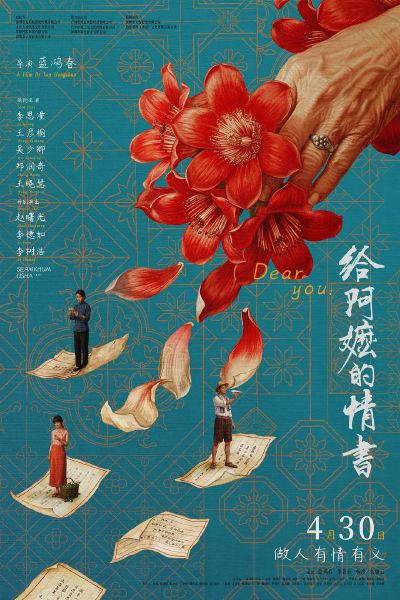 A poster for Dear You
A history unsealed Slow-cooked is an apt description, given Dear You is, above all, a story about waiting. At its center is the fading world of qiaopi, a unique system of correspondence that typically consists of a remittance and a letter sent by overseas Chinese emigrants to their families back home. The story began in an old Chaoshan household, where Shurou has spent much of her life guarding a box of timeworn qiaopi. Her husband, Musheng, left for Southeast Asia during wartime in the 1940s to seek work. Yet despite years of correspondence, he never returns. Only years later does Shurou discover the truth: Musheng had died long ago in Thailand, and it was Nanzhi, the daughter of his local landlord, who had quietly continued sending letters and money in his name for 18 years. For many from the Chaoshan region, this world is not unfamiliar. Over more than a century, millions in the area left their hometowns for Southeast Asia in search of opportunity. According to official customs records, nearly 2.94 million people from Chaoshan crossed the seas between 1864 and 1911 to make a living in Thailand, Malaysia, Indonesia and Myanmar. Like Musheng, they took whatever work they could find—pulling rickshaws, tapping rubber, clearing wasteland or laboring in mines. Qiaopi, therefore, became an essential lifeline connecting the two worlds. Between 1864 and 1980, according to figures cited by official media, more than 30 million qiaopi arrived in China, carrying remittances worth more than $10 billion. "It was not only a means of financial support, but also a way of keeping families intact across distance, uncertainty and time," Wang Yujiao, an independent qiaopi researcher based in Laos, told Chinese news portal ThePaper.cn. Growing up in Chaoshan, Lan Hongchun, the film's director, was surrounded by such stories, many of which were passed down by his grandmother. For years they remained hazy family lore. What brought them finally into sharper focus was Teochew, a documentary project he began in 2019. Conceived as a search for Teochew cuisine around the world, it led him into hundreds of Chinese households across Southeast Asia and the West, where he gathered many materials that would eventually feed into Dear You. "I've always believed that good stories are not invented out of thin air. They are rooted in life, in reality and in the emotions of everyday people," he said at a forum in Shenzhen, Guangdong, on May 22, noting that 90 percent of the film was based on real-world stories. "Authenticity has always been the first principle guiding our creative process." During pre-production, the production team visited some 300 Chinese families overseas. After the script was finalized, they spent another six months combing through archival footage of Chinatowns overseas, reading old Chinese-language newspapers and verifying the smallest details, from the price of a cinema ticket at the time to the licensing rules for rickshaw pullers. "What we did was take countless fragments of real stories and weave them into a story about devotion," Lan noted. "In a way, the film is itself a letter to all overseas Chinese and to the homeland they long for." 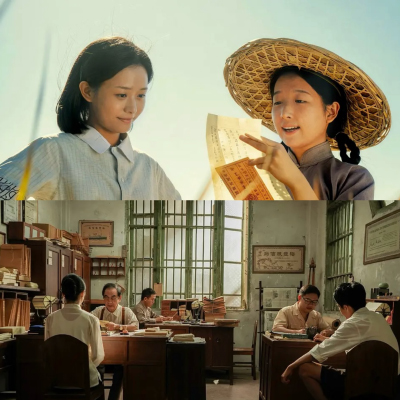 (Above) Shurou listens to a friend reading a qiaopi letter sent by Musheng; Musheng and Nanzhi mail qiaopi at a remittance agency in Thailand
The raw picture But for Lan, authenticity did not end with the physical reconstruction of a bygone age—something many Chinese films have achieved on a far larger scale. It also had to live in the people who inhabited it. Rather than fill the screen with trained actors, he turned largely to first-time actors whose accents and personal memories carry the traces of the world he was trying to recover. "The life experience these people bring with them is something professional acting can never replace," he observed. Social media became an unlikely casting office. Wu Haoqing, who plays the elderly Shurou, came to Lan's attention through videos posted by her grandson. Li Sitong, who plays the young Nanzhi, was a second-year finance student when Lan stumbled upon her account on Douyin (the Chinese version of TikTok). 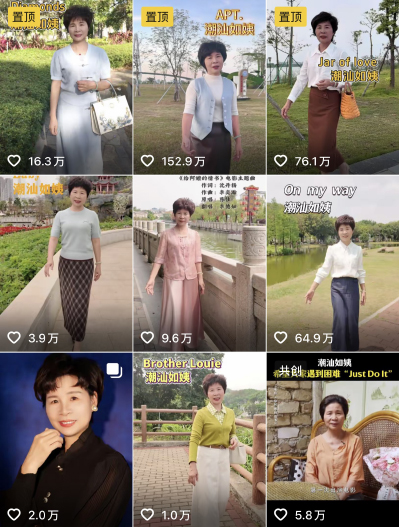 Ruyi’s account on Douyin (the Chinese version of TikTok)
For Li Deru, who plays a Chaoshan woman working at the Thai inn where Musheng stays, being drawn into Lan's project was something she had never quite dared to dream of. Better known as Ruyi, the 61-year-old was already an online phenomenon before the film—"Chaoshan people's own Janet Jackson," as her fans call her. In 2024, she went viral for posting videos of her singing English pop songs in a thick Chaoshan accent. On Douyin, she now has more than 418,000 followers; one clip of her singing Rose and Bruno Mars' APT has amassed more than 1.5 million views. Still, for all her years in front of the camera, being cast in a film was something she had never imagined—let alone having lines tailor-made for her, with English words folded into Teochew. Nor did she expect the film to become such a word-of-mouth hit. "I didn't dare to watch my own takes while shooting," she told Beijing Review. "In the film, I was an old, unfashionable auntie living in an old, dilapidated world. Only after it came out did I realize how deeply moving the whole thing was." The biggest surprise for her, however, was how much work went into making a film. "With short videos, I can do it on my own," she said. "But with this film, it was quite common to do 10 to 20 takes for a single shot." That discipline runs through the film's entire making. Its closing scene, which takes the audience back to the time when Musheng has just arrived in Thailand, was reportedly shot 39 times, just to capture the perfect light during the brief magic hour before sunset. In multiple interviews, Lan has described his approach as "hand-crafted." "This is a film that seems to have traveled from the 1980s or 90s," he said. "The way it was made belongs to an older, more classical tradition of cinema." The same philosophy has guided his work with actors. His job, as he described it, was to awaken the emotions they already carried, and then wait for the right moment. That is how the film's best-known scene came about. After finally learning the truth about her husband, Shurou merely remarks that it is raining and goes to check on the olives she is cooking. This scene, according to Lan, was unscripted: Rather than calling cut, the director kept the camera rolling to record the actress' natural reaction. "It is an experience that cannot be described in words, and one that can only be conveyed through film," Lan said. "It is moments like these that make it all worthwhile." 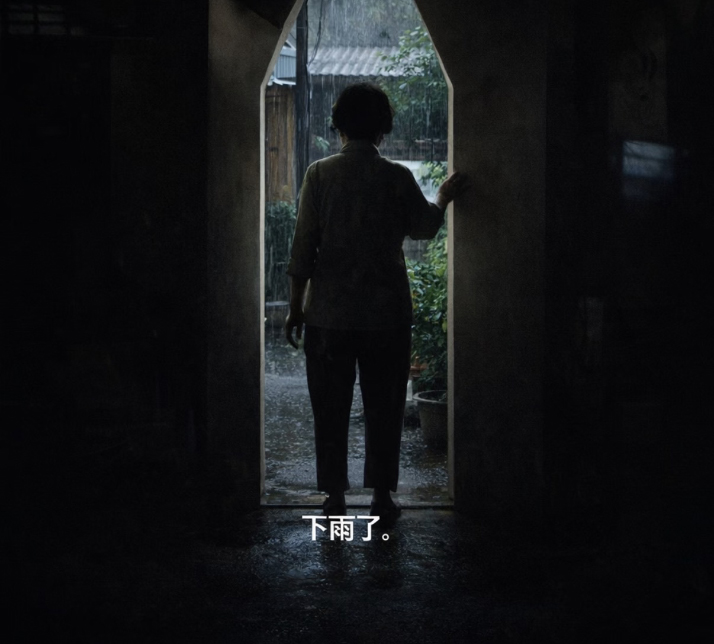 A scene from Dear You, in which the elderly Shurou learns the truth about her husband’s death. The subtitle reads, “It’s raining”
Off the beaten path What emerges is a film that seems to defy all the tropes familiar to contemporary Chinese audiences. Unlike many tear-jerkers, it offers no emotional breakdowns, no sweeping displays of joy or anguish, no heavy-handed rendering of suffering. Instead, it finds its force in restraint. After Musheng's death, the camera lingers on the scene, without giving too much emotional emphasis. When Shurou and Nanzhi finally meet in Thailand at the end of the film, there is no tearful embrace or outpouring of confession—only a brief question about the salted pork one had sent to the other. While many Chinese films have sought to broaden their appeal at home and abroad, Dear You takes a more specific and focused path, grounding itself firmly in the regional. Its world is built from dialect, a cast of local nonprofessional actors, a lesser-told chapter of local history and a host of local elements: olives, kapok flowers, Yingge dance, and the area's unique moon-worshiping ceremony. "Sometimes, creating a world around the plot matters even more than the plot itself," Lan said in a podcast. "I've always believed that the Chaoshan region offers rich soil for cinematic storytelling, with its traditions and rituals woven deeply into the fabric of daily life." Paradoxically, by digging into the local, the film arrives at something universal. According to Huo Shengxia, a professor at the Guangzhou Academy of Fine Arts who studies regional identity in Chinese cinema, Chaoshan's clan-based culture, sustained by its rituals and customs, was once often dismissed as backward. But times have changed. "In a highly atomized world, where emotional ties are fragile, the region's tight-knit communities and the sense of connection they sustain have become something we all crave," she said. That longing is only part of the film's broad appeal. During a Q&A session in Beijing, Lan was asked why the grandmother keeps tending to her olives throughout the film. It is her way of coping with life's unpredictability, he said: by doing something concrete, however small, and finding a measure of peace in the process. For viewers, this particular scene offers a sense of quiet strength. For the industry, the film carries a different kind of hope. Filmmakers have frequently lamented that the industry is bracing for a long winter, haunted by fast-paced short dramas and AI-generated content. Yet the success of Dear You suggests a way of coping: In difficult times, the best response may be to stay close to life, focus on the concrete and return to the most basic task of all: telling a story well. (Tao Xing contributed to this article) (Print edition title: To Chaoshan, With Love) Copyedited by G.P. Wilson Comments to pengjiawei@cicgamericas.com |
|
||||||||||||||||||||||||||||||
|