
|
| China |
| An appetite for AI | |
|
|
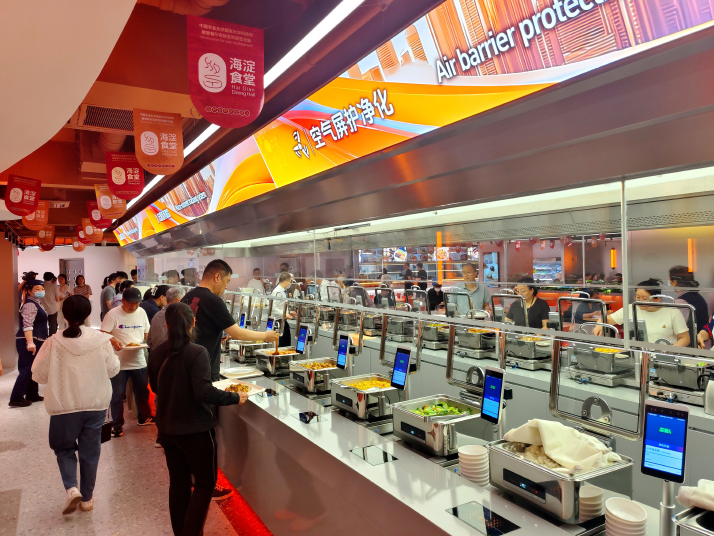 The AI-powered Haidian Dining Hall—Digital Intelligence Experience Restaurant in Haidian District, Beijing, on May 19 (VCG)
Imagine a kitchen devoid of smoke, sizzling pans and frantically cooking chefs. At the Haidian Dining Hall—Digital Intelligence Experience Restaurant, this vision is a reality. This innovative establishment, which opened its doors late last year in Beijing's Haidian District, is more than just a canteen; it's a testament to the current state of scientific research. Here, one head chef and two assistants can prepare lunch for 500 people in merely an hour. The canteen, a platform showcasing achievements from China Agricultural University's (CAU) College of Food Science and Nutritional Engineering, offers dishes with clearly displayed prices, weights and nutritional information. Since its opening, it has been consistently packed.
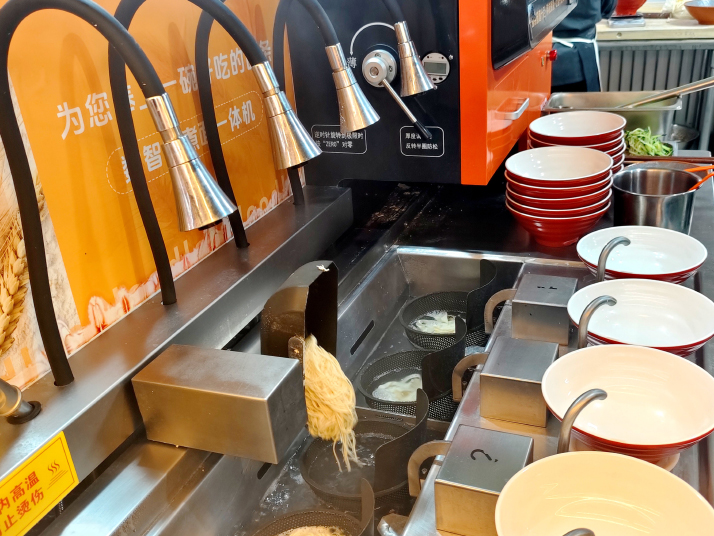 The automatic noodle-making robot in the Haidian Dining Hall—Digital Intelligence Experience Restaurant serves up ready-to-eat noodles in just eight seconds on May 19 (VCG)
The smart 'chef' The heart of this operation is the smart kitchen, an orderly and clean space where neat stainless steel equipment is meticulously arranged. Dominating the scene is a smart combi-oven, measuring approximately 1 meter wide and 2 meters high. Pan Qiang, the canteen manager, told news portal Haidian Multimedia Center that this machine allows over a dozen different dishes to be cooked inside simultaneously. "Once programmed, it automatically adjusts heat for each layer and prevents flavor transfer. It's capable of multiple cooking methods, including pan-frying, deep-frying, roasting, steaming, boiling and braising," he said. As he spoke, staff loaded trays of chicken legs, chopped vegetables and seasoned fish pieces into the oven. A selection of programs on the touchscreen commenced the cooking process. Within about 20 minutes, the machine signaled completion. The resulting braised chicken legs were savory and aromatic, while the stir-fried vegetables remained crisp and refreshing. This single, advanced appliance effectively replaced multiple traditional kitchen tools like steamers, ovens, fryers and soup pots. Adjacent to the combi-oven, several smart stir-fry machines efficiently handle high-heat dishes like eggplant stir-fry. There is also a machine capable of producing 70 to 80 types of pasta, as well as steamed buns, pizzas and burgers. In the vegetable washing area, an automatic peeler streamlines a once laborious task. Pan explained, "We place vegetables that require peeling, such as potatoes and carrots, into this machine. Previously, two assistants would spend half a morning just peeling. Now, the machine automatically peels and washes them. We can process all the vegetables needed for a meal in about 10 minutes." Lunchtime revolution At 11:30 a.m., the canteen comes alive with the day's lunch rush. A 63-year-old resident surnamed Xu, living just 2 km away, has been a near-daily patron since the canteen's opening. Balancing his tray, he serves himself. "Look at my choices today: braised chicken legs, beef, stir-fried cabbage… I could never prepare such variety at home," he told the multimedia center. What Xu finds particularly impressive is the immediate feedback from the weighing stations. Beyond the weight and price, each screen at the station clearly displays the calorie count of the selected dish, alongside the protein, fat, carbohydrate and sodium content. "Previously, I ate based on taste alone; now, I can track my nutritional intake," Xu said. The key to this transparency lies within the plates themselves. Each is equipped with a smart chip. As a dish is served, its data are instantly displayed, and the system automatically weighs and prices it by the gram. At checkout, the system calculates the total cost and provides a nutritional breakdown based on each food item's weight and type. Wen Jing, Assistant Director of the National Engineering Research Center for Fruits and Vegetables Processing at CAU, told news portal China.cnr.cn that every individual dish's data are available through the Digital Intelligence Haidian Dining Hall mini-program. Mini-programs are "light apps" that run inside popular super apps such as Weixin, known internationally as WeChat. "Through the mini-program," Wen said, "diners can understand their eating patterns over a month, a quarter or even an entire year. By opting to enter their personal information, they can also receive personalized dietary recommendations. For instance, a diner suffering high blood pressure, high blood sugar and high cholesterol might receive an alert if his or her fat intake is too high. Diners might also receive an alert when their calorie or carbohydrate intake is too low." A replicable practice The restaurant offers a replicable and scalable model of intelligent food service built on accredited industry-academia-research collaboration. Du Geng, Deputy Chief of the Food and Beverage Service Safety Supervision and Management Department of the Haidian District Market Regulation Bureau, told China.cnr.cn, "Beijing's first business license for embodied intelligent robot food operations was issued to an AI company in Haidian District in 2024." He added that with machines handling food preparation, their operational status is paramount for regulatory oversight. Ensuring both proper function and cleanliness is essential. "If a machine breaks down while cooking, it could cause problems like undercooked food or incorrect meals," he said. Operators and regulators will need to work together to fix these issues quickly and prevent food safety risks. Because robots handle most of the cooking, fewer kitchen staff are needed. Those who remain will be reassigned to new roles, such as supervising the machines, checking ingredients or cleaning equipment. This means training and management must be more rigorous, so that staff stay accountable and follow safety standards consistently, according to Du. The AI + Food Preparation model also offers a new approach to enhance the quality and upgrade of urban public services. Wen noted that AI-powered canteens will gradually expand to different settings, including meal assistance for hospital patients, dining for industrial park employees and nutritional meal planning for primary and secondary schools. Wen added, "Our objective this year is to achieve digitized operation for 1,000 dishes, and we are collaborating with a research and development team from CAU to develop more menu items. Furthermore, we aim to implement micronutrient monitoring this year. Currently, the system displays information about macronutrients like protein, carbohydrates and fats. Micronutrient analysis, however, requires more precise instruments and cutting-edge research data, which will be integrated once the technology is available." Copyedited by Elsbeth van Paridon Comments to jijing@cicgamericas.com |
|
||||||||||||||||||||||||||||||
|