
|
| China |
| Putting rights into action | |
|
|
 A scenic view of the Yangtze River in Chongqing on April 5 (VCG)
It is now the season for Yangtze finless porpoise mothers to blissfully cruise the river with their calves—a heartwarming sight that, in the eyes of Gao Baoyan, a senior journalist at the Changjiang Daily newspaper in Hubei Province, represents a hard-won triumph decades in the making. At a sub-forum of the Forum on Global Human Rights Governance, held in Beijing on June 11, Gao presented a striking contrast between photographs she took 20 years ago depicting the rescue of a sad-looking finless porpoise and the recent images of the same species gliding through the water with what looks like a smile. "That smile reads to me like a poem written by the Yangtze River to humanity—a testament to an ecosystem slowly healing," she said. "This is the human rights story I want to share today," she continued. In her view, such ecological improvement enhances the wellbeing of not only animals but also human beings.  A humanoid robot demonstrates vending services at the 2026 FAIR Plus Robotics Industry Link Conference in Shenzhen, Guangdong Province, on April 22 (VCG)
Green development The two-day forum, held on June 11-12, brought together more than 400 Chinese and international guests from over 100 countries and international organizations, including the United Nations. Under the theme Joint Development, Shared Human Rights: The 40th Anniversary of the Adoption of the Declaration on the Right to Development and a New Vision for Global Human Rights Governance, the event served as a platform for both reflection and forward-looking dialogue. A key outcome of the forum was the release of the National Human Rights Action Plan of China (2026-30), which outlines the country's priorities for human rights protection over the next five years. This new plan is the fifth to be implemented since the first was introduced in 2009. The event also featured five sub-forums, respectively delving into pressing topics such as the human rights dimensions of the Global Governance Initiative, green development in the protection of human rights, and the safeguarding of the right to development in the AI age. Beyond the conference rooms, many participants of the forum, including foreign officials, human rights scholars and experts, took part in field trips along five designated routes spanning three provinces: Zhejiang, Sichuan, and Hubei as well as Chongqing and Tianjin municipalities. These visits offered firsthand observations of China's human rights progress on the ground. The dramatic transformation of the Yangtze River that Gao described at her sub-forum was not lost on the foreign delegates either. During a field trip to Hubei Province from June 7 to 9, scholars and experts from countries including Mongolia, Chile, Uruguay, the Philippines and Madagascar traveled along the river from Wuhan to Yichang in Hubei, witnessing how central Chinese cities are weaving environmental protection, cultural preservation, and community participation into the fabric of their urban development strategies. In Wuhan, where the Yangtze River meanders through the urban heart, the delegates visited the Qingshan River Beach, a former industrial waterfront that has been transformed into a sprawling public green space. They also toured East Lake, the largest urban lake in China, which is now intertwined with a 102-km world-class greenway system. In Yichang, a 4.5-km ribbon-shaped wetland park along the Yangtze River is also part of the comprehensive ecological restoration effort. At the Yangtze River Biodiversity Protection Center, delegates learned that many plant and animal species once driven away by pollution have now returned to the river's ecosystem, a clear sign of the remarkable environmental recovery. Maria Florencia Porro, Advisor in Communication to the Chief Economist at the Development Center of Uruguay, was visibly moved by what she saw. "The changes here are very impressive," she said. "They now bring tangible benefits to local residents. You can see so many people coming here to walk and relax on weekends. I think this is an extremely meaningful and far-reaching contribution to the city." She added that the way China protects the ecosystem and cares for the river and the surrounding environment sets an example for all countries. "I will bring these experiences back to my country, in the hope that they can be studied and applied there," she said. Teresita Ang See, Executive Trustee of the Kaisa Heritage Foundation and a hi-tech leader in solid waste disposal in the Philippines, echoed that sentiment. "The government has really done a great deal," she told Beijing Review. "It not only drives economic development but also puts environmental protection measures firmly in place. I truly admire that. It is genuinely impressive." For Juan Carlos Moraga, President of the Chilean NGO Human Rights Without Frontiers, the visit carried special weight. He had not been to China in over 60 years, and the country's transformation over that span left him deeply struck. "The Yangtze River is part of world history," he said. "It is not only beautiful; we are positively surprised by the green care for nature and the ecological protection around it by the authorities." Meanwhile, at the sub-forum on Green Development and the Protection of Human Rights, delegates from Benin and Chad also shared their respective countries' experiences in pursuing green development. Rajaobarielina Faratiana, Acting Director of Legal, Consular, and Litigation Affairs at the Ministry of Foreign Affairs of the Republic of Madagascar, offered a sobering perspective. "The right to development is an undeniable basic human right. Every person should be a beneficiary of development," she said at the forum. "But today, the environment presents us with a very urgent challenge. We must face reality seriously. Only when we achieve justice in green development can we guarantee the human rights of every citizen." 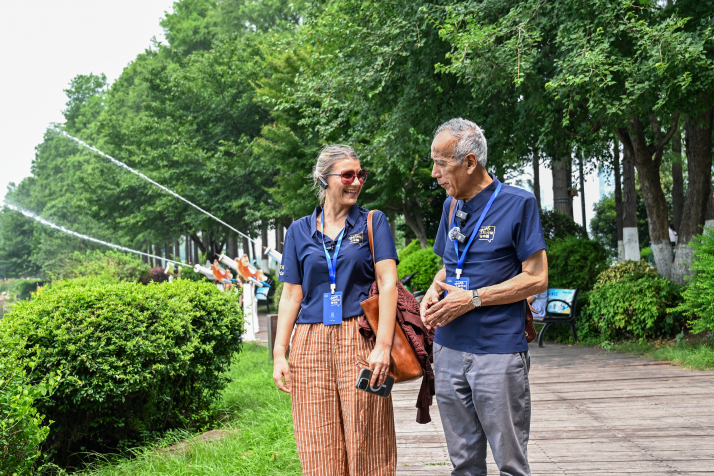 Forum participants tour the East Lake Greenway in Wuhan, Hubei Province, on June 7 (XINHUA)
From principle to practice Experts at the forum noted that, while the UN General Assembly enshrined the right to development as an inalienable human right 40 years ago with the adoption of the Declaration on the Right to Development, many countries are still grappling with development challenges today. The key task facing the international community, they stressed, is to translate that right from a principled aspiration into a lived reality. Former Iraqi President Abdul Latif Rashid, this time on his third visit to China, told Xinhua News Agency at the forum that he has witnessed firsthand China's rapid progress in urban development, infrastructure upgrading and overall social advancement. On the broader landscape of global human rights governance, he commended China's efforts to improve international relations and advance human rights. Addressing global challenges, Rashid called for stronger coordination and cooperation across the international community. "The right to development should be regarded as a common right of all humanity, not a privilege monopolized by a few nations," he said. "It is a basic human right. All people are entitled to participate in development, to contribute, and to enjoy economic, social, cultural, and political development." Ivan Cardillo, a researcher at the Center for International and Strategic Studies at Luiss University in Italy, offered a complementary view. He noted that while the right to development is the most fundamental of all human rights, it is often the least discussed. In September 2025, China introduced the Global Governance Initiative, following the Global Development Initiative, the Global Security Initiative and the Global Civilizations Initiative. "The Global Governance Initiative makes it clear that global governance should be oriented toward the common interests of all humanity and the shared wellbeing of people in all countries," Yu Yunquan, Vice President of China International Communications Group, said at the sub-forum on The Human Rights Implications of the Global Governance Initiative. "This underscores a fundamental truth: Only when global governance truly centers on human survival and development, and addresses the urgent concerns of every ordinary person, can human rights protection draw its deepest strength, and can the foundations of the global human rights cause be genuinely solidified," he added. Dayron Valido Escalona, Director of the Department of Multilateral Affairs and International Law and an expert on human rights and social humanitarian affairs at Cuba's Ministry of Foreign Affairs, offered his perspective on the initiative's significance. "The impact of the Global Governance Initiative on human rights lies in its ability to help us break free from unjust old frameworks and contribute to a fairer, more complete human rights system, one in which every country, regardless of size or strength, has the right to pursue its own development path and to achieve both development and dignity." The AI frontier Facing the human rights challenges emerging in the new AI landscape, delegates on the field trips witnessed firsthand the benefits AI has brought to people's lives, even as they acknowledged the new challenges AI poses to human rights in an evolving context. At Hangzhou Yanglingzi School, a special education institution in Zhejiang, a digital system developed by the school over the past 13 years tracks each student's cognitive, social and rehabilitation data to generate personalized growth profiles. Unlike general education, special education serves a diverse range of need. Some students require intensive language training, others need ongoing emotional intervention or long-term physical rehabilitation. Teachers, who once relied largely on experience, now use digital tools, including AI learning companions, to analyze subtle developmental changes and craft tailored education plans. Rashid appeared deeply impressed during his visit to the school. So captivated was he by the students' artwork that he requested a painting of a blossoming pink tree, which he plans to exhibit in Iraq to share the school's story. "AI opens a vast horizon for humanity," he said. "Yet it also presents challenges related to digital equality and participation in development. People have the right to help shape the future of technology, not merely to receive its outcomes." (Reporting from Beijing and Hubei Province) Copyedited by G.P. Wilson Comments to yuanyuan@cicgamericas.com |
|
||||||||||||||||||||||||||||
|