
|
| China |
| Expanding China's healthcare links with the world | |
|
|
 International medical coordinators at Xiamen Cardiovascular Hospital Xiamen University discuss commercial insurance arrangements with Indonesian patient Dodi Subrata (second right) and a family member on May 12, 2026 (COURTESY PHOTO)
In May, 62-year-old Indonesian-Chinese patient Dodi Subrata returned to Xiamen Cardiovascular Hospital Xiamen University (XMCH) for a follow-up visit. Dodi once lived a life of near constant breathlessness due to severe mitral regurgitation, a condition in which the heart's mitral valve does not close completely, forcing the heart to work harder. But his return visit to the hospital gave him every reason to smile: Tests showed that his heart valve function had fully returned to normal. Two years earlier, Dodi's condition had deteriorated to the point where even routine activities had become difficult. In Indonesia, the only treatment option available to him was open-heart surgery. Having just turned 60, he was reluctant to undergo such a traumatic procedure that necessitates a lengthy recovery. It was Indonesian cardiologist Andi Haryanto Lana who introduced him to another possibility, XMCH's minimally invasive transcatheter edge-to-edge repair (TEER) for mitral valve disease. After comparing hospitals in Malaysia and elsewhere, Dodi discovered that XMCH had extensive clinical experience, performing this procedure almost daily. A visit to the hospital confirmed his decision. Impressed by its advanced facilities and the professionalism of its medical staff, he chose to undergo surgery there. Following the surgery, Dodi regained the ability to travel freely and return to work. This year's follow-up examination confirmed that his mitral regurgitation had completely disappeared. Returning to Xiamen this time, Dodi came not as an anxious patient, but more like an old friend paying a visit. 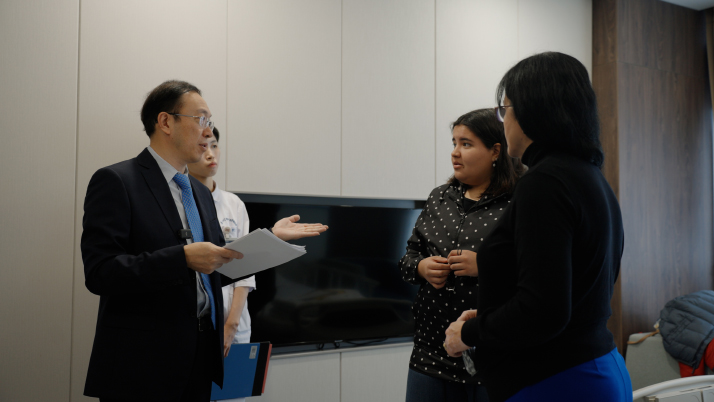 Wang Yan (first left), President of Xiamen Cardiovascular Hospital Xiamen University, discusses the treatment plan with Mercedes Menjivar (first right) and a family member on November 20, 2024 (COURTESY PHOTO) Borderless care For Gong Dongsha, an overseas Chinese resident who had lived in the Philippines for more than two decades, the sudden onset of a superior mesenteric artery dissection, a potentially life-threatening tear in the lining of the artery that supplies blood to the pancreas and intestines, remains a terrifying memory. He waited an hour and a half before seeing a doctor at a local hospital and endured three hours of severe pain in a hospital bed. The treatment plan offered to him failed to provide reassurance. Faced with a medical emergency, he decided to return to China. What happened next exceeded all of his expectations. By the time he arrived at XMCH, emergency staff were already waiting at the entrance. After a quick identity check, he was immediately taken upstairs for a CT scan. From admission to diagnosis, every step of the process flowed seamlessly. Because treatment began in time, surgery ultimately proved unnecessary, and his condition was stabilized through conservative treatment. For Mercedes Menjivar, a physician from El Salvador, the experience in Xiamen carried an even deeper emotional resonance. For most of her life, she had provided rather than received medical treatment, listening, diagnosing, comforting and treating patients. "Back then, I never imagined that one day I would become a patient, holding on to hope," she told Beijing Review. But about 10 years ago, she was diagnosed with mitral regurgitation, the same condition affecting Dodi Subrata. "At first, I learned to live with it. I continued working, caring for others, and telling myself the condition was under control. But little by little, almost without noticing, my world began to shrink. By 2024, walking a short distance, climbing a gentle slope or even taking a deep breath had become exhausting. My heart was failing, and with it, my normal life was slipping away," Menjivar said. After evaluation at a hospital in El Salvador, the conclusion was clear: She needed open-heart surgery. "As a patient, I was terrified," she said. "The risks, the recovery, the uncertainty... Everything felt overwhelming." Fortunately, Ricardo Castillo, a cardiovascular specialist at Rosales National Hospital who had just returned from a six-month fellowship at XMCH, used the techniques he had learned in Xiamen to conduct a precise assessment of Menjivar's condition. He then arranged an online consultation with specialists at XMCH, and together they determined that she was a suitable candidate for the less invasive TEER procedure. "The thought of traveling more than 15,000 km to an unfamiliar country for heart treatment frightened me. I didn't speak the language. I didn't understand the culture. I had no idea what awaited me. But I knew it was a chance, a chance to live well again, to breathe freely again and to reclaim my life," Menjivar recalled. In November 2024, she flew across continents to Xiamen. The 45-minute operation went smoothly. She regained consciousness just 10 minutes after surgery and was able to walk six hours later. "Outside the operating room, they were cheering me on," she said. "They were not just doctors and nurses—they felt like family. In that moment, I was not a foreign patient or a medical record number. I was simply a person being cared for." Stories like these reflect the standards of care upheld by XMCH's International Medical Center. According to Xu Liangyou, the hospital's Vice President, the hospital performs more than 23,000 cardiovascular procedures each year, and its Case Mix Index, a key indicator of ability to treat complex and critically ill patients, has ranked second nationwide for five consecutive years. In 2025 alone, XMCH received more than 400 international patient visits from 33 countries. The cases covered a wide spectrum of complex cardiovascular conditions, ranging from coronary artery disease and major vascular disorders to valvular heart disease and other critical cardiovascular illnesses. 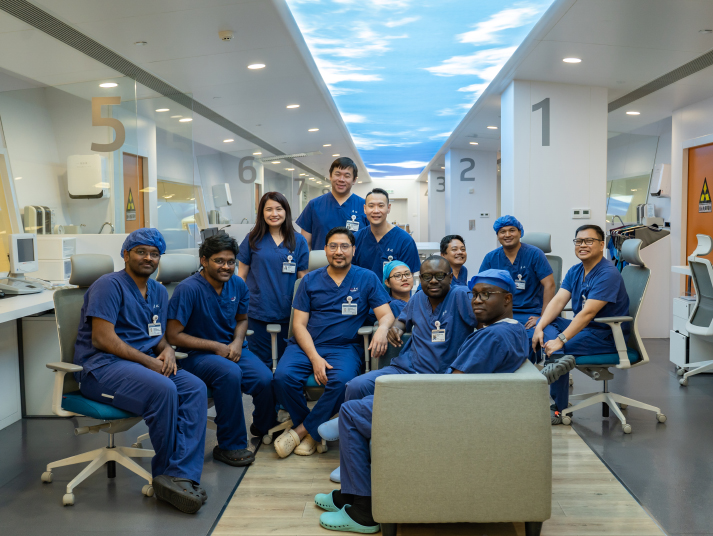 Twelve cardiovascular specialists from six countries and regions participating in the Heart Sapling Program pose for a group photo in the catheterization laboratory at Xiamen Cardiovascular Hospital Xiamen University in April 2026 (COURTESY PHOTO)
Seeds of hope When Dodi returned for his follow-up appointment in May, Andi, the physician who had first recommended treatment in China, had taken on a new role. As a participant in the Heart Sapling Visiting Scholar Program, he is now learning minimally invasive valve interventions in XMCH's catheterization laboratory. When he returns to Indonesia, patients like Dodi will be able to receive life-saving treatment without leaving their own country. In addition to bringing overseas patients to China, it also shares expertise beyond China's borders, strengthening local cardiovascular care systems worldwide. Launched by XMCH in 2022, the Heart Sapling Program recruits promising young cardiovascular specialists from around the world for structured clinical training in China. Under the guidance of experienced mentors, participants engage in clinical practice, multidisciplinary case discussions and academic exchanges, gaining hands-on experience with the latest advances in cardiovascular diagnosis and treatment. The program is a flagship international medical cooperation initiative supported by the China International Development Cooperation Agency (CIDCA) and was officially introduced at United Nations headquarters in 2023. The following year, it was included in CIDCA's Global Development Project Pool and recognized among the outcomes of the second high-level meeting of the Global Shared Development Action Forum. CIDCA has announced plans to support the training of 50 cardiovascular specialists from member countries of the Group of Friends of the Global Development Initiative (GDI) over the coming three years. The Group of Friends, launched by China in 2022, is a platform for exchanging development experience, enhancing cooperation and seeking common development. It supports the UN's work in the field of development, and help other developing countries to implement the UN 2030 Agenda. The program has now trained nearly 40 cardiovascular specialists from 16 countries. To ensure participants acquire skills that are practical and applicable, the hospital develops tailored training plans for every participant, providing mentorship from classroom learning to hands-on procedures. Many have gone on to become leading experts in their home countries. Some have introduced procedures never before performed locally, helping fill critical gaps in healthcare. "The Heart Sapling Program planted a seed of knowledge in my country long before I arrived in China. The doctors who trained in Xiamen returned home carrying new skills, broader perspectives and specialized expertise. One of those seeds ultimately saved my life," Menjivar said. During his training at the hospital, Dominador Valdez Del Castillo III, a participating cardiologist from the Philippines, observed firsthand the management of acute aortic dissection, a tear in the lining of the aorta, which is one of the most challenging cardiovascular emergencies. "In Xiamen, mortality for these patients is around 3 percent. In the Philippines, it can be as high as 85 to 90 percent," he told Beijing Review. "My goal is to bring these techniques back to the Philippines, help close that gap, and ensure that fewer patients need to travel abroad in search of life-saving care," he continued. Boundless hearts According to the 2025 report on international medical services released by China's National Health Commission, designated hospitals across the country handled 1.28 million visits from international patients. More than 850 medical institutions in 57 cities now provide international medical services nationwide, according to a recent report by the International Medical Services Specialized Committee of the Chinese Hospital Association. This inflow of international patients also aligns with China's broader health strategy under the Healthy China 2030 blueprint, issued in 2016, which calls for building a high-quality and efficient healthcare system that serves the entire population, while strengthening both medical service capacity and international exchange. China's healthcare system has been steadily opening up in both directions, expanding access to advanced treatment through international cooperation, while also facilitating greater professional exchange with the outside world. Increasingly, Chinese hospitals are not only treating overseas patients but also training physicians from other countries through structured clinical programs and hands-on fellowship opportunities. XMCH is not alone. On March 29, the 2026 Belt and Road International Training Program on Minimally Invasive Liver Surgery was launched at West China Hospital of Sichuan University. Twenty hepatobiliary surgeons from 11 countries, including Italy, Kenya and Thailand, gathered in Chengdu, Sichuan Province, for a three-week intensive training course. Guided by China's Ministry of Science and Technology, the program has trained 93 physicians from 24 countries since 2023, positioning itself as a platform for medical exchange under the Belt and Road Initiative framework. (Printed Edition Title: Hope on the Horizon) (Reporting from Xiamen, Fujian Province) Copyedited by G.P. Wilson Comments to xubei@cicgamericas.com |
|
||||||||||||||||||||||||||||||
|