
|
| China |
| Green shoots in a sea of stone | |
|
|
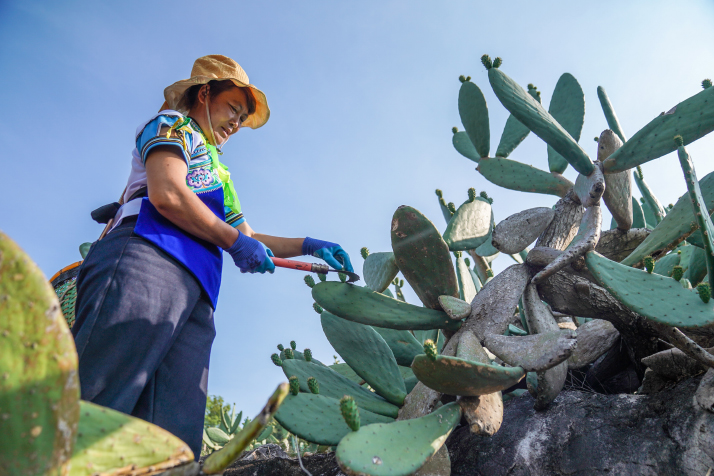 A villager picks fresh cactus fruit in Zhuangzitian Village in Wenshan, Yunnan Province, on May 15 (XINHUA)
On the jagged hills of Zhuangzitian, a remote village in Wenshan City, Yunnan Province, a transformation is taking hold. Once covered by bare rock and gravel, the slopes are now blanketed with hundreds of hectares of prickly pear cactus basking in the sun. Villagers move nimbly between the rows, harvesting prickly pears and tender pads, a harvest that has not only greened a once-desolate landscape but also revitalized the village. Zhuangzitian is a village defined by its stark, challenging karst topography. A decade ago, it was known locally as a "stone village," a place where extreme rocky desertification had rendered 80 percent of the land barren. With less than 0.13 hectares of arable land per person, farming was a desperate, high-risk gamble. "Growing corn, pseudoginseng, tobacco, fruit trees... nothing worked," 69-year-old Tang Tianzhang, one of the first villagers to embrace cactus cultivation, told Yunnan Daily. "The mountains were so barren that even the birds wouldn't stop to rest." With the land unable to provide a living, the village's youth had no choice but to leave. For years, Zhuangzitian was a hollowed-out settlement, inhabited mainly by the elderly and children waiting for parents who rarely returned. Today, that narrative has been rewritten. The village now cultivates over 300 hectares of cactus. Vegetation coverage soared from a meager 32 percent in 2021 to 75 percent by the end of 2025. And the people who once fled are coming home. 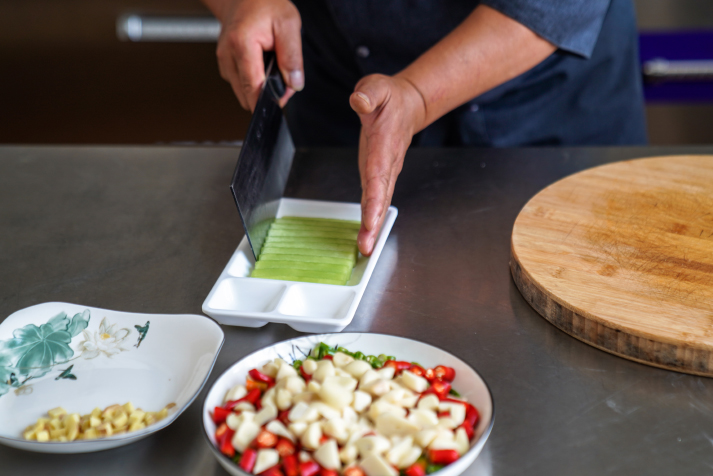 A cook prepares cactus-based dishes at a restaurant in Zhuangzitian Village on May 15 (XINHUA)
The return of the natives The transformation was policy-driven. In 2021, the local government launched the Returning Goose Project, an initiative designed to entice talented people back to their roots to revitalize the rural areas. Lu Chunhong, a native of Zhuangzitian who had spent years building a successful business in a city, answered the call. He was elected secretary of the village branch of the Communist Party of China (CPC), bringing with him the management acumen and commercial mindset that the village desperately lacked. The village leadership made a bold decision: to go all in on developing the prickly pear cactus industry. They noted that prickly pear cacti had been grown in the area for centuries, but only sporadically. These plants are resilient, drought-resistant and most importantly, can thrive in the very conditions that defeated conventional agriculture. But the decision was met with deep skepticism. "If you plant so much, who will buy it?" the villagers asked. Many believed the new leadership was chasing a pipe dream. To convince villagers, the village leadership held courtyard meetings, explaining how they can benefit from cactus growing. "Cactus is a 'lazy crop'," Lu explained during these sessions. "It requires minimal investment and survives where everything else withers. You can tend to it without sacrificing your ability to seek other work." By 2021, they had formed a collective company, and every villager contributed their fallow land as shares. For the first time, the entire village was united by the same vision. The economic results were swift and significant. The cooperative created over 100 steady jobs in growing, harvesting and processing cacti. For Lu Chunneng, a migrant worker who returned after 12 years in Guangdong Province, the shift was life-changing. "Now I work at my doorstep," he told news portal Kunming.cn. "I can take care of my aging parents and my children. Last year, selling prickly pears alone earned me over 100,000 yuan ($14,754). It's far better than the uncertainty of working far away." From survival to sustainability The village soon moved beyond selling just the raw fruit. In 2023, Zhuangzitian established an agricultural processing firm to explore the full potential of the plant. The stem is now sliced and transformed into beer and health beverages, and the flowers are dried for herbal teas. Even the waste pulp is repurposed to extract polysaccharides and pectin for high-end cosmetics and health products. The spines, once dismissed as waste, are now meticulously crafted into handicrafts. This vertical integration has been highly lucrative: Selling raw fruit alone fetched 30,000 yuan ($4,426) per hectare but now, after processing, the annual income per hectare can exceed 150,000 yuan ($22,131). The village is also leveraging its transformed landscape to pioneer eco-tourism. In 2025, Zhuangzitian welcomed 100,000 visitors to its cactus ecological park, generating an additional 3 million yuan ($442,626) through cultural festivals and experiential tourism. Wang Yunxi, once a migrant worker who spent years working far from home, runs a restaurant in the village. His restaurant serves cactus dishes such as spicy cold-tossed cactus salad and hearty cactus-stewed chicken. He now makes 200,000 ($29,508) to 300,000 yuan ($44,262) a year, more than what he made as a migrant worker. A blueprint for the future The ecological impact of this project is also profound. Rocky desertification is often called the "cancer of the mountains," and it plagues vast swathes of southwest China. By pioneering a cactus-plus-grain composite planting model, Zhuangzitian has successfully re-vegetated 95 percent of its once-barren hills. The cactus's extensive root system anchors the thin soil, preventing the erosion that previously stripped the mountains bare during the rainy season. The village is setting its sights overseas. Last summer, Zhuangzitian exported 20 tons of prickly pear leaves to Southeast Asia—China's first-ever international shipment of this kind. Their products now also reach markets including the Republic of Korea and Mexico. Today, Zhuangzitian is known as "China's No.1 Cactus Village," serving as the nation's largest cactus cultivation hub. Its success has become a model for other karst regions. It has become a testament to the power of local leadership and the resilience of nature, proving that with the right vision, even a "sea of stone" can bloom. Copyedited by G.P. Wilson Comments to jijing@cicgamericas.com |
|
||||||||||||||||||||||||||||||
|