|
| China |
| Legend of the Long March drives modern rural revival | |
|
|
|
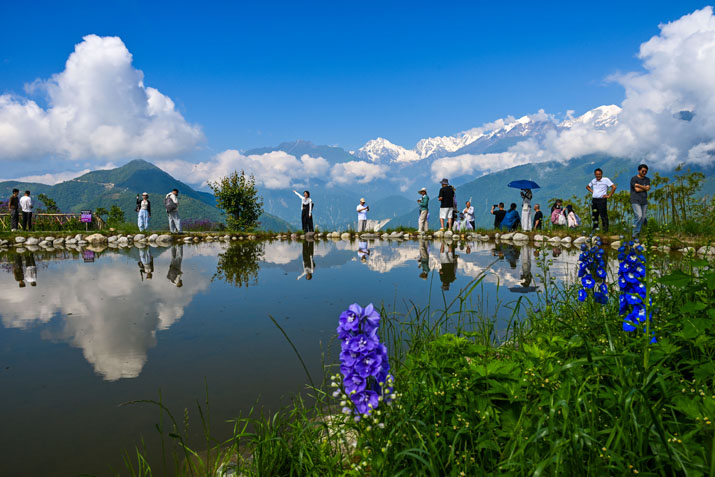
Mount Gongga rises above the Guluhai Flower Park in Luding County, Sichuan Province, on July 5 (WEI YAO) Along the Dadu River Valley in Luding County, Sichuan Province, lies Haizi Village, a small community perched more than 2,100 meters above sea level. "Right down there, at the foot of our mountain, the Red Army marched day and night, 120 km in 24 hours, to seize Luding Bridge before enemy reinforcements arrived," local resident Qiu Gang, 33, said. Qiu was speaking to a group of journalists from China International Communications Group (CICG)'s Together on the Long March project. The media project was launched to commemorate the 90th anniversary of the completion of the Long March, a series of strategic relocations undertaken by the Red Army to break through encirclement by the Kuomintang party's repressive regime. CICG is a leading media and publishing agency based in Beijing and the publisher of Beijing Review. For Qiu, a member of the Yi ethnic group that has lived in the valley for generations, the stories of the Long March were once just family folklore passed down by his grandfather. But in recent years, as more travelers have come to relive that history, they've also brought something else: opportunity.
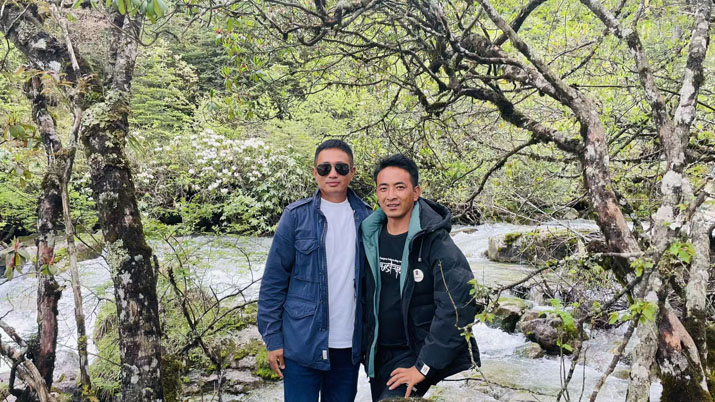
Tian Honggang (left), founder of the Guluhai Flower Park and Qiu Gang, a manager of the park (COURTESY PHOTO) A new chapter Best known as the site of the Red Army's heroic seizure of the Luding Bridge in 1935, the county has become a must-see stop along the iconic Sichuan-Xizang Highway. Tourism has surged, with Luding welcoming more than 5.7 million tourist visits in 2025, generating over 6.3 billion yuan ($928 million) in revenue. Yet for years, little of that success reached Haizi Village. Hemmed in by cliffs and connected by a winding mountain road climbing over 1,000 meters, the village struggled with poverty. After a magnitude 6.8 earthquake occurred in 2022, most residents relocated; only a handful chose to stay, including Qiu's family. Still, Haizi's setting offered a priceless asset. It sits less than 20 km from Mount Gongga, which attracts tourists with snow-capped peaks that appear to glow at sunrise. In early 2023, entrepreneur Tian Honggang from Inner Mongolia Autonomous Region accidentally stumbled upon the village while exploring the region. Struck by the scenery and simplicity of local life, he decided to stay. "What began as a plan to open a small guesthouse soon turned into a dream to do something bigger," Tian said. With strong support from local authorities, he invested 17 million yuan ($2.5 million) in building the Guluhai Flower Park, a scenic resort blending red tourism, mountain ecology and rural industry. The effort aligned neatly with Luding's broader push to link its history, culture and nature in one integrated tourism strategy.
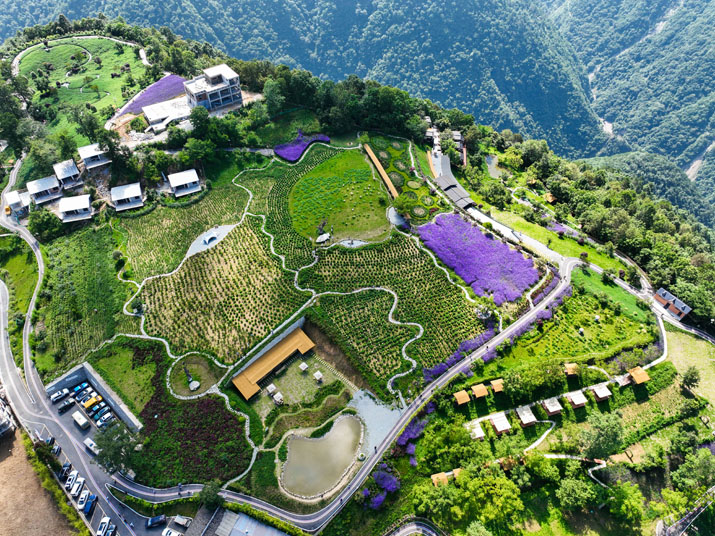
The mountaintop Guluhai Flower Park on July 5 (WEI YAO) From isolation to inspiration After three years of development, the flower park has transformed the once-quiet valley. Covering about 20 hectares, the site now features vast flower fields, lookout platforms with views of Mount Gongga, family recreation areas and a camping area. During its trial operations in 2025, the park usually drew 300 to 400 tourists daily, with peaks exceeding 2,000. More importantly, the park has created 23 long-term jobs for residents from Haizi and nearby villages, plus seasonal employment during busy months. Qiu and his wife now manage the park's daily operations. "I never thought I'd go from being a farmer to a business manager," Qiu laughed. "But staying here and helping my neighbors earn a good living means more than anything." Encouraged by Tian and Qiu, several remaining households have opened family-run guesthouses, with more in the works. Plans are also underway for a Guluhai Hiking Park to extend the tourism network and involve even more villagers. Local official Luo Jin said the government is upgrading the road to Haizi, paving it with asphalt to make access smoother. With new expressways to link Sichuan with Xizang Autonomous Region and Xinjiang Uygur Autonomous Region in the coming years, Luding expects an even greater influx of visitors. "We hope that when people follow the Long March trail here," Luo said, "they also see a new kind of march, one toward a thriving, revitalized countryside." (Reporting from Luding, Sichuan Province) Copyedited by G.P. Wilson Comments to liangxiao@cicgamericas.com |
|
||||||||||||||||||||||||||||
|