
|
| China |
| In Xiongan, young people and AI are shaping China's city of tomorrow | |
|
|
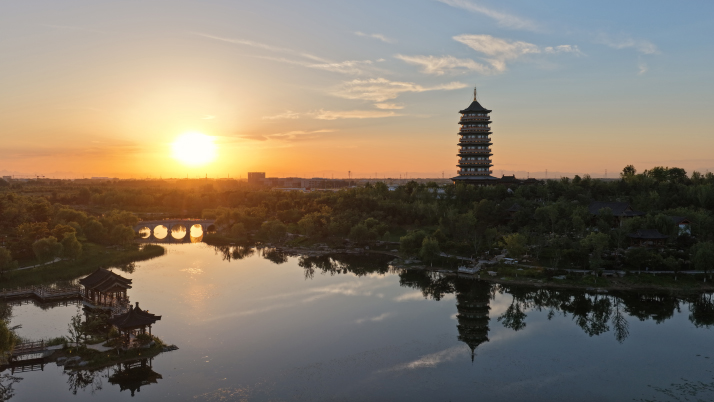 Early summer views at Yuerong Park in Xiongan New Area, Hebei Province, on May 28 (XINHUA)
The Central Government of China established Xiongan New Area in Hebei Province on April 1, 2017. Following the Shenzhen Special Economic Zone and Shanghai's Pudong New Area, Xiongan became the third new area of national significance. Across Xiongan today, commercial districts and cultural and creative products bearing the name "1741" are a common sight. The number represents April 1, 2017, the date the new area was established. As the city takes shape, young people from across China are helping build its future while also creating opportunities for themselves. A new AI hub Anying Technology, a startup with an average employee age of 27, began operations at the Xiongan Artificial Intelligence Industrial Park in August 2024. The company has developed the world's first portable medical device integrating AI and radio-frequency microwave technology for the accurate, real-time and noninvasive detection of intracranial hemorrhage. Zhang Zequn, the company's co-founder and head of research and development (R&D), was born in 1999. He is pursuing a doctorate in medical AI through a joint program run by the University of Science and Technology of China and Eastern Institute of Technology, Ningbo. The park is also home to Zhonghe Technology, which specializes in trustworthy intelligent computing, and dozens of other AI companies, including Insight Technology, Huaqing Zhiyan Technology and Wenzhun Intelligence. Located in the Start-up Area of Xiongan New Area, the Xiongan Artificial Intelligence Industrial Park forms an integrated innovation hub with nearby facilities. The park officially opened on June 10, 2025. Initially, only a few scattered lights could be seen after dark. A year later, around 70 AI companies had moved in. The park now has approximately 69,000 square meters of floor space, with an additional 400,000 square meters planned. According to Cui Hang, head of the park, Xiongan has taken a different approach from the conventional "AI+" model used to upgrade established industries. Instead, AI has been built into the city's infrastructure from the outset. Focusing on innovation in AI theory and applications, the park is developing an ecosystem spanning the foundation, technology and application layers. It has also established an end-to-end industrial system covering R&D, project incubation, business growth and headquarters operations. Most companies in the park are from Beijing. A defining feature of the park is that companies operating within the same supply chain are often neighbors, as are their business partners. Teams developing large AI models work alongside robot-testing facilities, connecting algorithm development and computing power with model training and real-world deployment. Companies including Wenzhun Intelligence, Insight Technology and Huaqing Zhiyan Technology have formed an ecosystem in which closely located partners collaborate across the entire industrial chain. Anying Technology has grown within this industrial ecosystem. Zhang told Beijing Review that the team chose Xiongan partly because of its support policies, including reduced office rents, financial assistance and a monthly living allowance of 3,000 yuan ($440) for each recent PhD graduate. More importantly, the team believed strongly in the city's potential. "Xiongan is being built from the ground up, and our R&D follows the same path—we focus on creating something new from nothing. Pursuing zero-to-one innovation in a city undergoing its own transformation is both meaningful and especially exciting," Zhang said. Xiongan New Area has developed eight major AI application scenarios in fields such as aerospace information, meteorology and urban operations. Wenzhun Intelligence was among the first companies to move into the park. Its vice president Yu Fei told Beijing Review: "Many places attract companies first and then seek markets for them. Xiongan takes a different approach, creating application scenarios first so that when companies arrive, there are orders for them." To date, Xiongan New Area has attracted 96 AI companies developing nearly 30 large AI models. Zhang Yingjie, deputy director of the bureau responsible for industry, technology and data administration in Xiongan New Area, said that over the next three years, Xiongan aims to cultivate five enterprises with an annual revenue of 10 billion yuan ($1.5 billion), 10 with 5 billion yuan ($750 million) and 100 key AI enterprises. 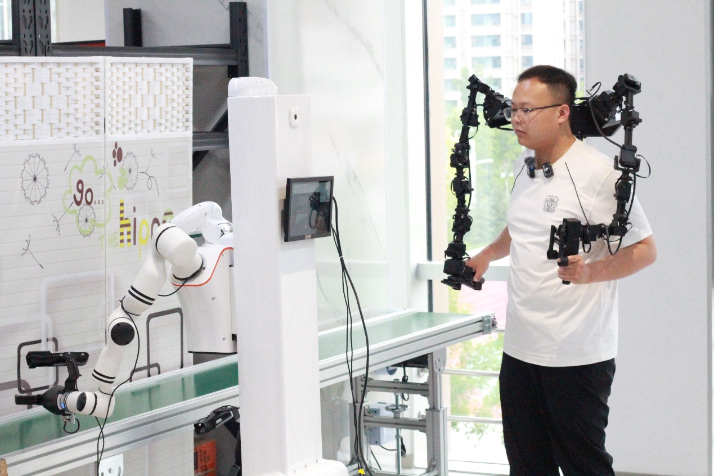 Guo Chenyang operates a robotic arm at his workstation in Xiongan New Area, Hebei Province, on June 23(XINHUA)
A magnet for talent Once a city attracts talent, how does it encourage people to stay? Xiongan's answer is to give young people ample room to grow, both professionally and personally. Born in 2002, Zhang Yang knows this firsthand. After graduating from university, he worked in Shanghai before moving to Xiongan a year ago for an R&D position at Zhonghe Technology that matched his academic background. In Shanghai, he struggled to find suitable housing near his workplace and endured a long daily commute. In Xiongan, workplaces, homes and leisure amenities are within easy reach of each other, making everyday life more convenient. "I really like the atmosphere here," Zhang told Beijing Review. Xiongan New Area has attracted many young tech professionals, and conversations about cutting-edge technologies and industry trends are common in the park's cafés. "It feels like a university campus. Relationships here are uncomplicated and genuine." Outside work, Zhang follows developments in open-source AI communities and attends online industry seminars. In his view, the people here share the same drive as the city taking shape around them. "China's first-tier cities are already highly developed. Even after working in one such city for 10 years, you may see little change around you. Xiongan, however, changes every day, and you grow along with it." For young people, as for AI and robotics, Xiongan offers ample room to grow and evolve. Born in Anxin County, Xiongan New Area, in 2004, Guo Chenyang has witnessed nearly a decade of transformation in his hometown. He was 13 when Xiongan New Area was established in 2017. Now, the highly polluting, low-end industries that once supported the local economy, including plastic packaging, shoemaking and nonferrous metal recycling, have been phased out, giving way to advanced sectors such as aerospace information, AI, new materials and digital technology. After graduating from university, Guo returned home to work as a data collection technician at China Xiongan Group Digital City Technology Co. Ltd. His work involves operating robots, robotic arms and other embodied AI systems in full-scale environments simulating visitor reception and guidance, industrial cargo handling and household activities. He collects real-world data to improve the robots' motion control, adaptability and task performance. At the company's embodied AI training center, Guo operates robots through nearly 1,000 object-picking tasks a day. He also spends hours evaluating their movements and selecting usable training data. "Training a robot takes patience. It's like teaching a child in kindergarten—you have to keep giving it clear, effective instructions," he said. "For example, once a robot has accumulated more than 10,000 valid data samples for a conveyor-based logistics scenario, you could say it has earned a college degree." He added, "I plan to stay in my hometown of Xiongan and grow alongside the city." Nearly a decade after Xiongan New Area was established, its transformation extends far beyond the physical landscape. An ecosystem is taking shape in which people and the city develop together. Entrepreneurs arrive from Beijing to launch businesses, young professionals come in search of opportunity and local graduates return home. Together, their choices show that Xiongan is becoming a place where talented people want to build their futures. It gives young people room to develop and AI companies space to innovate, bringing the "city of the future" closer to reality. BR (Building the Future) (Reporting from Xiongan New Area, Hebei Province) Copyedited by G.P. Wilson Comments to liangxiao@cicgamericas.com |
|
||||||||||||||||||||||||||||
|