
|
| China |
| Summer break, no breakdowns | |
|
|
 A child tries out a Van de Graaff generator at an electricity-themed exhibition at a science and technology museum in Jinhua, Zhejiang Province, on July 5 (XINHUA)
As the heat rises, the summer holiday rolls in. For Liu Tong, mother of a primary school student in Xi'an, Shaanxi Province, the school break isn't a welcome reprieve, but a testing time for parents.
She and her husband both hold full‑time daytime jobs. They leave home at eight in the morning and get back no earlier than six in the evening. When school is in session, her mother‑in‑law, who lives in a nearby apartment complex, steps in to lend a hand. She drops Liu's daughter off at the school gate each morning, picks her up in the afternoon, cooks dinner and makes sure homework gets finished. Though over 60 and less steady on her feet than before, the older woman can still reliably keep up with this routine of school runs, cooking and supervising the child. Once school breaks up, however, this well-established daily routine completely falls apart. With the whole day stretching out ahead, the child has hours of free time and pent‑up energy to burn off. After lunch, her grandma settles down for naps on the sofa, while the girl wanders restlessly between the living room, bedroom and balcony. She quickly grows tired of watching TV and skims a couple of pages of a book before putting it aside, and eventually she curls up in a corner, glued to her tablet. "She's well‑behaved, barely saying a word and with her eyes fixated on her screen," Liu told Beijing Review. That stings because it mirrors her own childhood. Back then her parents worked, leaving her bored at home during school vacations. "It left me with deep‑seated loneliness," she admitted. "I never want my daughter to go through the same kind of summer." Still, she struggles to come up with a practical solution. Enrolling the girl in a holiday daycare program would cost at least 3,000 yuan ($442) for one summer. The combined monthly salary for her and her husband is less than 15,000 yuan ($2,211). After covering their mortgage, car‑loan repayments and daily living costs, they would be able to scrape together the money but would wind up living paycheck‑to‑paycheck. Sending her to her grandparents' rural home is another option. The girl would have playmates out there, yet she would get no supervision on homework and fall into a messy daily schedule. Liu said she believes it would take a full month after the new term starts for her daughter to refocus on school again. "Holidays fill me with anxiety," Liu said. "They tire me out far more than regular workdays." Liu's predicament is hardly unique. Across China, tens of millions of dual‑income families face identical struggles. Holiday childcare has become the major headache for urban households. Without proper solutions to this problem, children's growth and wellbeing during holidays will suffer. Thankfully, some local governments and grassroots communities across China have recognized this pressing issue and begun to work out viable solutions. 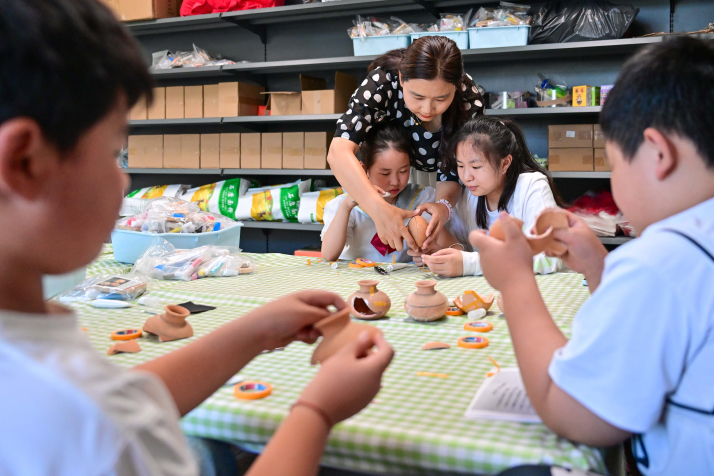 Students learn about cultural relic restoration at a hands-on learning center in Luoyang, Henan Province, on July 4 (XINHUA)
Affordable community care To address the childcare dilemma faced by dual-income families during summer vacations, residential communities in Xi'an have launched free public holiday tutoring programs. These programs offer a wide range of services including schoolwork guidance, interest cultivation, physical exercise, scientific practice and psychological counseling, turning residential communities into vibrant holiday classrooms and lifting worries off working parents. These programs offer courses that are well-designed. On July 1, Jiaotong Community in Beilin District of Xi'an kicked off its summer public tutoring program. Children learned upcycling crafts by remaking old clothes into handbags, gaining hands-on experience and a new understanding of environmental sustainability. The program offers 29 public courses covering intangible cultural heritage crafts, parent-child DIY, scientific experiments and mental growth sessions to nurture children's practical thinking and social skills. Another community in the same district, Xikan, runs full-day summer care with a set weekly schedule. Mornings start with reading, followed by tutoring, art, sports and science. Lunch and naps are also provided. The program is open to kids from preschool through sixth grade and helps them stay on track with good routines. Kaitong Lane Community puts extra focus on emotional wellbeing. Their activities include group games, outdoor exercise, and classes that teach kids how to manage emotions, work in teams and communicate better. "These community programs are safe, reliable and totally free. They let kids spend their summer break learning and progressing productively," Wang Xiaoxia, a local parent, told local news portal Hsw.cn. Similar programs are popping up across the country. In Shenghua Village in Fuyang City, Anhui Province, nearly 90 percent of school-age children are left-behind kids—children whose parents work in cities and leave them behind in rural areas, usually in the care of grandparents. This year, the village set up a free summer class led by college student volunteers, where children spend time finishing homework and practicing calligraphy, and the classroom is full of laughter. A local house was also turned into a small library with over 2,000 books, giving children a quiet place to read. Some areas are taking the idea even further. In Linxia, Gansu Province, volunteers take children on trips to museums and science centers. These interactive visits let kids explore technology and science in a fun way, adding real-world experiences to their summer learning. Best of all, these services are either free or come with only a minimal fee, far cheaper than commercial options. Policy support These community programs are backed by strong government support. In July, 16 organizations including the All-China Women's Federation jointly issued a notice asking local authorities to offer summer childcare services. The policy encourages communities and employers to provide summer care, with a special focus on left-behind children, rural families who have moved to cities for work and low-income households. The Ministry of Education has also called on local governments to work with communities and social organizations to set up summer childcare, helping families who struggle to find care during the holiday. Despite these policy efforts, many communities still face bottlenecks, including limited space, making it difficult to accommodate all eligible children. Liu is one of the lucky ones. Before summer even started, she had reached out to several community childcare programs near her home and signed her daughter up for one that offered a mix of homework tutoring, arts and crafts classes and outdoor activities. Now her summer looks very different from what she had feared. "I feel much more at ease now knowing she'll have a structured day and be around other kids," Liu said. Still, she knows these programs are not a substitute for parental involvement. "No matter how good the community programs are, they can't replace the time and attention a parent gives," she admitted. "I've made up my mind to take more time off work this summer, even if it's just a couple of afternoons a week, to be with her, take her to the park, or simply sit down and talk about her day." "These programs take a huge burden off working parents, but at the end of the day, it's us parents who need to be there for our children. I don't want to look back and regret missing out on her childhood," she added. Copyedited by G.P. Wilson Comments to luyan@cicgamericas.com |
|
||||||||||||||||||||||||||||
|