
|
| China |
| Rocket recovery breakthrough | |
|
|
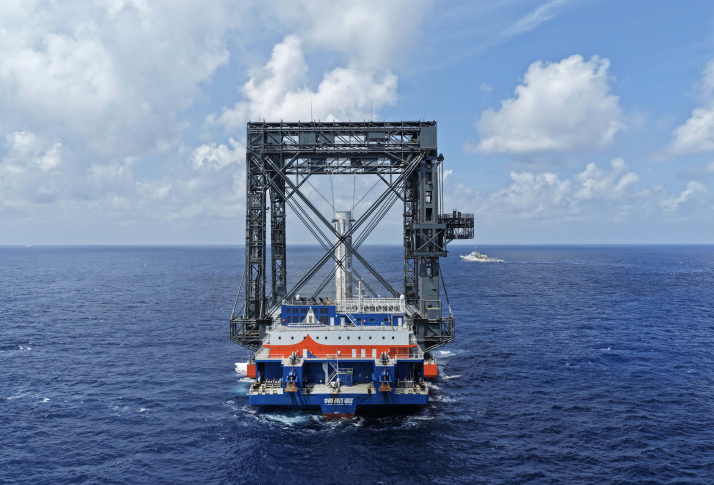 The first stage of the Long March-10B carrier rocket suspended within the offshore recovery platform on July 10 (XINHUA)
After several failed attempts at a controlled rocket recovery, China has secured a major triumph.
On July 10, the Long March-10B carrier rocket, developed by the China Academy of Launch Vehicle Technology (CALT), the leading rocket designer and manufacturer under the state-owned space giant China Aerospace Science and Technology Corp. (CASC), successfully completed its maiden flight, lifting off from the Hainan Commercial Spacecraft Launch Site in south China. Following stage separation, the first-stage booster embarked on a grueling 6-minute descent back to Earth, navigating through phases of unpowered coasting, attitude adjustments, engine-powered braking, and aerodynamic deceleration. It ultimately executed a pinpoint landing, caught flawlessly by a groundbreaking, cross-shaped arresting net system that worked in tandem with the booster's onboard hook mechanism. The floating base Diverging from conventional landing-leg methods, the Long March-10B utilizes an innovative ocean-based recovery setup. In this system, the descending booster is guided directly into a massive, offshore arresting net, which securely snags the vehicle. "By catching the rocket with a net, we can streamline the booster's hardware, shed excess weight, and ultimately maximize payload capacity," Chen Muye, a rocket designer at CASC, told Xinhua News Agency. "Furthermore, this system is highly forgiving of trajectory errors, practically expanding our landing margin through coordinated, real-time adjustments of the net." To support this cutting-edge landing method, CALT delivered a custom-built, sea-based recovery platform in November 2025. Stretching 144 meters long and 50 meters wide, with a full-load displacement of 25,000 tons, this massive vessel serves as the vital floating foundation for the entire operation. The platform's massive tower structure is anchored to the deck by four large supports. Equipped with light detection and ranging units at each corner, the system automatically tracks the rocket's position and attitude and uses specialized cables to absorb its kinetic and potential energy. This fully automated, unmanned process leaves the rocket suspended motionless at the center of the net. The Long March-10B is a reusable, liquid-propellant vehicle designed specifically for the commercial space sector. It stands 63 meters tall with a core-stage diameter of 5 meters. With a liftoff mass of roughly 760 tons, it generates an impressive 890 tons of thrust at launch. Configured for recovery and reuse, it can deliver a hefty 16-ton payload into low Earth orbit (LEO). "The Long March-10B was engineered to be a highly versatile workhorse for the commercial space market, offering superior lifting performance and operational flexibility," Chen explained. He noted that the vehicle is ideally suited for a wide array of demanding roles, from deploying massive LEO Internet constellations to launching heavy commercial satellites, slashing launch costs through its rapid reusability. Chen highlighted that this successful maiden flight marks a major leap forward in cost-effective, heavy-lift reusable rocketry. The flight also provides invaluable engineering data for the nation's upcoming crewed spaceflight program. Moving forward, the booster will support massive LEO satellite arrays as well as medium Earth orbit communications networks. Meanwhile, development is moving at a rapid pace for the Long March-10C carrier rocket. Positioned by CASC as a premier commercial vehicle, it will feature enhanced payload capacities to meet increasingly diverse market demands. "Together, the Long March-10A, 10B and 10C will form the backbone of China's space logistics infrastructure," said Long Lehao, a prominent space expert at the Chinese Academy of Engineering. He emphasized that this trio is poised to unlock high-frequency, rapid-turnaround launch schedules, ultimately serving as a springboard for deeper human exploration into the cosmos. 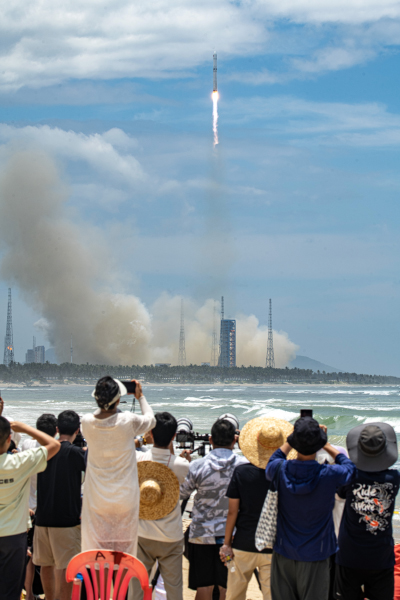 The Long March-10B carrier rocket blasts off from the Hainan commercial spacecraft launch site in Wenchang, Hainan Province, on July 10 (XINHUA)
More to come News of the successful recovery sparked an immediate surge in China's aerospace stocks on the A-share market on the day of the launch. This triumph came after a period of intense public and industry anticipation. Ever since December 3, 2025, when the Zhuque-3 rocket, developed by the private aerospace firm LandSpace, failed in its initial recovery attempt, the timeline for China's first successful booster recovery had become a focal point of intense speculation. Zhuque-3 is a domestically built, reusable launch vehicle propelled by liquid oxygen-methane, specifically designed to deploy large-scale satellite constellations. It relies on a globally conventional landing-leg configuration for vertical touchdowns. CASC expert Xu Xuelei told the Beijing-based Global Times that this traditional method requires the booster to be outfitted with specialized hardware, including grid fins and landing legs. The grid fins deploy during the re-entry phase to precisely control the rocket's attitude and landing point, while the landing legs extend moments before touchdown to cushion the vehicle and achieve a stable, upright soft landing. During its December attempt, however, the Zhuque-3 failed the recovery test because of an anomalous combustion event during the final landing burn, and it missed its designated landing target by approximately 40 meters. This setback was part of a challenging month for Chinese rocketry; just weeks later, on December 23, 2025, China launched the Long March-12A Y1 carrier rocket, but the recovery of its first-stage booster also ended in failure. Following the unsuccessful debut of the reusable Zhuque-3, LandSpace has been preparing for its second launch attempt. On June 29, the rocket successfully completed a static fire test. This critical pre-launch procedure involves igniting the rocket's engines while the vehicle remains anchored to the launch pad, allowing engineers to rigorously verify its overall propulsion performance and safety systems. Conducted at the Dongfeng commercial space innovation pilot zone in Inner Mongolia Autonomous Region, the test thoroughly validated the integration and compatibility between the rocket and the ground launch systems. According to LandSpace, all systems operated normally throughout the test, with telemetry and performance data meeting all design expectations. The company confirmed that this successful run has laid a robust foundation for upcoming flight missions by verifying the precise coordination and accuracy of all operational systems. With all critical pre-launch ground verification now complete, the engineering team is transitioning to the final phase of preparations for the upcoming flight test. According to the latest schedules, the second launch of the Zhuque-3 is slated to take place this August. As more developers gear up for their own attempts and new variants on the horizon, China's commercial space race is entering a more exciting phase. Copyedited by G.P. Wilson Comments to yuanyuan@cicgamericas.com |
|
||||||||||||||||||||||||||||||
|








